QUESTION IMAGE
Question
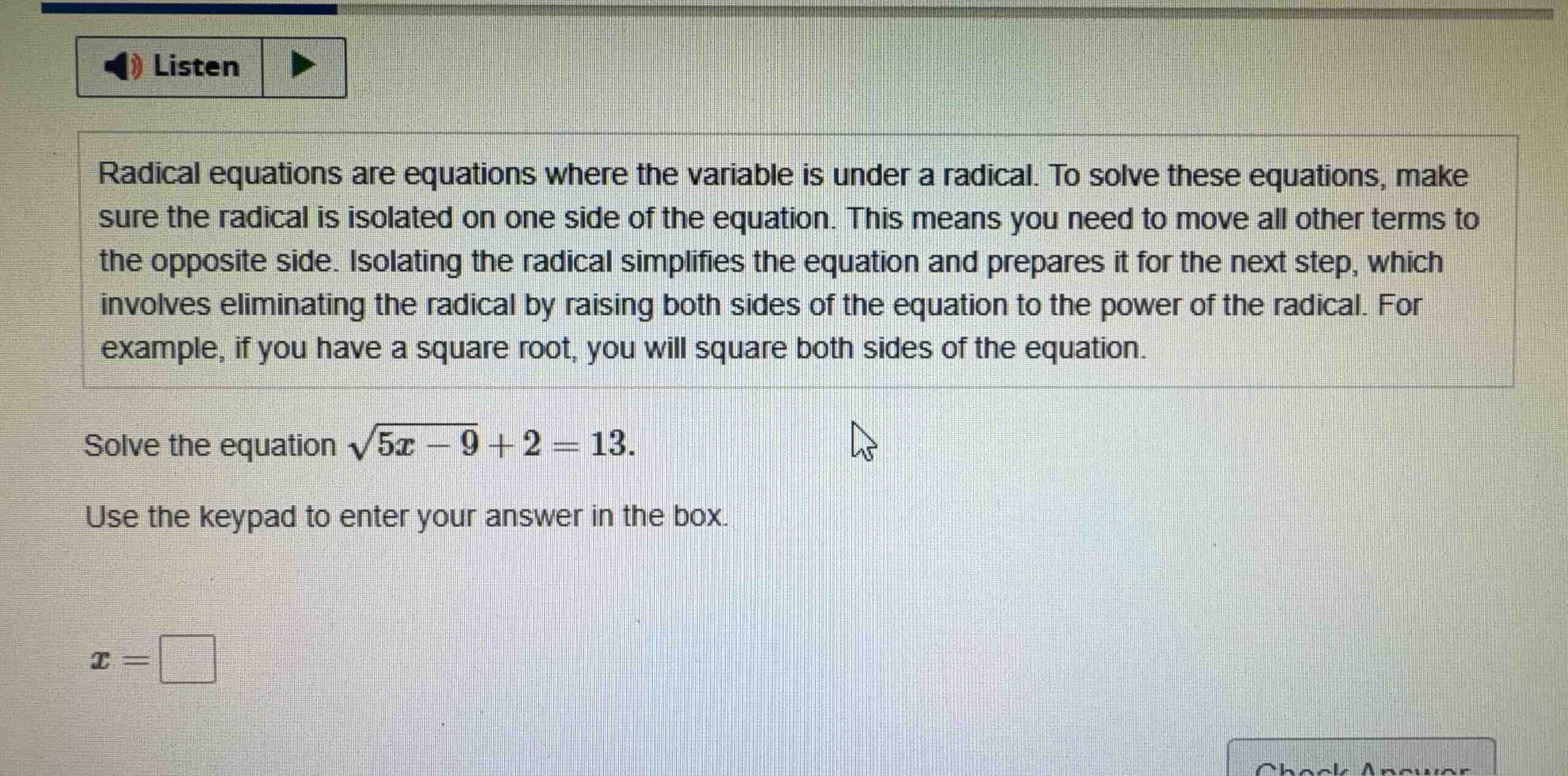
radical equations are equations where the variable is under a radical. to solve these equations, make sure the radical is isolated on one side of the equation. this means you need to move all other terms to the opposite side. isolating the radical simplifies the equation and prepares it for the next step, which involves eliminating the radical by raising both sides of the equation to the power of the radical. for example, if you have a square root, you will square both sides of the equation.
solve the equation \\(\sqrt{5x - 9} + 2 = 13\\).
use the keypad to enter your answer in the box.
\\(x = \square\\)
Isolate the radical term
To solve the equation, we first isolate the square root term on one side.
Subtract \(2\) from both sides of the equation:
Eliminate the radical
Eliminate the square root by squaring both sides of the equation:
Solve for x
Isolate the variable term by adding \(9\) to both sides, then divide by \(5\):
Verify the solution
Check the solution by substituting \(x = 26\) back into the original equation:
Since the left side equals the right side, the solution is valid.

Snap & solve any problem in the app
Get step-by-step solutions on Sovi AI
Photo-based solutions with guided steps
Explore more problems and detailed explanations
Solve the equation \(\sqrt{5x - 9} + 2 = 13\).
Use the keypad to enter your answer in the box.
\(x =\) <blank>26</blank>