QUESTION IMAGE
Question
question 4
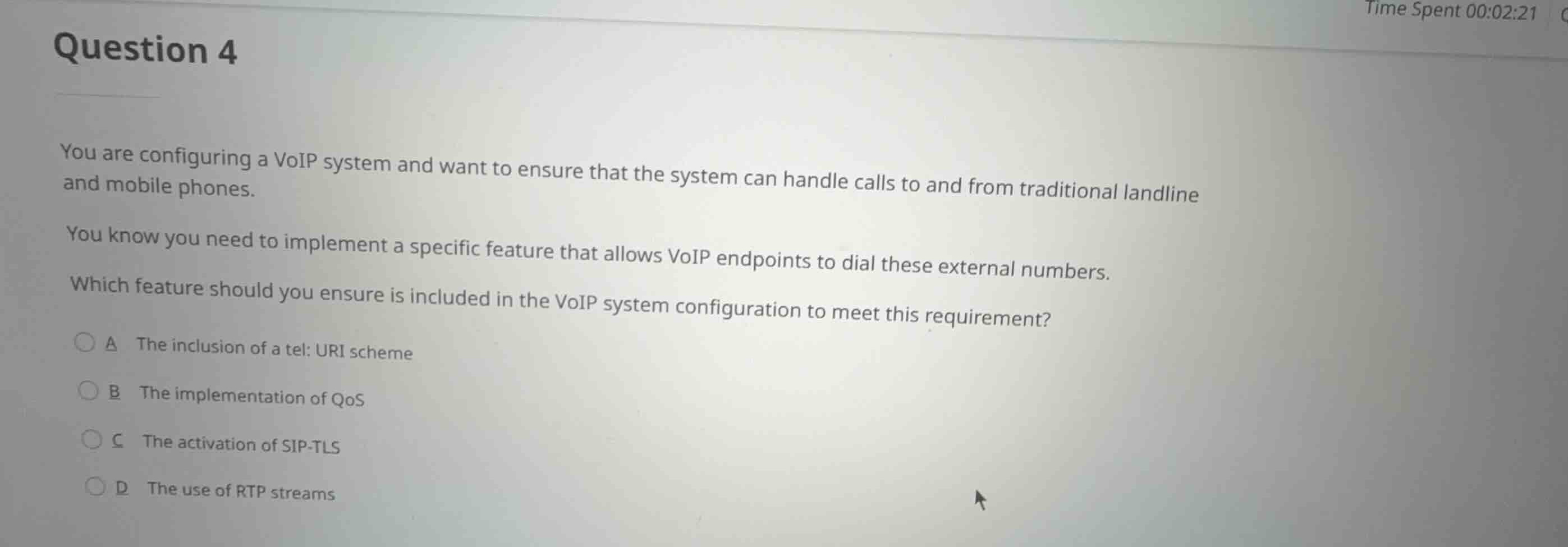
you are configuring a voip system and want to ensure that the system can handle calls to and from traditional landline and mobile phones.
you know you need to implement a specific feature that allows voip endpoints to dial these external numbers.
which feature should you ensure is included in the voip system configuration to meet this requirement?
a the inclusion of a tel: uri scheme
b the implementation of qos
c the activation of sip-tls
d the use of rtp streams
Identify the core requirement
The goal is to allow VoIP endpoints to dial external numbers like traditional landlines and mobile phones.
Analyze the options
- Option A (tel: URI scheme): The
tel:URI scheme is specifically designed for telephone numbers, allowing VoIP systems to route calls to the Public Switched Telephone Network (PSTN) for landlines and mobiles. - Option B (QoS): Quality of Service (QoS) manages network traffic to reduce packet loss and latency, but it does not enable dialing external numbers.
- Option C (SIP-TLS): Transport Layer Security for SIP (SIP-TLS) encrypts signaling traffic, providing security rather than routing capabilities to external networks.
- Option D (RTP streams): Real-time Transport Protocol (RTP) carries the actual audio/video media streams once a connection is established, but it does not handle the dialing or routing of telephone numbers.
Determine the correct feature
To dial traditional telephone numbers from a VoIP system, the system must support a telephone-specific addressing format. The tel: URI scheme (defined in RFC 3966) represents a telephone number, enabling integration with traditional telecommunication networks.

Snap & solve any problem in the app
Get step-by-step solutions on Sovi AI
Photo-based solutions with guided steps
Explore more problems and detailed explanations
- (A) The inclusion of a tel: URI scheme (Correct answer)
- (B) The implementation of QoS
- (C) The activation of SIP-TLS
- (D) The use of RTP streams