QUESTION IMAGE
Question
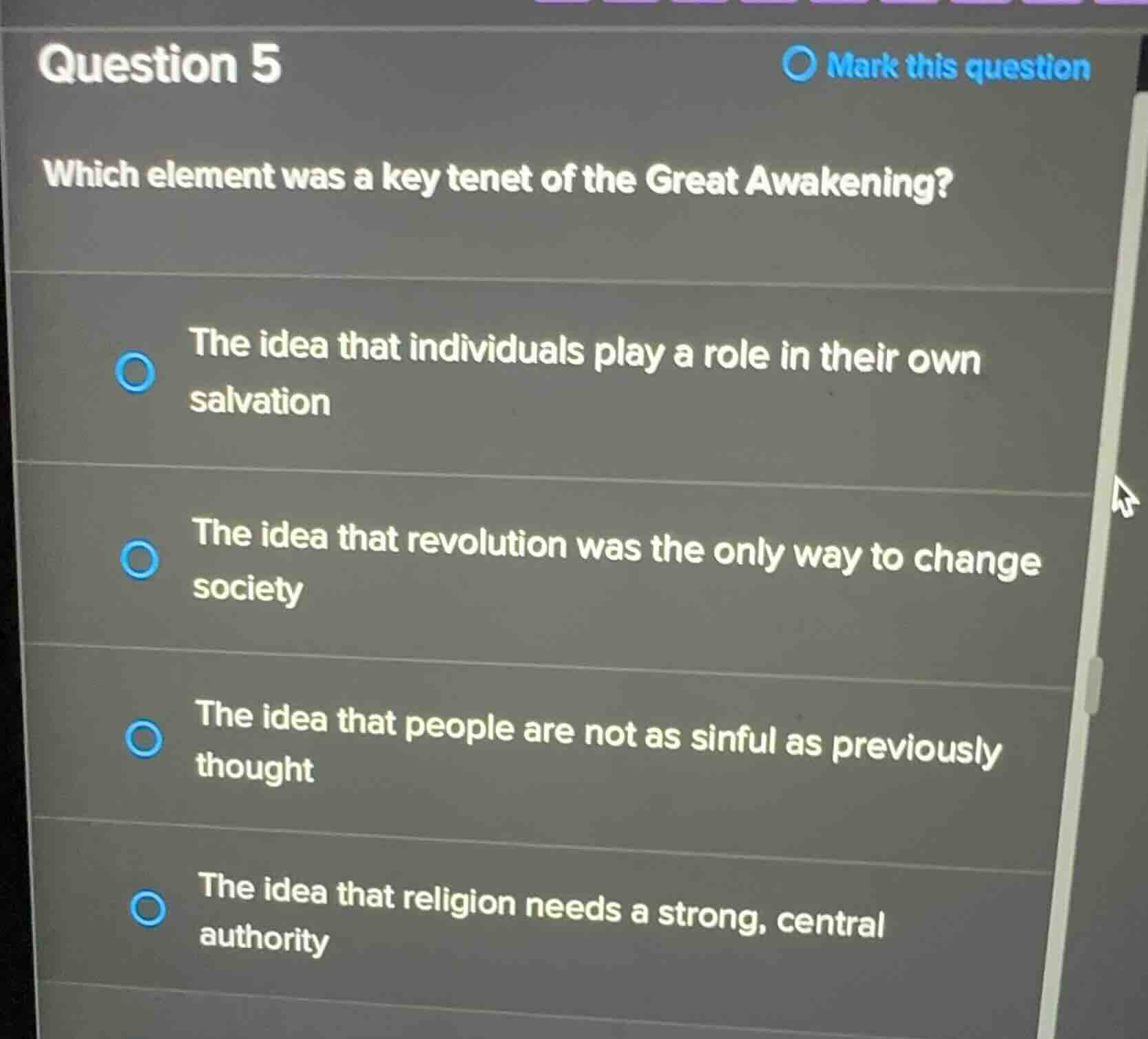
question 5
which element was a key tenet of the great awakening?
- the idea that individuals play a role in their own salvation
- the idea that revolution was the only way to change society
- the idea that people are not as sinful as previously thought
- the idea that religion needs a strong, central authority
Analyze the Great Awakening
Using the Great Awakening knowledge point
The First Great Awakening (1730s–1740s) was a major religious revival in the American colonies that emphasized personal, emotional religiosity. It challenged traditional, formal church hierarchies by asserting that individuals could experience a direct, personal relationship with God and play an active role in their own spiritual salvation through repentance and conversion.
Evaluate the options
Using the Great Awakening knowledge point
- The idea that individuals play a role in their own salvation: This aligns directly with the revivalist message of personal conversion, individual spiritual agency, and the democratization of religious experience.
- The idea that revolution was the only way to change society: This is a political concept associated with the American Revolution, not a core theological tenet of the Great Awakening.
- The idea that people are not as sinful as previously thought: Revivalists like Jonathan Edwards strongly emphasized human sinfulness (e.g., "Sinners in the Hands of an Angry God"), making this incorrect.
- The idea that religion needs a strong, central authority: The movement actually fractured established churches and promoted individual conscience over centralized ecclesiastical authority.

Snap & solve any problem in the app
Get step-by-step solutions on Sovi AI
Photo-based solutions with guided steps
Explore more problems and detailed explanations
- (A) The idea that individuals play a role in their own salvation (Correct answer)
- (B) The idea that revolution was the only way to change society
- (C) The idea that people are not as sinful as previously thought
- (D) The idea that religion needs a strong, central authority