QUESTION IMAGE
Question
question 7
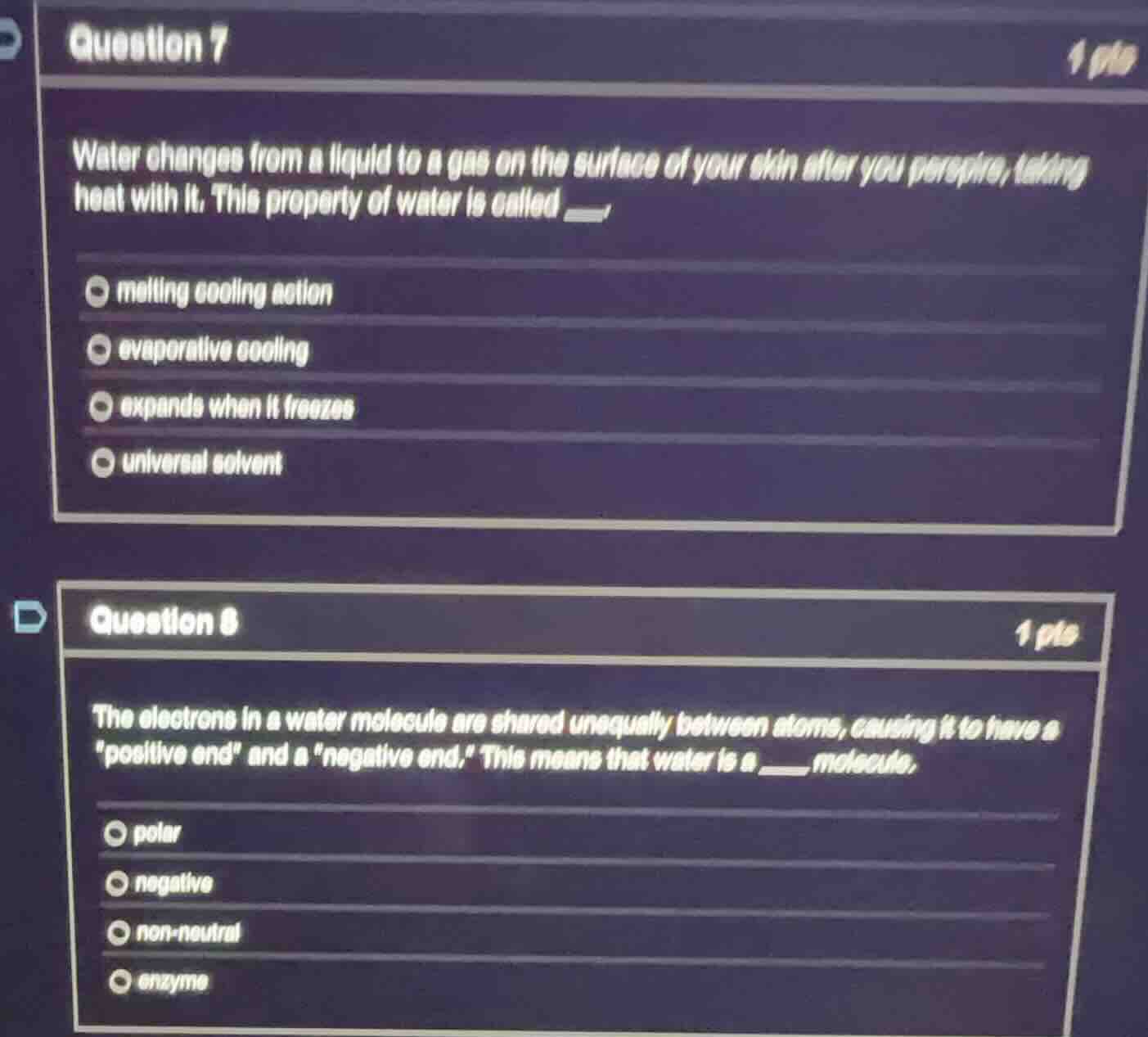
water changes from a liquid to a gas on the surface of your skin after you perspire, taking heat with it. this property of water is called __.
- melting cooling action
- evaporative cooling
- expands when it freezes
- universal solvent
question 8
the electrons in a water molecule are shared unequally between atoms, causing it to have a \positive end\ and a
egative end.\ this means that water is a __ molecule.
- polar
- negative
- non-neutral
- enzyme
<pre_analysis>
{
"quality": "clear",
"question_count": 2,
"skills_matched": [
"direct_cot",
"multiple_choice_formatter",
"explain_then_answer",
"tutor"
],
"needs_drawing": false,
"concepts_used": [
"Properties of Water"
],
"new_concepts": [
"Evaporative Cooling",
"Polarity of Water"
],
"current_concepts": [
"Properties of Water",
"Evaporative Cooling",
"Polarity of Water"
]
}
</pre_analysis>
<reasoning>
Analyze Question 7
This question asks about the process where water changes from a liquid to a gas on the skin, taking heat with it. This is a classic biological and physical phenomenon. Using the Properties of Water knowledge point, we know that as liquid water evaporates, the surface of the liquid that remains behind cools down because the molecules with the highest kinetic energy escape as gas. This specific property is known as evaporative cooling.
Analyze Question 8
This question describes the unequal sharing of electrons between the oxygen and hydrogen atoms in a water molecule. Oxygen is highly electronegative, pulling the shared electrons closer to itself, which creates a partial negative charge near the oxygen atom and a partial positive charge near the hydrogen atoms. A molecule with this uneven distribution of charge is defined as a polar molecule.
</reasoning>
<answer>
Question 7
<mcq-option>melting cooling action</mcq-option>
<mcq-correct>evaporative cooling</mcq-correct>
<mcq-option>expands when it freezes</mcq-option>
<mcq-option>universal solvent</mcq-option>
Question 8
<mcq-correct>polar</mcq-correct>
<mcq-option>negative</mcq-option>
<mcq-option>non-neutral</mcq-option>
<mcq-option>enzyme</mcq-option>
</answer>
<post_analysis>
{
"subject": "Natural Science",
"question_type": "Multiple Choice",
"knowledge_point": [
"Natural Science",
"Biology",
"Properties of Water"
]
}
</post_analysis>
Snap & solve any problem in the app
Get step-by-step solutions on Sovi AI
Photo-based solutions with guided steps
Explore more problems and detailed explanations
<pre_analysis>
{
"quality": "clear",
"question_count": 2,
"skills_matched": [
"direct_cot",
"multiple_choice_formatter",
"explain_then_answer",
"tutor"
],
"needs_drawing": false,
"concepts_used": [
"Properties of Water"
],
"new_concepts": [
"Evaporative Cooling",
"Polarity of Water"
],
"current_concepts": [
"Properties of Water",
"Evaporative Cooling",
"Polarity of Water"
]
}
</pre_analysis>
<reasoning>
Analyze Question 7
This question asks about the process where water changes from a liquid to a gas on the skin, taking heat with it. This is a classic biological and physical phenomenon. Using the Properties of Water knowledge point, we know that as liquid water evaporates, the surface of the liquid that remains behind cools down because the molecules with the highest kinetic energy escape as gas. This specific property is known as evaporative cooling.
Analyze Question 8
This question describes the unequal sharing of electrons between the oxygen and hydrogen atoms in a water molecule. Oxygen is highly electronegative, pulling the shared electrons closer to itself, which creates a partial negative charge near the oxygen atom and a partial positive charge near the hydrogen atoms. A molecule with this uneven distribution of charge is defined as a polar molecule.
</reasoning>
<answer>
Question 7
<mcq-option>melting cooling action</mcq-option>
<mcq-correct>evaporative cooling</mcq-correct>
<mcq-option>expands when it freezes</mcq-option>
<mcq-option>universal solvent</mcq-option>
Question 8
<mcq-correct>polar</mcq-correct>
<mcq-option>negative</mcq-option>
<mcq-option>non-neutral</mcq-option>
<mcq-option>enzyme</mcq-option>
</answer>
<post_analysis>
{
"subject": "Natural Science",
"question_type": "Multiple Choice",
"knowledge_point": [
"Natural Science",
"Biology",
"Properties of Water"
]
}
</post_analysis>