QUESTION IMAGE
Question
question:
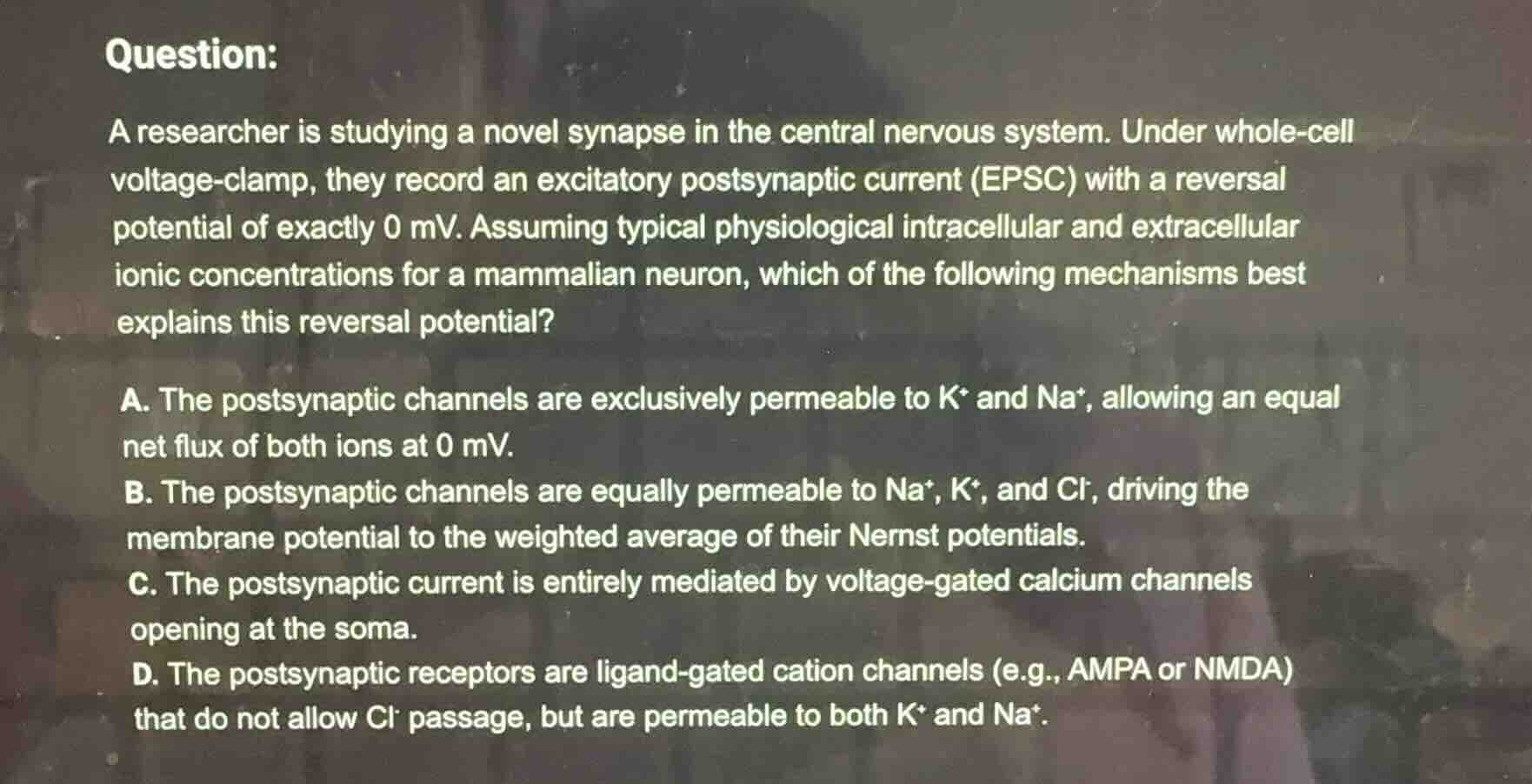
a researcher is studying a novel synapse in the central nervous system. under whole-cell voltage-clamp, they record an excitatory postsynaptic current (epsc) with a reversal potential of exactly 0 mv. assuming typical physiological intracellular and extracellular ionic concentrations for a mammalian neuron, which of the following mechanisms best explains this reversal potential?
a. the postsynaptic channels are exclusively permeable to \\(\text{k}^+\\) and \\(\text{na}^+\\), allowing an equal net flux of both ions at 0 mv.
b. the postsynaptic channels are equally permeable to \\(\text{na}^+\\), \\(\text{k}^+\\), and \\(\text{cl}^-\\), driving the membrane potential to the weighted average of their nernst potentials.
c. the postsynaptic current is entirely mediated by voltage-gated calcium channels opening at the soma.
d. the postsynaptic receptors are ligand-gated cation channels (e.g., ampa or nmda) that do not allow \\(\text{cl}^-\\) passage, but are permeable to both \\(\text{k}^+\\) and \\(\text{na}^+\\).
Analyze the reversal potential of EPSCs
Evaluate channel properties and permeability
Compare options

Snap & solve any problem in the app
Get step-by-step solutions on Sovi AI
Photo-based solutions with guided steps
Explore more problems and detailed explanations
- A. The postsynaptic channels are exclusively permeable to K⁺ and Na⁺, allowing an equal net flux of both ions at 0 mV.
- B. The postsynaptic channels are equally permeable to Na⁺, K⁺, and Cl⁻, driving the membrane potential to the weighted average of their Nernst potentials.
- C. The postsynaptic current is entirely mediated by voltage-gated calcium channels opening at the soma.
- D. The postsynaptic receptors are ligand-gated cation channels (e.g., AMPA or NMDA) that do not allow Cl⁻ passage, but are permeable to both K⁺ and Na⁺. (Correct answer)