QUESTION IMAGE
Question
question 1
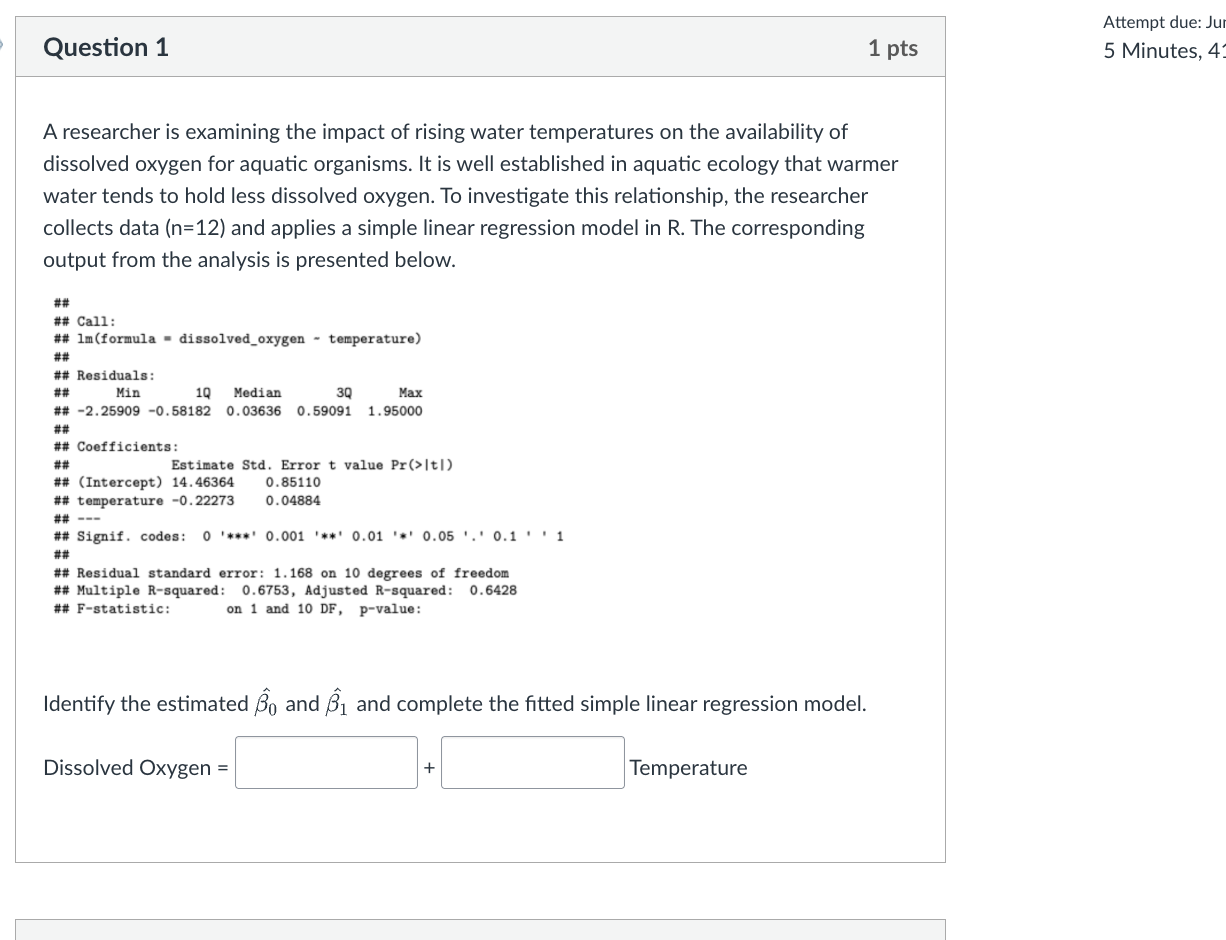
a researcher is examining the impact of rising water temperatures on the availability of dissolved oxygen for aquatic organisms. it is well established in aquatic ecology that warmer water tends to hold less dissolved oxygen. to investigate this relationship, the researcher collects data (n=12) and applies a simple linear regression model in r. the corresponding output from the analysis is presented below.
call:
lm(formula = dissolved_oxygen ~ temperature)
##
residuals:
min 1q median 3q max
-2.25909 -0.58182 0.03636 0.59091 1.95000
##
coefficients:
estimate std. error t value pr(>|t|)
(intercept) 14.46364 0.85110
temperature -0.22273 0.04884
---
signif. codes: 0 0.001 0.01 0.05 . 0.1 1
##
residual standard error: 1.168 on 10 degrees of freedom
multiple r-squared: 0.6753, adjusted r-squared: 0.6428
f-statistic: on 1 and 10 df, p-value:
identify the estimated \\(\hat{\beta}_0\\) and \\(\hat{\beta}_1\\) and complete the fitted simple linear regression model.
dissolved oxygen = + temperature
⚡ Using what you learned: regression, residuals, and model fit
Step 1: Identify the Intercept Coefficient \(\hat{\beta}_0\)
From the R output under the Coefficients: section, the estimate for the (Intercept) is:
Step 2: Identify the Slope Coefficient \(\hat{\beta}_1\)
From the R output under the Coefficients: section, the estimate for the predictor variable temperature is:
Step 3: Formulate the Fitted Regression Model
The general equation for a simple linear regression model is:
Substituting the identified estimates:

Snap & solve any problem in the app
Get step-by-step solutions on Sovi AI
Photo-based solutions with guided steps
Explore more problems and detailed explanations
Dissolved Oxygen = 14.46364 + -0.22273 Temperature