QUESTION IMAGE
Question
question 6
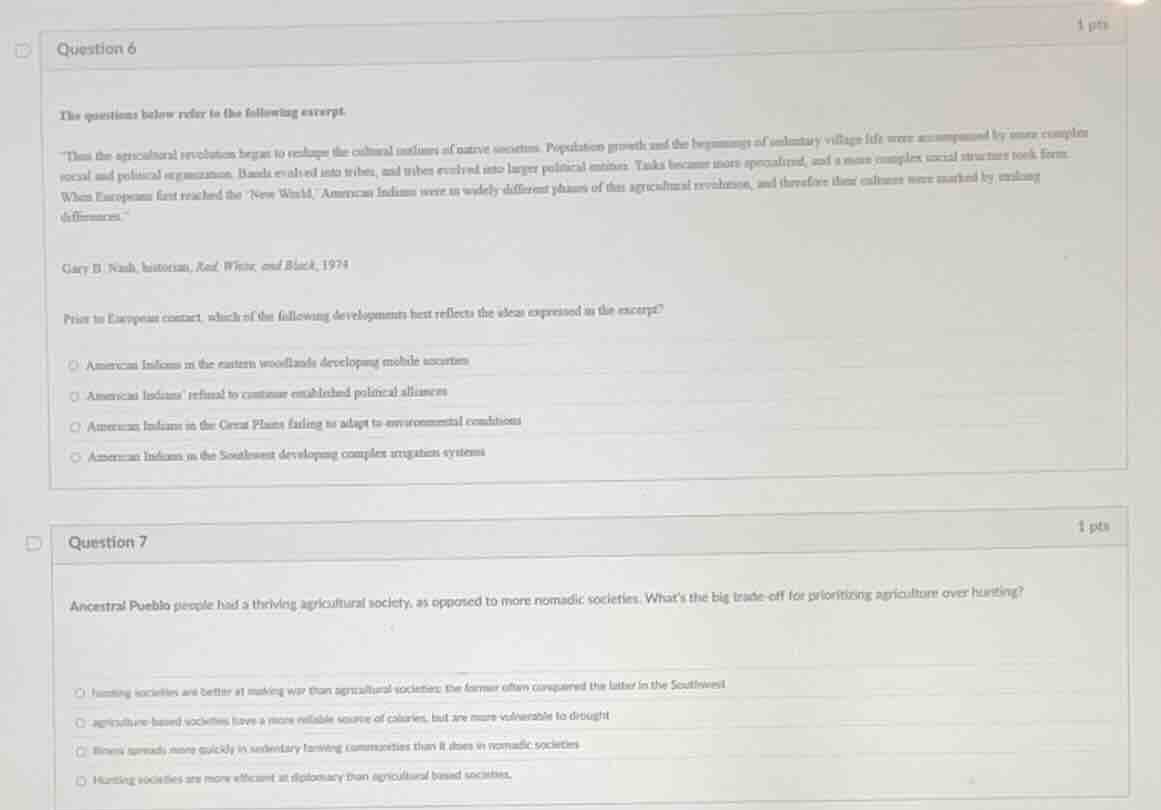
the questions below refer to the following excerpt.
\thus the agricultural revolution began to reshape the cultural outlines of native societies. population growth and the beginnings of sedentary village life were accompanied by more complex social and political organization. bands evolved into tribes, and tribes evolved into larger political entities. tasks became more specialized, and a more complex social structure took form. when europeans first reached the new world, american indians were in widely different phases of this agricultural revolution, and therefore their cultures were marked by striking differences.\
gary b. nash, historian, red, white, and black, 1974
prior to european contact, which of the following developments best reflects the ideas expressed in the excerpt?
american indians in the eastern woodlands developing mobile societies
american indians refusal to continue established political alliances
american indians in the great plains failing to adapt to environmental conditions
american indians in the southwest developing complex irrigation systems
question 7
ancestral pueblo people had a thriving agricultural society, as opposed to more nomadic societies. whats the big trade-off for prioritizing agriculture over hunting?
hunting societies are better at making war than agricultural societies; the former often conquered the latter in the southwest
agriculture-based societies have a more reliable source of calories, but are more vulnerable to drought
illness spreads more quickly in sedentary farming communities than it does in nomadic societies
hunting societies are more efficient at diplomacy than agricultural-based societies.
Analyze the excerpt for Question 6
The excerpt by historian Gary B. Nash describes how the "agricultural revolution" reshaped Native American societies prior to European contact. It notes that agriculture led to population growth, sedentary village life, and increasingly complex social and political structures (evolving from bands to tribes to larger political entities). It also emphasizes that different cultures were at "widely different phases of this agricultural revolution" when Europeans arrived. We must connect this to Pre-Columbian Societies and Native American Diversity.
Evaluate the options for Question 6
- Option A: "American Indians in the eastern woodlands developing mobile societies" contradicts the excerpt's focus on sedentary village life and agricultural development.
- Option B: "American Indians' refusal to continue established political alliances" is historically inaccurate and not supported by the text, which describes growing political complexity.
- Option C: "American Indians in the Great Plains failing to adapt to environmental conditions" is incorrect; Plains societies adapted successfully to their environments, and this option does not reflect the positive development of agricultural complexity described.
- Option D: "American Indians in the Southwest developing complex irrigation systems" perfectly reflects the ideas of agricultural adaptation, sedentary life, and technological/social complexity described in the excerpt. This is a prime example of Native American Adaptation to arid environments.
Analyze the prompt for Question 7
Question 7 asks about the Ancestral Pueblo people, who had a thriving agricultural society. It asks for the "big trade-off" of prioritizing agriculture over hunting. This relates to the ecological and social realities of Pre-Columbian Societies in the Southwest.
Evaluate the options for Question 7
- Option A: "Hunting societies are better at making war..." is a historical generalization not supported as a primary ecological trade-off.
- Option B: "Agriculture-based societies have a more reliable source of calories, but are more vulnerable to drought" is a classic ecological trade-off. Sedentary agriculturalists rely heavily on crop yields, making them highly susceptible to localized environmental changes like prolonged droughts, whereas mobile hunters can relocate.
- Option C: "Illness spreads more quickly..." is a consequence of sedentary living, but the phrasing "What's the big trade-off for prioritizing agriculture over hunting" in economic/ecological terms is best represented by resource reliability versus environmental vulnerability.
- Option D: "Hunting societies are more efficient at diplomacy..." is historically inaccurate.
Finalize the selections
- Question 6: Option D is the correct choice.
- Question 7: Option B is the correct choice.

Snap & solve any problem in the app
Get step-by-step solutions on Sovi AI
Photo-based solutions with guided steps
Explore more problems and detailed explanations
Question 6
- (A) American Indians in the eastern woodlands developing mobile societies
- (B) American Indians' refusal to continue established political alliances
- (C) American Indians in the Great Plains failing to adapt to environmental conditions
- (D) American Indians in the Southwest developing complex irrigation systems (Correct answer)
Question 7
- (A) Hunting societies are better at making war than agricultural societies; the former often conquered the latter in the Southwest
- (B) Agriculture-based societies have a more reliable source of calories, but are more vulnerable to drought (Correct answer)
- (C) Illness spreads more quickly in sedentary farming communities than it does in nomadic societies
- (D) Hunting societies are more efficient at diplomacy than agricultural-based societies