QUESTION IMAGE
Question
question 3
8 pts
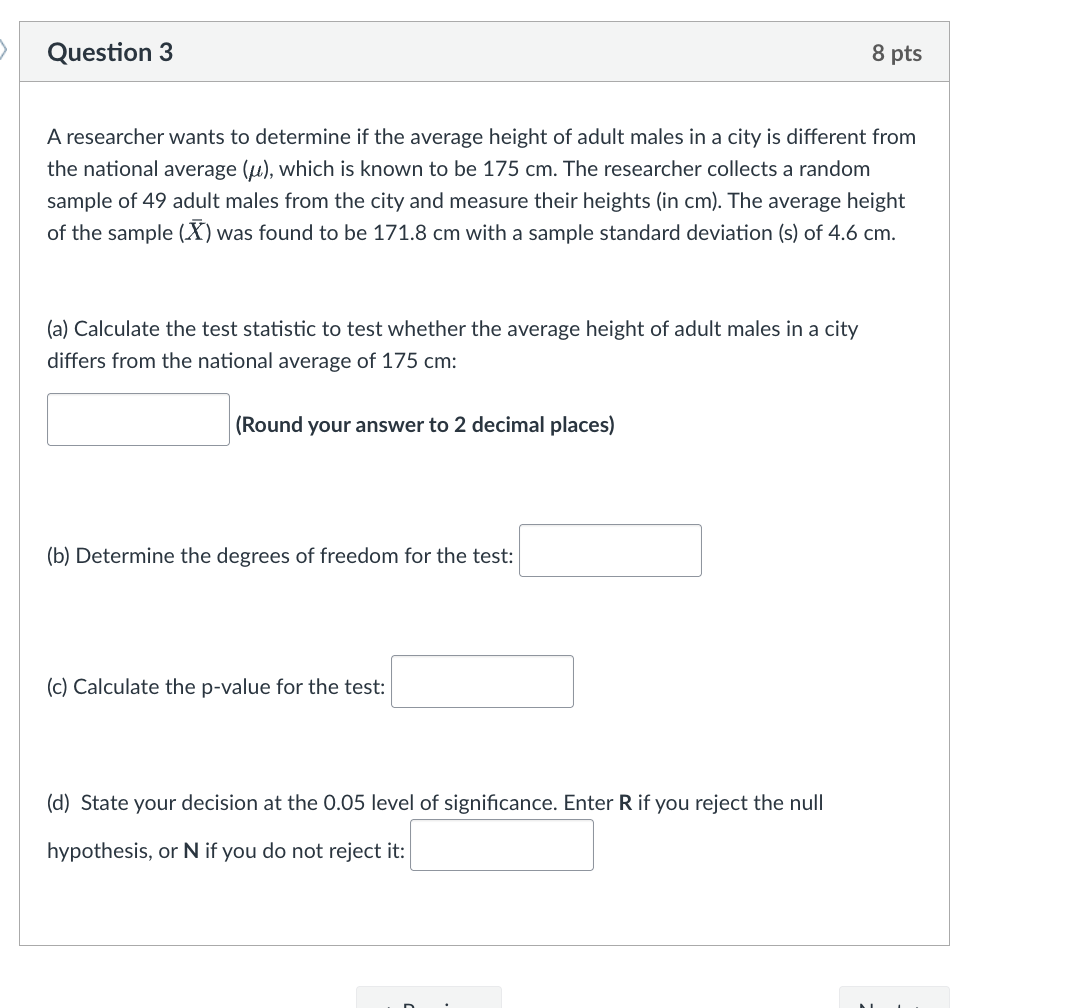
a researcher wants to determine if the average height of adult males in a city is different from the national average (\mu), which is known to be 175 cm. the researcher collects a random sample of 49 adult males from the city and measure their heights (in cm). the average height of the sample (\bar{x}) was found to be 171.8 cm with a sample standard deviation (s) of 4.6 cm.
(a) calculate the test statistic to test whether the average height of adult males in a city differs from the national average of 175 cm:
(round your answer to 2 decimal places)
(b) determine the degrees of freedom for the test:
(c) calculate the p-value for the test:
(d) state your decision at the 0.05 level of significance. enter r if you reject the null hypothesis, or n if you do not reject it:
⚡ Using what you learned: Hypothesis Testing
Step 1: Identify the given values
Extract the parameters from the problem description:
- Null hypothesis mean: \(\mu_0 = 175\)
- Sample size: \(n = 49\)
- Sample mean: \(\bar{X} = 171.8\)
- Sample standard deviation: \(s = 4.6\)
Step 2: Calculate the test statistic
Since the population standard deviation \(\sigma\) is unknown and we use the sample standard deviation \(s\), we use a one-sample \(t\)-test:
Substitute the values:
Step 3: Determine the degrees of freedom
The degrees of freedom (\(df\)) for a one-sample \(t\)-test is:
Step 4: Calculate the p-value
The alternative hypothesis is two-tailed because we want to determine if the average height is "different from" the national average:
- \(H_0: \mu = 175\)
- \(H_1: \mu
eq 175\)
Using a \(t\)-distribution table or calculator with \(df = 48\) and \(t = -4.87\):
Rounded to four decimal places, the \(p\)-value is \(0.0000\) (or extremely close to \(0\)).
Step 5: State the decision
Compare the \(p\)-value to the significance level \(\alpha = 0.05\):
- Since \(p\text{-value} \approx 0.0000 < 0.05\), we reject the null hypothesis.
- Therefore, the decision is R.

Snap & solve any problem in the app
Get step-by-step solutions on Sovi AI
Photo-based solutions with guided steps
Explore more problems and detailed explanations
(a) -4.87
(b) 48
(c) 0.0000 (or < 0.0001)
(d) R