QUESTION IMAGE
Question
question 2
1 pts
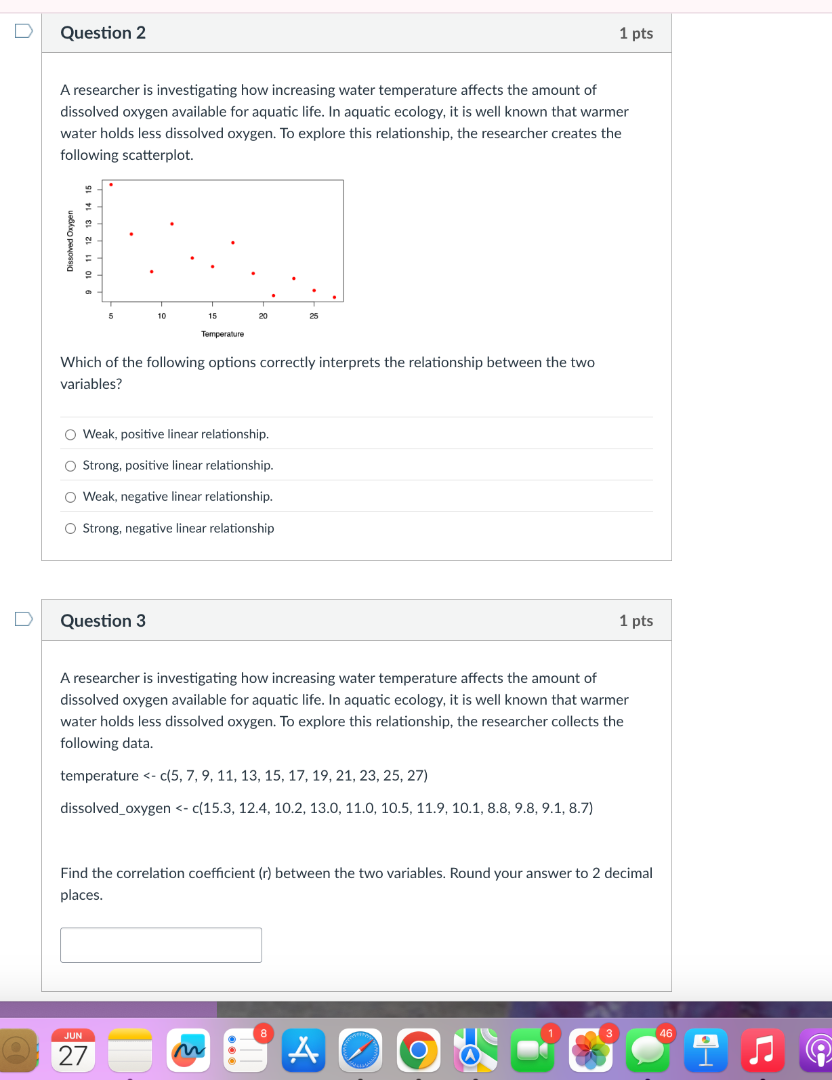
a researcher is investigating how increasing water temperature affects the amount of dissolved oxygen available for aquatic life. in aquatic ecology, it is well known that warmer water holds less dissolved oxygen. to explore this relationship, the researcher creates the following scatterplot.
which of the following options correctly interprets the relationship between the two variables?
- weak, positive linear relationship.
- strong, positive linear relationship.
- weak, negative linear relationship.
- strong, negative linear relationship.
question 3
1 pts
a researcher is investigating how increasing water temperature affects the amount of dissolved oxygen available for aquatic life. in aquatic ecology, it is well known that warmer water holds less dissolved oxygen. to explore this relationship, the researcher collects the following data.
temperature <- c(5, 7, 9, 11, 13, 15, 17, 19, 21, 23, 25, 27)
dissolved_oxygen <- c(15.3, 12.4, 10.2, 13.0, 11.0, 10.5, 11.9, 10.1, 8.8, 9.8, 9.1, 8.7)
find the correlation coefficient (r) between the two variables. round your answer to 2 decimal places.
🆕 New Concept Discovered: Linear Correlation and Scatterplots
How variables move together and measuring their strength
Step 1: Interpret the scatterplot (Question 2)
To describe the relationship between temperature and dissolved oxygen:
- Direction: As temperature (x-axis) increases, dissolved oxygen (y-axis) generally decreases. This indicates a negative relationship.
- Strength: The points do not lie perfectly on a straight line and show noticeable vertical spread/scatter around any potential trend line, indicating a weak to moderate relationship rather than a strong, tightly clustered one.
Therefore, the relationship is a Weak, negative linear relationship.
Step 2: Calculate the correlation coefficient (Question 3)
We use the formula for Pearson's correlation coefficient \( r \):
Let \( x \) be temperature and \( y \) be dissolved_oxygen.
1. Summary Statistics:
- Number of pairs (\( n \)) = 12
Values of \( x \):
- \(\sum x = 192\)
- \(\sum x^2 = 5^2 + 7^2 + \dots + 27^2 = 3620\)
Values of \( y \):
- \(\sum y = 130.8\)
- \(\sum y^2 = 15.3^2 + 12.4^2 + \dots + 8.7^2 = 1465.18\)
Product \( xy \):
- \(\sum xy = 1974.4\)
Step 3: Compute \( r \)
Substitute the values into the formula:
Rounding to 2 decimal places:

Snap & solve any problem in the app
Get step-by-step solutions on Sovi AI
Photo-based solutions with guided steps
Explore more problems and detailed explanations
Question 2:
Weak, negative linear relationship.
Question 3:
-0.81