QUESTION IMAGE
Question
question 5
1 pts
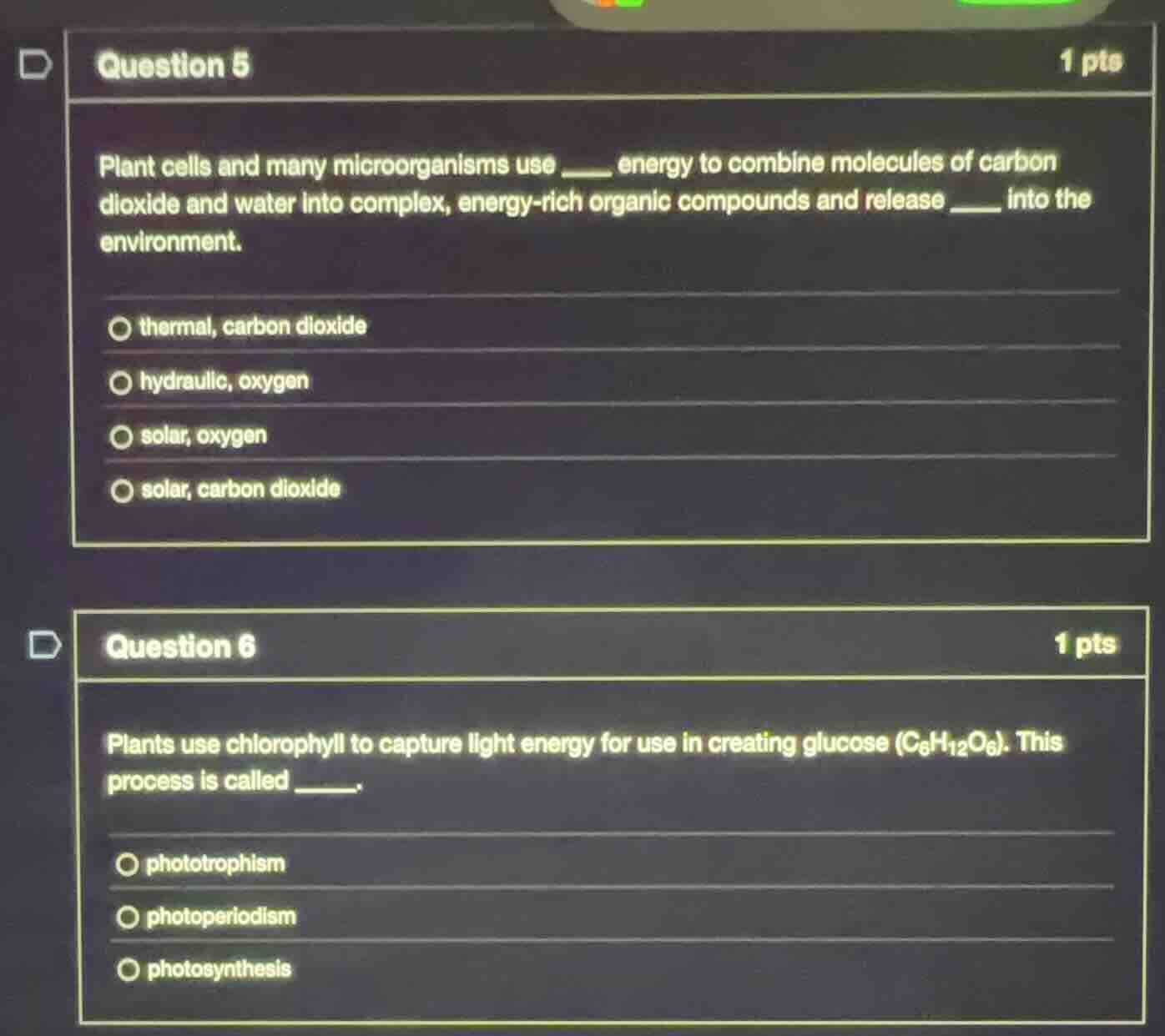
plant cells and many microorganisms use _ energy to combine molecules of carbon dioxide and water into complex, energy-rich organic compounds and release _ into the environment.
thermal, carbon dioxide
hydraulic, oxygen
solar, oxygen
solar, carbon dioxide
question 6
1 pts
plants use chlorophyll to capture light energy for use in creating glucose (c6h12o6). this process is called ___.
phototrophism
photoperiodism
photosynthesis
Analyze Question 5
The sentence describes the process of combining carbon dioxide and water into complex, energy-rich organic compounds (like glucose). This biochemical pathway is Photosynthesis.
- The primary energy source driving this reaction in plant cells and photosynthetic microorganisms is light energy from the sun, which is solar energy.
- The chemical equation for this process is:
- This shows that oxygen (\(\text{O}_2\)) is released into the environment as a byproduct.
- Therefore, the blanks should be filled with "solar" and "oxygen".
Analyze Question 6
The prompt describes plants using the pigment chlorophyll to capture light energy to synthesize glucose (\(\text{C}_6\text{H}_{12}\text{O}_6\)).
- This biological process of converting light energy into chemical energy is defined as Photosynthesis.
- Phototrophism (usually phototropism) refers to growth in response to light.
- Photoperiodism refers to physiological reactions to the length of day or night.
- Therefore, the correct term is photosynthesis.

Snap & solve any problem in the app
Get step-by-step solutions on Sovi AI
Photo-based solutions with guided steps
Explore more problems and detailed explanations
Question 5
- thermal, carbon dioxide
- hydraulic, oxygen
- solar, oxygen (Correct answer)
- solar, carbon dioxide
Question 6
- phototrophism
- photoperiodism
- photosynthesis (Correct answer)