QUESTION IMAGE
Question
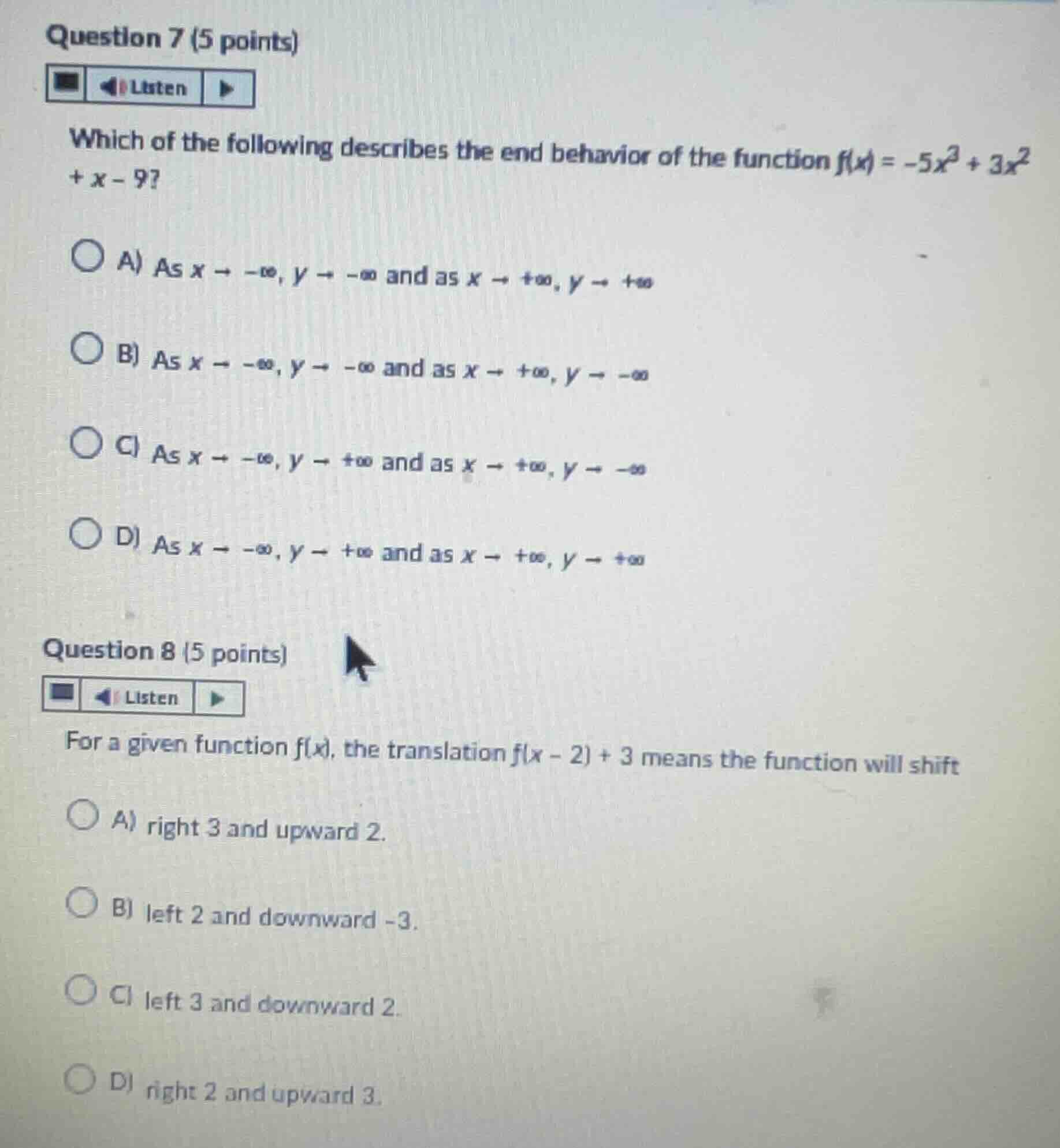
question 7 (5 points)
which of the following describes the end behavior of the function \\(f(x) = -5x^3 + 3x^2 + x - 9\\)?
a) as \\(x \to -\infty\\), \\(y \to -\infty\\) and as \\(x \to +\infty\\), \\(y \to +\infty\\)
b) as \\(x \to -\infty\\), \\(y \to -\infty\\) and as \\(x \to +\infty\\), \\(y \to -\infty\\)
c) as \\(x \to -\infty\\), \\(y \to +\infty\\) and as \\(x \to +\infty\\), \\(y \to -\infty\\)
d) as \\(x \to -\infty\\), \\(y \to +\infty\\) and as \\(x \to +\infty\\), \\(y \to +\infty\\)
question 8 (5 points)
for a given function \\(f(x)\\), the translation \\(f(x - 2) + 3\\) means the function will shift
a) right 3 and upward 2.
b) left 2 and downward -3.
c) left 3 and downward 2.
d) right 2 and upward 3.
Identify the leading term of the polynomial
To find the end behavior of the polynomial function \(f(x) = -5x^3 + 3x^2 + x - 9\), we analyze its leading term, which is the term with the highest power of \(x\).
The leading term is \(-5x^3\).
The degree of this polynomial is \(n = 3\) (which is odd).
The leading coefficient is \(a = -5\) (which is negative).
Determine the end behavior limits
For a polynomial with an odd degree and a negative leading coefficient:
- As \(x \to -\infty\), the term \(x^3 \to -\infty\). Multiplying by the negative coefficient \(-5\) results in \(y \to +\infty\).
- As \(x \to +\infty\), the term \(x^3 \to +\infty\). Multiplying by the negative coefficient \(-5\) results in \(y \to -\infty\).
Thus, the end behavior is:
As \(x \to -\infty\), \(y \to +\infty\) and as \(x \to +\infty\), \(y \to -\infty\).
This matches option C.
Analyze the horizontal translation
Using the Horizontal Translation knowledge point
For the given transformation \(f(x - 2) + 3\), we have \(h = 2\). This represents a shift of 2 units to the right.
Analyze the vertical translation
Using the Vertical Translation knowledge point
For the given transformation \(f(x - 2) + 3\), we have \(k = 3\). This represents a shift of 3 units upward.
Combining both shifts, the function will shift right 2 and upward 3.
This matches option D.

Snap & solve any problem in the app
Get step-by-step solutions on Sovi AI
Photo-based solutions with guided steps
Explore more problems and detailed explanations
Question 7
- A) As \(x \to -\infty\), \(y \to -\infty\) and as \(x \to +\infty\), \(y \to +\infty\)
- B) As \(x \to -\infty\), \(y \to -\infty\) and as \(x \to +\infty\), \(y \to -\infty\)
- C) As \(x \to -\infty\), \(y \to +\infty\) and as \(x \to +\infty\), \(y \to -\infty\) (Correct answer)
- D) As \(x \to -\infty\), \(y \to +\infty\) and as \(x \to +\infty\), \(y \to +\infty\)
Question 8
- A) right 3 and upward 2.
- B) left 2 and downward -3.
- C) left 3 and downward 2.
- D) right 2 and upward 3. (Correct answer)