Sovi.AI - AI Math Tutor

Scan to solve math questions

QUESTION IMAGE

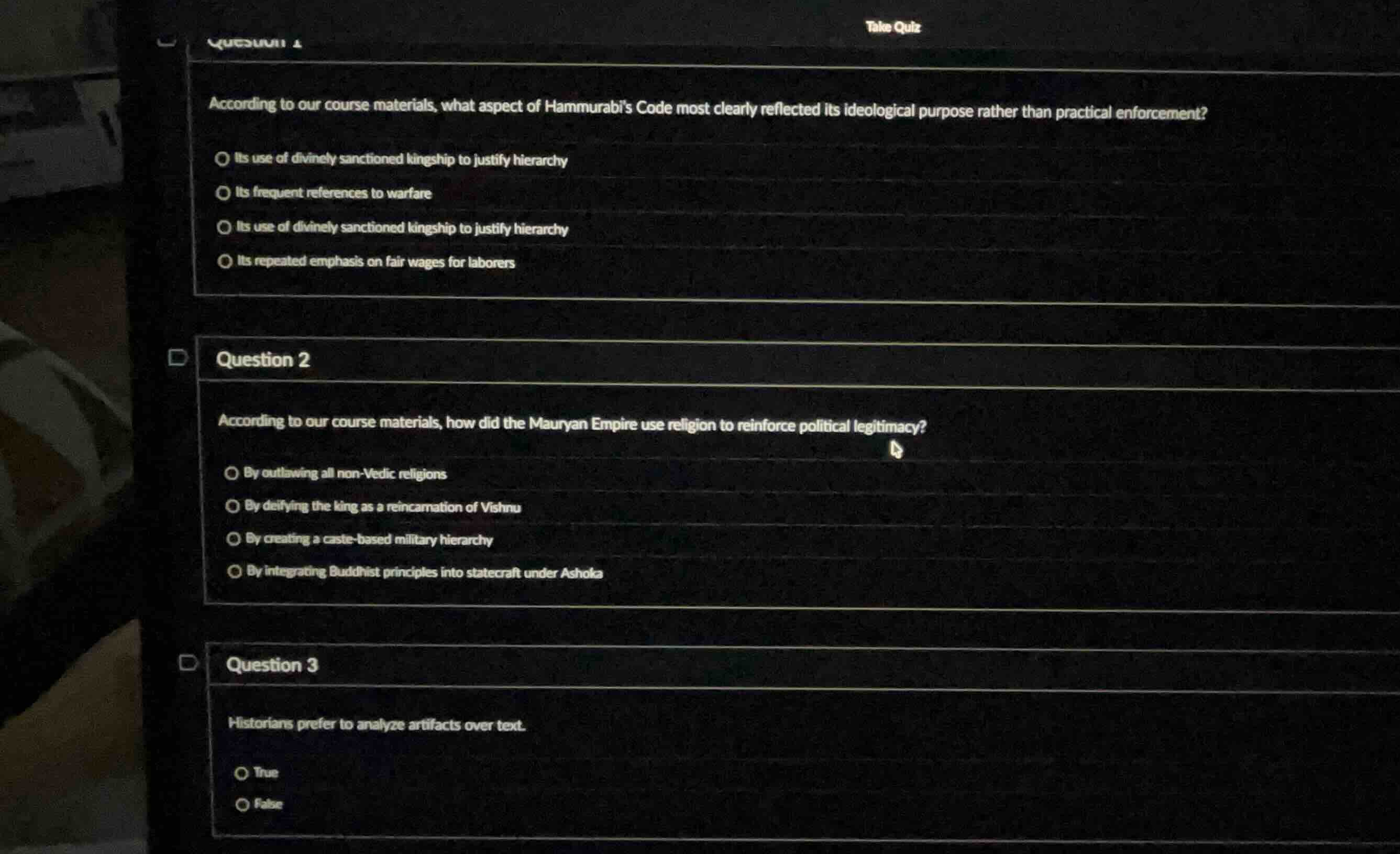
question 1 according to our course materials, what aspect of hammurabis…

Question

question 1
according to our course materials, what aspect of hammurabis code most clearly reflected its ideological purpose rather than practical enforcement?

  • its use of divinely sanctioned kingship to justify hierarchy
  • its frequent references to warfare
  • its use of divinely sanctioned kingship to justify hierarchy
  • its repeated emphasis on fair wages for laborers

question 2
according to our course materials, how did the mauryan empire use religion to reinforce political legitimacy?

  • by outlawing all non-vedic religions
  • by deifying the king as a reincarnation of vishnu
  • by creating a caste-based military hierarchy
  • by integrating buddhist principles into statecraft under ashoka

question 3
historians prefer to analyze artifacts over text.

  • true
  • false

Explanation:

Response

<pre_analysis>
{
"quality": "clear",
"question_count": 3,
"skills_matched": [
"direct_cot",
"multiple_choice_formatter",
"explain_then_answer",
"quick"
],
"needs_drawing": false,
"concepts_used": [
"Hammurabi Code Ideology",
"Mauryan Empire Statecraft",
"Historical Methodology"
],
"new_concepts": [],
"current_concepts": [
"Hammurabi Code Ideology",
"Mauryan Empire Statecraft",
"Historical Methodology"
]
}
</pre_analysis>

<reasoning>

Analyze Question 1

The question asks which aspect of Hammurabi's Code most clearly reflected its ideological purpose rather than practical enforcement. The prologue and epilogue of the Code heavily emphasize divine selection and the king's role as a just ruler chosen by the gods (like Shamash and Marduk) to maintain cosmic order and justify the social hierarchy. Thus, the use of divinely sanctioned kingship to justify hierarchy represents its primary ideological purpose.

Analyze Question 2

The question asks how the Mauryan Empire used religion to reinforce political legitimacy. Under Emperor Ashoka, the Mauryan state integrated Buddhist principles (Dhamma) into statecraft, promoting moral governance, social welfare, and religious tolerance through rock and pillar edicts to unify and legitimize his rule.

Analyze Question 3

The statement is "Historians prefer to analyze artifacts over text." In historical methodology, historians do not inherently prefer artifacts over texts; rather, they analyze both textual sources and material artifacts in tandem depending on the period, availability, and research question. Textual documents remain central to historical analysis, making the blanket statement false.
</reasoning>

<answer>

Question 1

<mcq-correct>(A) Its use of divinely sanctioned kingship to justify hierarchy</mcq-correct>
<mcq-option>(B) Its frequent references to warfare</mcq-option>
<mcq-option>(C) Its use of divinely sanctioned kingship to justify hierarchy</mcq-option>
<mcq-option>(D) Its repeated emphasis on fair wages for laborers</mcq-option>

Question 2

<mcq-option>(A) By outlawing all non-Vedic religions</mcq-option>
<mcq-option>(B) By deifying the king as a reincarnation of Vishnu</mcq-option>
<mcq-option>(C) By creating a caste-based military hierarchy</mcq-option>
<mcq-correct>(D) By integrating Buddhist principles into statecraft under Ashoka</mcq-correct>

Question 3

<mcq-option>(A) True</mcq-option>
<mcq-correct>(B) False</mcq-correct>
</answer>

<post_analysis>
{
"subject": "Social Science",
"question_type": "Multiple Choice",
"knowledge_point": [
"Social Science",
"History",
"Ancient Civilizations"
]
}
</post_analysis>

Answer:

<pre_analysis>
{
"quality": "clear",
"question_count": 3,
"skills_matched": [
"direct_cot",
"multiple_choice_formatter",
"explain_then_answer",
"quick"
],
"needs_drawing": false,
"concepts_used": [
"Hammurabi Code Ideology",
"Mauryan Empire Statecraft",
"Historical Methodology"
],
"new_concepts": [],
"current_concepts": [
"Hammurabi Code Ideology",
"Mauryan Empire Statecraft",
"Historical Methodology"
]
}
</pre_analysis>

<reasoning>

Analyze Question 1

The question asks which aspect of Hammurabi's Code most clearly reflected its ideological purpose rather than practical enforcement. The prologue and epilogue of the Code heavily emphasize divine selection and the king's role as a just ruler chosen by the gods (like Shamash and Marduk) to maintain cosmic order and justify the social hierarchy. Thus, the use of divinely sanctioned kingship to justify hierarchy represents its primary ideological purpose.

Analyze Question 2

The question asks how the Mauryan Empire used religion to reinforce political legitimacy. Under Emperor Ashoka, the Mauryan state integrated Buddhist principles (Dhamma) into statecraft, promoting moral governance, social welfare, and religious tolerance through rock and pillar edicts to unify and legitimize his rule.

Analyze Question 3

The statement is "Historians prefer to analyze artifacts over text." In historical methodology, historians do not inherently prefer artifacts over texts; rather, they analyze both textual sources and material artifacts in tandem depending on the period, availability, and research question. Textual documents remain central to historical analysis, making the blanket statement false.
</reasoning>

<answer>

Question 1

<mcq-correct>(A) Its use of divinely sanctioned kingship to justify hierarchy</mcq-correct>
<mcq-option>(B) Its frequent references to warfare</mcq-option>
<mcq-option>(C) Its use of divinely sanctioned kingship to justify hierarchy</mcq-option>
<mcq-option>(D) Its repeated emphasis on fair wages for laborers</mcq-option>

Question 2

<mcq-option>(A) By outlawing all non-Vedic religions</mcq-option>
<mcq-option>(B) By deifying the king as a reincarnation of Vishnu</mcq-option>
<mcq-option>(C) By creating a caste-based military hierarchy</mcq-option>
<mcq-correct>(D) By integrating Buddhist principles into statecraft under Ashoka</mcq-correct>

Question 3

<mcq-option>(A) True</mcq-option>
<mcq-correct>(B) False</mcq-correct>
</answer>

<post_analysis>
{
"subject": "Social Science",
"question_type": "Multiple Choice",
"knowledge_point": [
"Social Science",
"History",
"Ancient Civilizations"
]
}
</post_analysis>