QUESTION IMAGE
Question
question 66
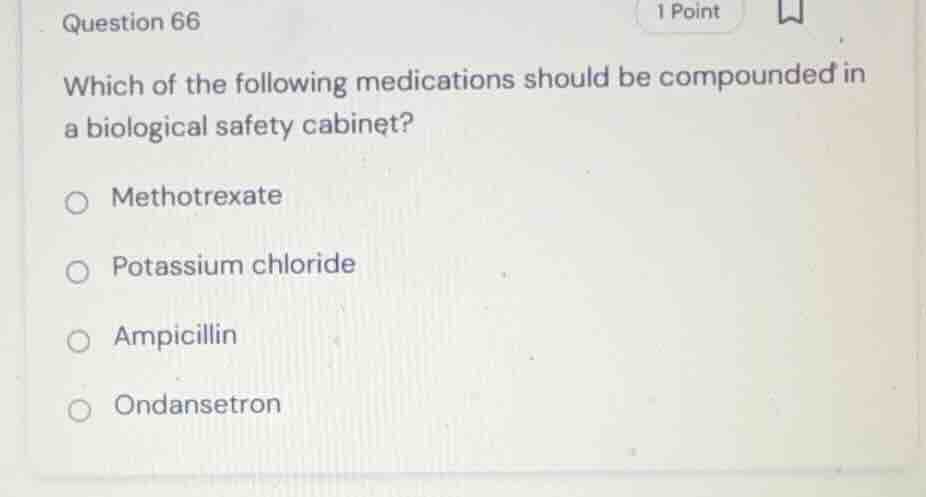
which of the following medications should be compounded in a biological safety cabinet?
- methotrexate
- potassium chloride
- ampicillin
- ondansetron
Identify the purpose of a biological safety cabinet
A Biological Safety Cabinet (BSC) is a specialized engineering control designed to provide environmental, personnel, and product protection. In pharmacy practice, a BSC (specifically Class II) is used for compounding sterile hazardous drugs to protect the operator from exposure to toxic aerosols or spills.
Evaluate the listed medications for hazardous properties
We must determine which of the listed options is classified as a hazardous drug:
- Methotrexate: An antineoplastic/chemotherapeutic agent and immunosuppressant. It is highly toxic, teratogenic, and classified as a hazardous drug by NIOSH (National Institute for Occupational Safety and Health).
- Potassium chloride: An electrolyte solution, non-hazardous.
- Ampicillin: A standard beta-lactam antibiotic, non-hazardous.
- Ondansetron: An antiemetic, non-hazardous.
Apply compounding standards
Using the Sterile Compounding knowledge point, sterile preparations must be prepared in appropriate environments. Under USP standards (specifically USP <800> for hazardous drugs), hazardous sterile compounds like methotrexate must be prepared in a negative-pressure containment primary engineering control (C-PEC) such as a Class II Biological Safety Cabinet (BSC) or a Compounding Aseptic Containment Isolator (CACI) to ensure operator safety. Non-hazardous sterile medications are typically compounded in a positive-pressure Laminar Airflow Workbench (LAFW). Therefore, methotrexate is the medication that must be compounded in a BSC.

Snap & solve any problem in the app
Get step-by-step solutions on Sovi AI
Photo-based solutions with guided steps
Explore more problems and detailed explanations
- (A) Methotrexate (Correct answer)
- (B) Potassium chloride
- (C) Ampicillin
- (D) Ondansetron