QUESTION IMAGE
Question
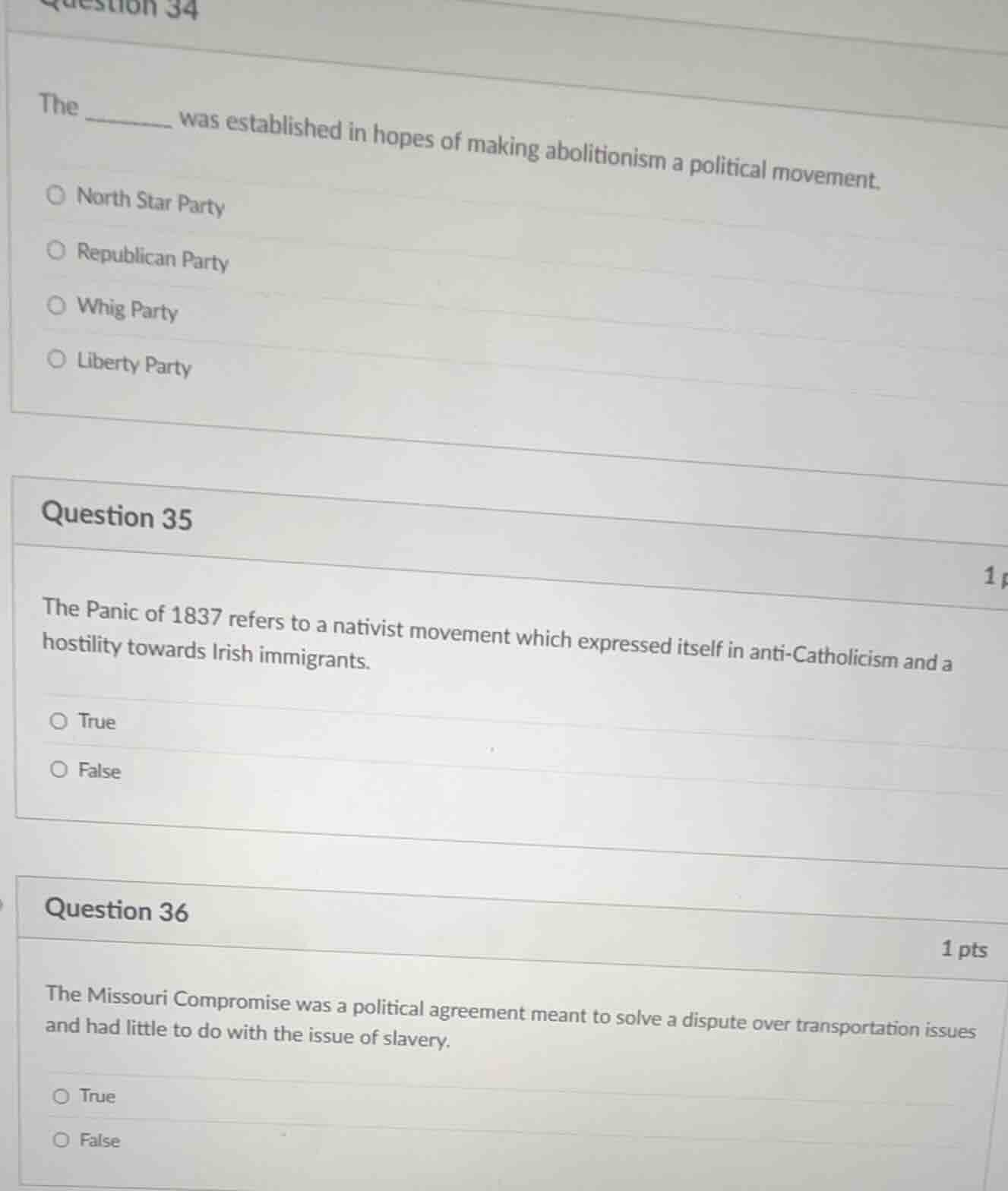
question 34
the ________ was established in hopes of making abolitionism a political movement.
- north star party
- republican party
- whig party
- liberty party
question 35
the panic of 1837 refers to a nativist movement which expressed itself in anti-catholicism and a hostility towards irish immigrants.
- true
- false
question 36
the missouri compromise was a political agreement meant to solve a dispute over transportation issues and had little to do with the issue of slavery.
- true
- false
🆕 New Concept Discovered: Political Abolitionism and Sectionalism
How 19th-century political parties and compromises shaped the debate over slavery.
Step 1: Analyze Question 34
The question asks which political party was established to turn abolitionism into a political movement.
- Liberty Party: Formed in 1840, this was the first political party in the United States to run on an explicitly anti-slavery platform. Its founders believed in using the electoral system and the Constitution to fight slavery, distinguishing themselves from moral suasionists like William Lloyd Garrison who avoided party politics.
- North Star Party: Not a historical political party (though The North Star was Frederick Douglass's famous abolitionist newspaper).
- Whig Party / Republican Party: While both had members opposed to the expansion of slavery, the Whigs were a broad coalition not founded solely for abolitionism, and the Republican Party was founded later (1854) on a "free soil" platform rather than immediate abolitionism.
Thus, the correct choice is the Liberty Party.
Step 2: Analyze Question 35
The statement asserts that the "Panic of 1837 refers to a nativist movement which expressed itself in anti-Catholicism and a hostility towards Irish immigrants."
- The Panic of 1837 was a major financial and economic crisis in the United States that led to a deep depression, bank failures, and high unemployment. It was not a nativist movement.
- Nativist movements and anti-Catholic hostility during this era were associated with groups like the "Know-Nothings" (the American Party), not the Panic of 1837.
Therefore, the statement is False.
Step 3: Analyze Question 36
The statement claims that the "Missouri Compromise was a political agreement meant to solve a dispute over transportation issues and had little to do with the issue of slavery."
- The Missouri Compromise (1820) was entirely about the expansion of slavery. It admitted Missouri as a slave state and Maine as a free state to maintain the balance of power in the Senate, and it banned slavery in the remaining Louisiana Purchase territory north of the \(36^\circ 30'\) parallel.
- It had nothing to do with transportation issues.
Therefore, the statement is False.

Snap & solve any problem in the app
Get step-by-step solutions on Sovi AI
Photo-based solutions with guided steps
Explore more problems and detailed explanations
- Question 34: Liberty Party
- Question 35: False
- Question 36: False