QUESTION IMAGE
Question
question 32 (5.5 points)
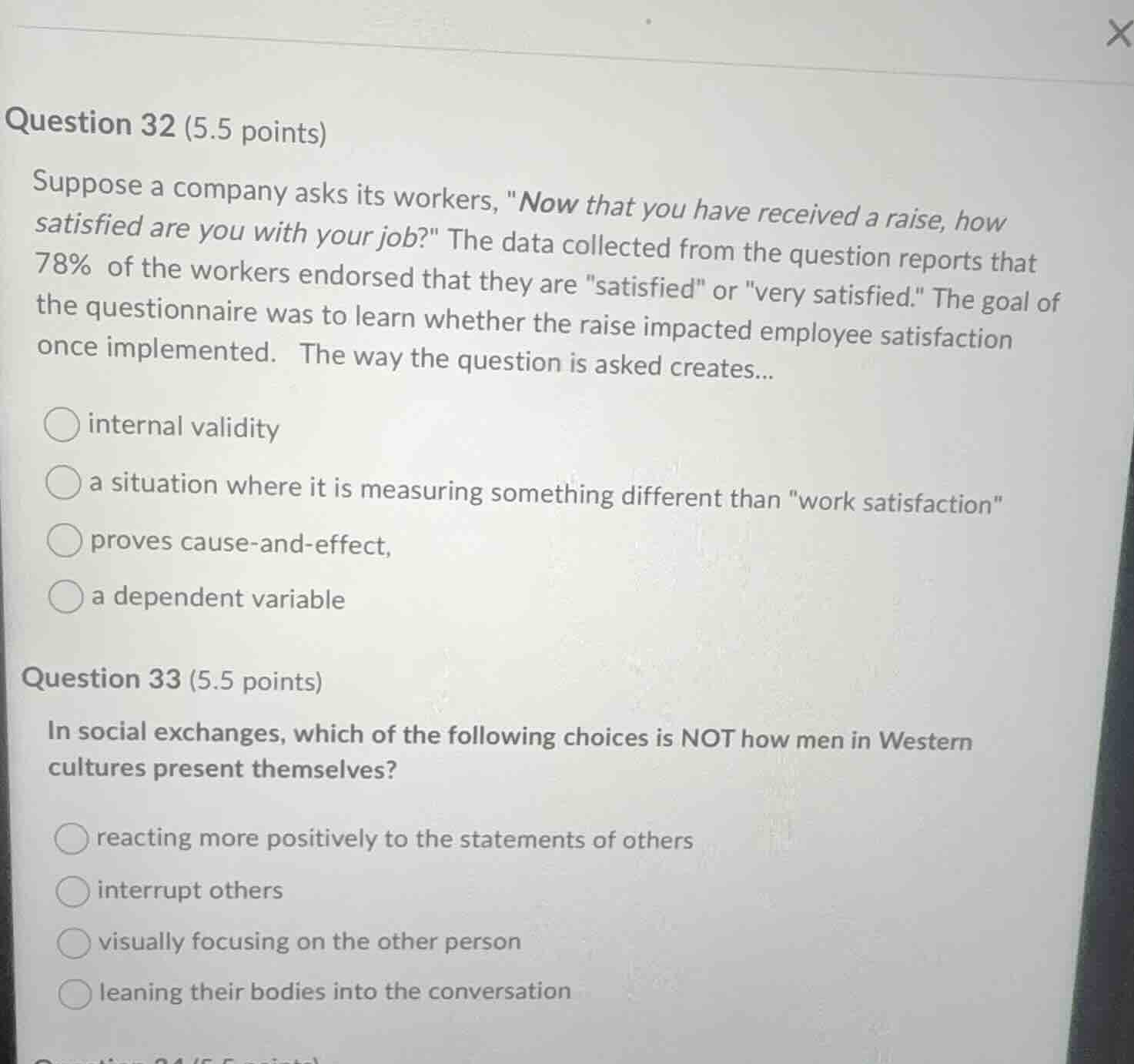
suppose a company asks its workers,
ow that you have received a raise, how satisfied are you with your job?\ the data collected from the question reports that 78% of the workers endorsed that they are \satisfied\ or \very satisfied.\ the goal of the questionnaire was to learn whether the raise impacted employee satisfaction once implemented. the way the question is asked creates...
internal validity
a situation where it is measuring something different than \work satisfaction\
proves cause-and-effect,
a dependent variable
question 33 (5.5 points)
in social exchanges, which of the following choices is not how men in western cultures present themselves?
reacting more positively to the statements of others
interrupt others
visually focusing on the other person
leaning their bodies into the conversation
Analyze Question 32
The question asks about the impact of the phrasing: "Now that you have received a raise, how satisfied are you with your job?"
By explicitly reminding employees that they just received a raise, the question introduces a strong bias. It primes them to feel obligated to report higher satisfaction or directly links their satisfaction to the raise, rather than measuring their general, objective "work satisfaction." This creates a demand characteristic or priming effect, meaning the question is measuring the reaction to the prompt itself rather than the intended construct of baseline work satisfaction. Thus, it creates a situation where it is measuring something different than "work satisfaction."
Analyze Question 33
The question asks which choice is NOT how men in Western cultures typically present themselves in social exchanges.
According to sociological and psychological research on gendered communication styles in Western cultures:
- Men are more likely to interrupt others to assert dominance or status.
- Men often use visual dominance behaviors (such as looking away when listening but staring when speaking, or maintaining specific visual focus patterns).
- Men frequently use nonverbal cues like leaning in to assert presence.
- Conversely, women are statistically more likely to react more positively to the statements of others, using supportive vocalizations, nodding, and agreement to build rapport. Therefore, reacting more positively to the statements of others is NOT a typical self-presentation style for men in Western cultures.

Snap & solve any problem in the app
Get step-by-step solutions on Sovi AI
Photo-based solutions with guided steps
Explore more problems and detailed explanations
Question 32
- internal validity
- a situation where it is measuring something different than "work satisfaction" (Correct answer)
- proves cause-and-effect,
- a dependent variable
Question 33
- reacting more positively to the statements of others (Correct answer)
- interrupt others
- visually focusing on the other person
- leaning their bodies into the conversation