Sovi.AI - AI Math Tutor

Scan to solve math questions

QUESTION IMAGE

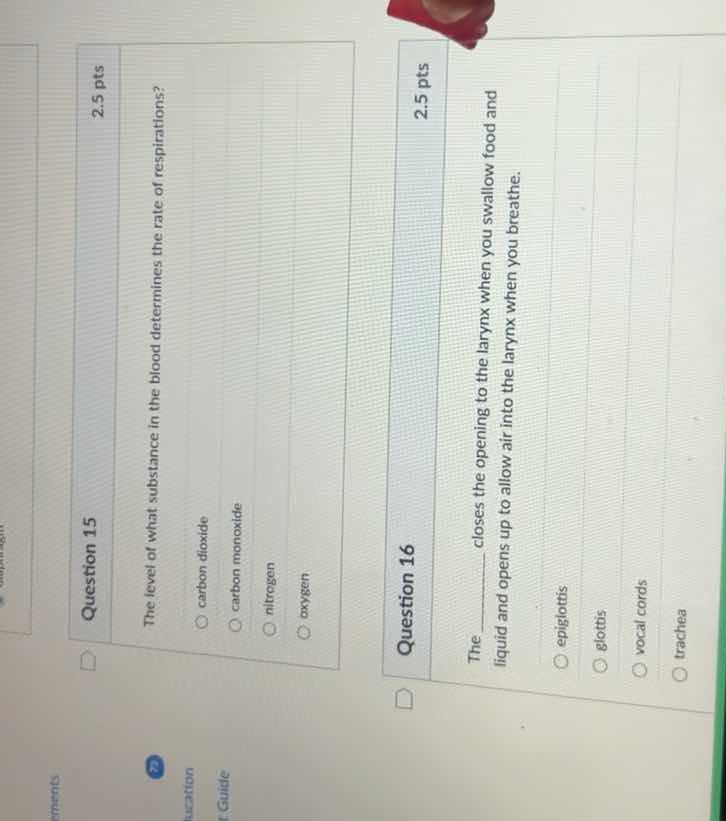
question 15 2.5 pts the level of what substance in the blood determines…

Question

question 15
2.5 pts
the level of what substance in the blood determines the rate of respirations?
carbon dioxide
carbon monoxide
nitrogen
oxygen

question 16
2.5 pts
the ________ closes the opening to the larynx when you swallow food and liquid and opens up to allow air into the larynx when you breathe.
epiglottis
glottis
vocal cords
trachea

Explanation:

Response

<pre_analysis>
{
"quality": "clear",
"question_count": 2,
"skills_matched": [
"direct_cot",
"multiple_choice_formatter",
"explain_then_answer",
"tutor"
],
"needs_drawing": false,
"concepts_used": [
"Respiratory Control Center",
"Respiratory Anatomy"
],
"new_concepts": [
"Chemical Regulation of Respiration",
"Laryngeal Protective Mechanisms"
],
"current_concepts": [
"Respiratory Control Center",
"Respiratory Anatomy",
"Chemical Regulation of Respiration",
"Laryngeal Protective Mechanisms"
]
}
</pre_analysis>

<reasoning>

Analyze Question 15

Using the Respiratory Control Center knowledge point, we analyze what chemical substance primarily regulates the rate and depth of breathing. The brain's respiratory center in the medulla oblongata and pons is highly sensitive to changes in the chemical composition of the blood. Specifically, central chemoreceptors are extremely sensitive to the concentration of hydrogen ions (\(\text{H}^+\)) and carbon dioxide (\(\text{CO}_2\)) in the cerebrospinal fluid and arterial blood. An increase in carbon dioxide levels leads to an increase in hydrogen ion concentration (lowering pH), which triggers the respiratory center to increase the rate and depth of breathing to expel the excess gas. Therefore, carbon dioxide is the primary chemical stimulus regulating respiration under normal physiological conditions.

Analyze Question 16

Using the Respiratory Anatomy knowledge point, we identify the anatomical structure that guards the entrance to the larynx. The larynx serves as a passageway for air and contains a protective mechanism to prevent food and liquids from entering the lower respiratory tract during swallowing. The epiglottis is a leaf-shaped flap of elastic cartilage located at the root of the tongue. During swallowing, the larynx rises, causing the epiglottis to fold down over the glottis (the opening into the larynx), effectively sealing it off so that swallowed material is routed into the esophagus. When breathing, the epiglottis stands upright, allowing air to pass freely into the trachea.
</reasoning>

<answer>

Question 15

<mcq-correct>carbon dioxide</mcq-correct>
<mcq-option>carbon monoxide</mcq-option>
<mcq-option>nitrogen</mcq-option>
<mcq-option>oxygen</mcq-option>

Question 16

<mcq-correct>epiglottis</mcq-correct>
<mcq-option>glottis</mcq-option>
<mcq-option>vocal cords</mcq-option>
<mcq-option>trachea</mcq-option>
</answer>

<post_analysis>
{
"subject": "Natural Science",
"question_type": "Multiple Choice",
"knowledge_point": [
"Natural Science",
"Biology",
"Human Anatomy and Physiology"
]
}
</post_analysis>

Answer:

<pre_analysis>
{
"quality": "clear",
"question_count": 2,
"skills_matched": [
"direct_cot",
"multiple_choice_formatter",
"explain_then_answer",
"tutor"
],
"needs_drawing": false,
"concepts_used": [
"Respiratory Control Center",
"Respiratory Anatomy"
],
"new_concepts": [
"Chemical Regulation of Respiration",
"Laryngeal Protective Mechanisms"
],
"current_concepts": [
"Respiratory Control Center",
"Respiratory Anatomy",
"Chemical Regulation of Respiration",
"Laryngeal Protective Mechanisms"
]
}
</pre_analysis>

<reasoning>

Analyze Question 15

Using the Respiratory Control Center knowledge point, we analyze what chemical substance primarily regulates the rate and depth of breathing. The brain's respiratory center in the medulla oblongata and pons is highly sensitive to changes in the chemical composition of the blood. Specifically, central chemoreceptors are extremely sensitive to the concentration of hydrogen ions (\(\text{H}^+\)) and carbon dioxide (\(\text{CO}_2\)) in the cerebrospinal fluid and arterial blood. An increase in carbon dioxide levels leads to an increase in hydrogen ion concentration (lowering pH), which triggers the respiratory center to increase the rate and depth of breathing to expel the excess gas. Therefore, carbon dioxide is the primary chemical stimulus regulating respiration under normal physiological conditions.

Analyze Question 16

Using the Respiratory Anatomy knowledge point, we identify the anatomical structure that guards the entrance to the larynx. The larynx serves as a passageway for air and contains a protective mechanism to prevent food and liquids from entering the lower respiratory tract during swallowing. The epiglottis is a leaf-shaped flap of elastic cartilage located at the root of the tongue. During swallowing, the larynx rises, causing the epiglottis to fold down over the glottis (the opening into the larynx), effectively sealing it off so that swallowed material is routed into the esophagus. When breathing, the epiglottis stands upright, allowing air to pass freely into the trachea.
</reasoning>

<answer>

Question 15

<mcq-correct>carbon dioxide</mcq-correct>
<mcq-option>carbon monoxide</mcq-option>
<mcq-option>nitrogen</mcq-option>
<mcq-option>oxygen</mcq-option>

Question 16

<mcq-correct>epiglottis</mcq-correct>
<mcq-option>glottis</mcq-option>
<mcq-option>vocal cords</mcq-option>
<mcq-option>trachea</mcq-option>
</answer>

<post_analysis>
{
"subject": "Natural Science",
"question_type": "Multiple Choice",
"knowledge_point": [
"Natural Science",
"Biology",
"Human Anatomy and Physiology"
]
}
</post_analysis>