QUESTION IMAGE
Question
question 13 (1 point) saved
solve the problem.
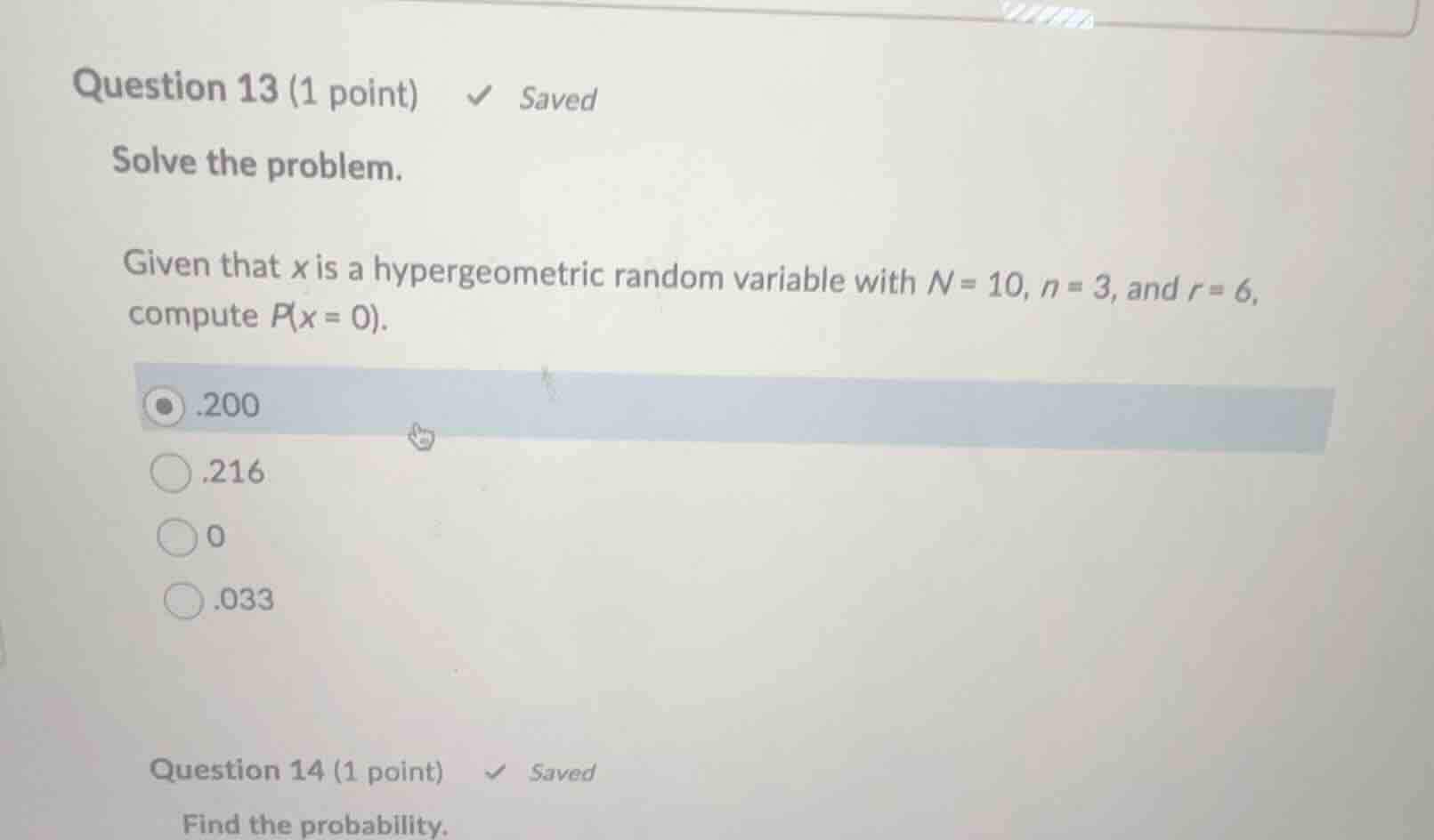
given that \\(x\\) is a hypergeometric random variable with \\(n = 10\\), \\(n = 3\\), and \\(r = 6\\), compute \\(p(x = 0)\\).
.200
.216
0
.033
Identify the hypergeometric parameters
To solve this problem, we first identify the parameters of the hypergeometric distribution from the given information:
- \(N = 10\): The total population size.
- \(r = 6\): The number of success states in the population.
- \(n = 3\): The number of draws (sample size).
- \(x = 0\): The number of observed successes in the sample.
We want to compute the probability \(P(x = 0)\).
State the hypergeometric probability formula
The probability mass function of a hypergeometric random variable is given by:
This formula calculates the probability of obtaining exactly \(x\) successes in \(n\) draws without replacement from a population of size \(N\) containing \(r\) successes.
Calculate the combinations
We need to evaluate each binomial coefficient (combination) in the formula for \(x = 0\):
- The number of ways to choose \(0\) successes from the \(r = 6\) available successes:
- The number of ways to choose \(n - x = 3 - 0 = 3\) failures from the \(N - r = 10 - 6 = 4\) available failures:
- The total number of ways to choose a sample of \(n = 3\) from the population of \(N = 10\):
Compute the final probability
Now, we substitute these calculated combinations back into the hypergeometric probability formula:
Simplifying the fraction:
Comparing this result with the given choices, the value matches \(0.033\) (rounded to three decimal places).

Snap & solve any problem in the app
Get step-by-step solutions on Sovi AI
Photo-based solutions with guided steps
Explore more problems and detailed explanations
- (A) .200
- (B) .216
- (C) 0
- (D) .033 (Correct answer)