QUESTION IMAGE
Question
question 10
1 pts
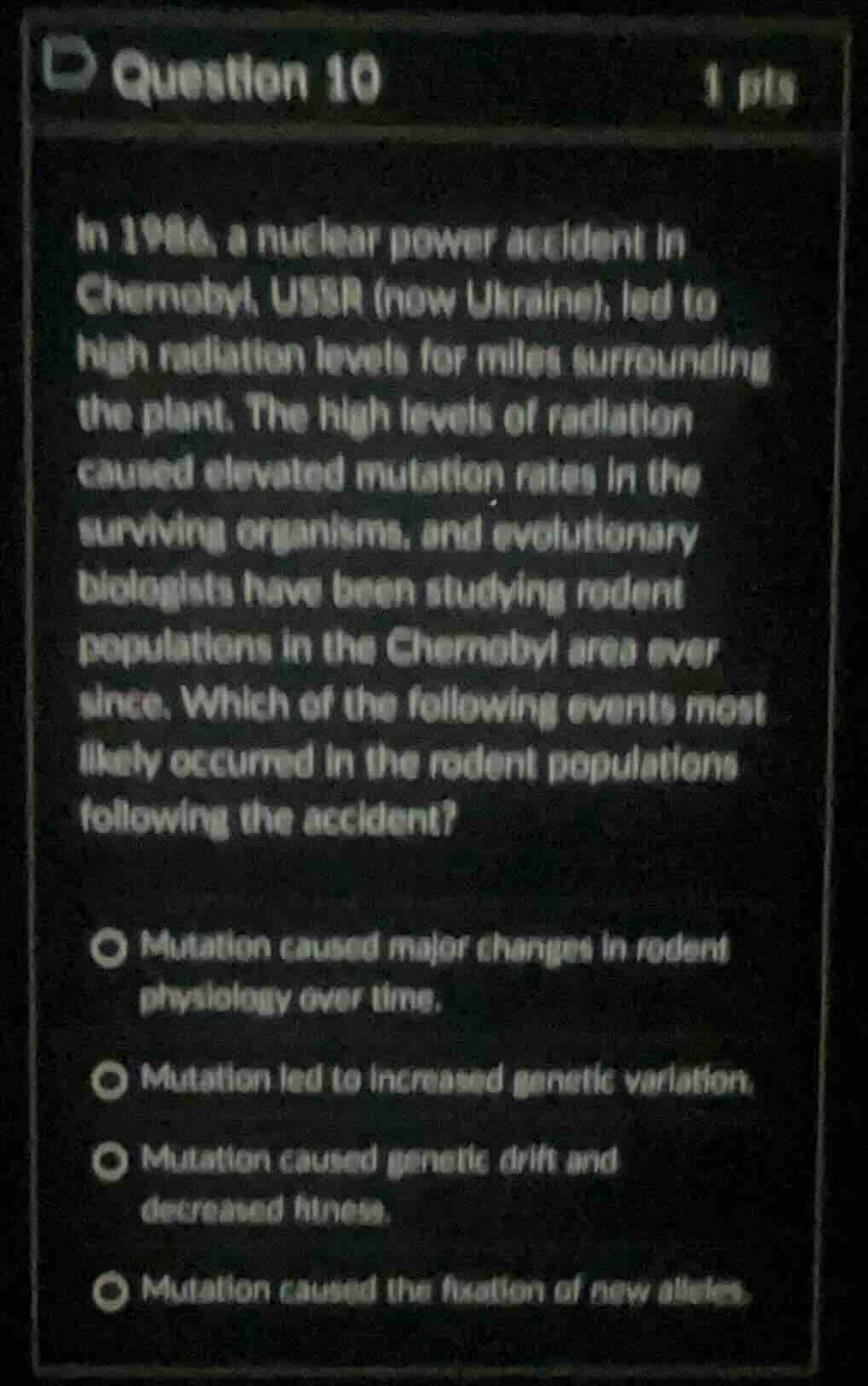
in 1986, a nuclear power accident in chernobyl, ussr (now ukraine), led to high radiation levels for miles surrounding the plant. the high levels of radiation caused elevated mutation rates in the surviving organisms, and evolutionary biologists have been studying rodent populations in the chernobyl area ever since. which of the following events most likely occurred in the rodent populations following the accident?
- mutation caused major changes in rodent physiology over time.
- mutation led to increased genetic variation.
- mutation caused genetic drift and decreased fitness.
- mutation caused the fixation of new alleles.
<pre_analysis>
{
"quality": "clear",
"question_count": 1,
"skills_matched": [
"direct_cot",
"multiple_choice_formatter",
"explain_then_answer",
"quick"
],
"needs_drawing": false,
"concepts_used": [],
"new_concepts": [
"Mutation Effects",
"Genetic Variation"
],
"current_concepts": [
"Mutation Effects",
"Genetic Variation",
"Evolutionary Biology"
]
}
</pre_analysis>
<reasoning>
Analyze the direct effect of radiation-induced mutations
Radiation increases the rate of random DNA sequence changes (mutations) in the germline and somatic cells of surviving organisms.
Evaluate the impact on genetic diversity
Because mutations introduce new alleles and sequence changes randomly across individuals in a population, the immediate direct consequence of an elevated mutation rate is an increase in the overall genetic diversity (variation) within that population.
Assess the alternative options
Major physiological changes over time, genetic drift, or immediate allele fixation require subsequent evolutionary processes (such as natural selection or demographic bottlenecks) and are not the direct, guaranteed immediate consequence of mutation itself.
</reasoning>
<answer>
<mcq-option>Mutation caused major changes in rodent physiology over time.</mcq-option>
<mcq-correct>Mutation led to increased genetic variation.</mcq-correct>
<mcq-option>Mutation caused genetic drift and decreased fitness.</mcq-option>
<mcq-option>Mutation caused the fixation of new alleles.</mcq-option>
</answer>
<post_analysis>
{
"subject": "Natural Science",
"question_type": "Multiple Choice",
"knowledge_point": [
"Natural Science",
"Biology",
"Evolutionary Genetics"
]
}
</post_analysis>
Snap & solve any problem in the app
Get step-by-step solutions on Sovi AI
Photo-based solutions with guided steps
Explore more problems and detailed explanations
<pre_analysis>
{
"quality": "clear",
"question_count": 1,
"skills_matched": [
"direct_cot",
"multiple_choice_formatter",
"explain_then_answer",
"quick"
],
"needs_drawing": false,
"concepts_used": [],
"new_concepts": [
"Mutation Effects",
"Genetic Variation"
],
"current_concepts": [
"Mutation Effects",
"Genetic Variation",
"Evolutionary Biology"
]
}
</pre_analysis>
<reasoning>
Analyze the direct effect of radiation-induced mutations
Radiation increases the rate of random DNA sequence changes (mutations) in the germline and somatic cells of surviving organisms.
Evaluate the impact on genetic diversity
Because mutations introduce new alleles and sequence changes randomly across individuals in a population, the immediate direct consequence of an elevated mutation rate is an increase in the overall genetic diversity (variation) within that population.
Assess the alternative options
Major physiological changes over time, genetic drift, or immediate allele fixation require subsequent evolutionary processes (such as natural selection or demographic bottlenecks) and are not the direct, guaranteed immediate consequence of mutation itself.
</reasoning>
<answer>
<mcq-option>Mutation caused major changes in rodent physiology over time.</mcq-option>
<mcq-correct>Mutation led to increased genetic variation.</mcq-correct>
<mcq-option>Mutation caused genetic drift and decreased fitness.</mcq-option>
<mcq-option>Mutation caused the fixation of new alleles.</mcq-option>
</answer>
<post_analysis>
{
"subject": "Natural Science",
"question_type": "Multiple Choice",
"knowledge_point": [
"Natural Science",
"Biology",
"Evolutionary Genetics"
]
}
</post_analysis>