QUESTION IMAGE
Question
question 10 of 10
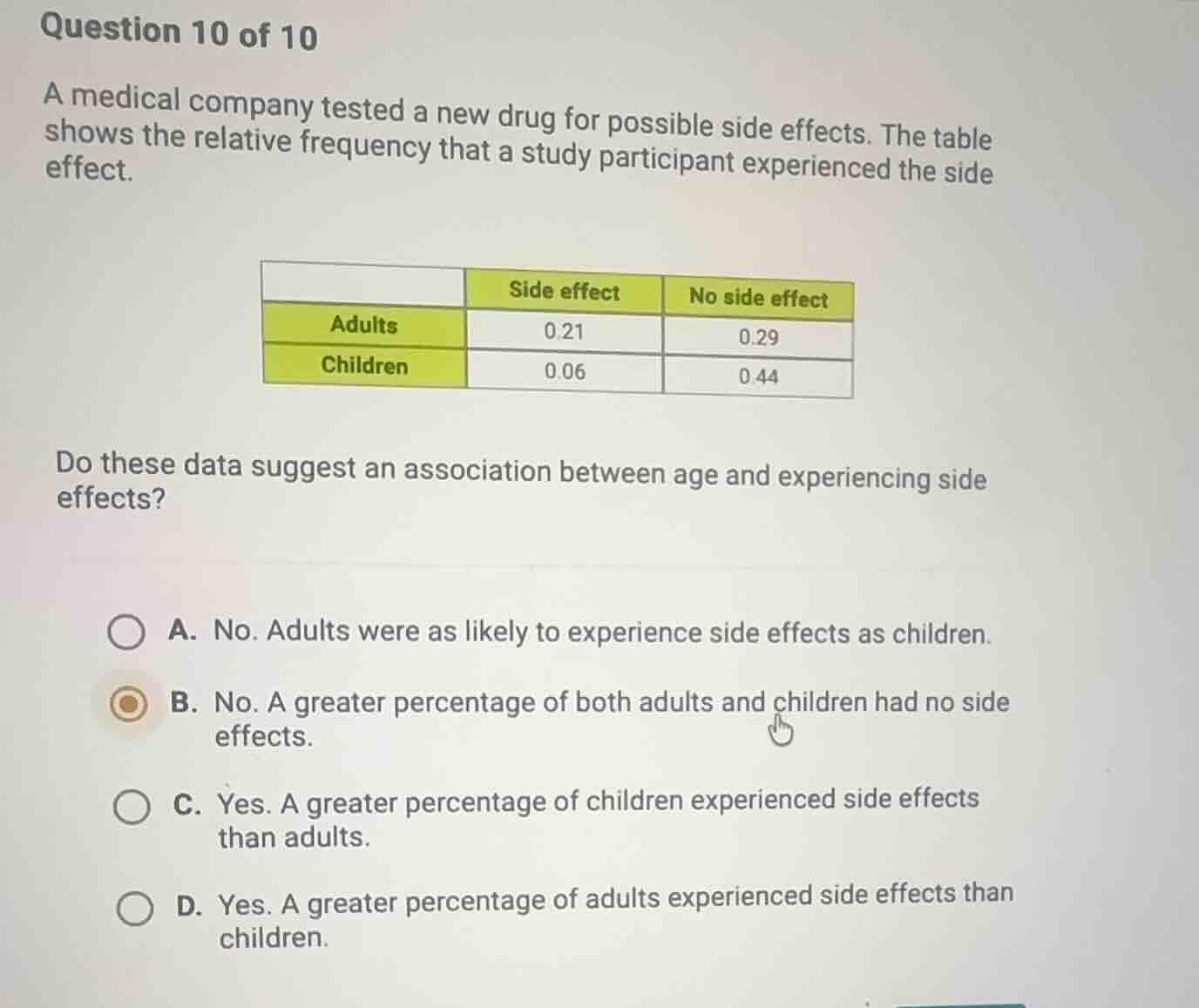
a medical company tested a new drug for possible side effects. the table shows the relative frequency that a study participant experienced the side effect.
do these data suggest an association between age and experiencing side effects?
a. no. adults were as likely to experience side effects as children.
b. no. a greater percentage of both adults and children had no side effects.
c. yes. a greater percentage of children experienced side effects than adults.
d. yes. a greater percentage of adults experienced side effects than children.
Calculate conditional relative frequencies
We calculate the conditional probability of experiencing a side effect given the age group.
Using the Two-Way Relative Frequency Tables concept:
- For Adults:
- For Children:
Analyze association
Using the Conditional Probability concept:
- Compare the conditional relative frequencies:
- Since the percentages differ significantly, an association exists between age and experiencing side effects.
- Adults (\(42\%\)) are more likely to experience side effects than children (\(12\%\)).
- This matches option D.

Snap & solve any problem in the app
Get step-by-step solutions on Sovi AI
Photo-based solutions with guided steps
Explore more problems and detailed explanations
- A. No. Adults were as likely to experience side effects as children.
- B. No. A greater percentage of both adults and children had no side effects.
- C. Yes. A greater percentage of children experienced side effects than adults.
- D. Yes. A greater percentage of adults experienced side effects than children. (Correct answer)