QUESTION IMAGE
Question
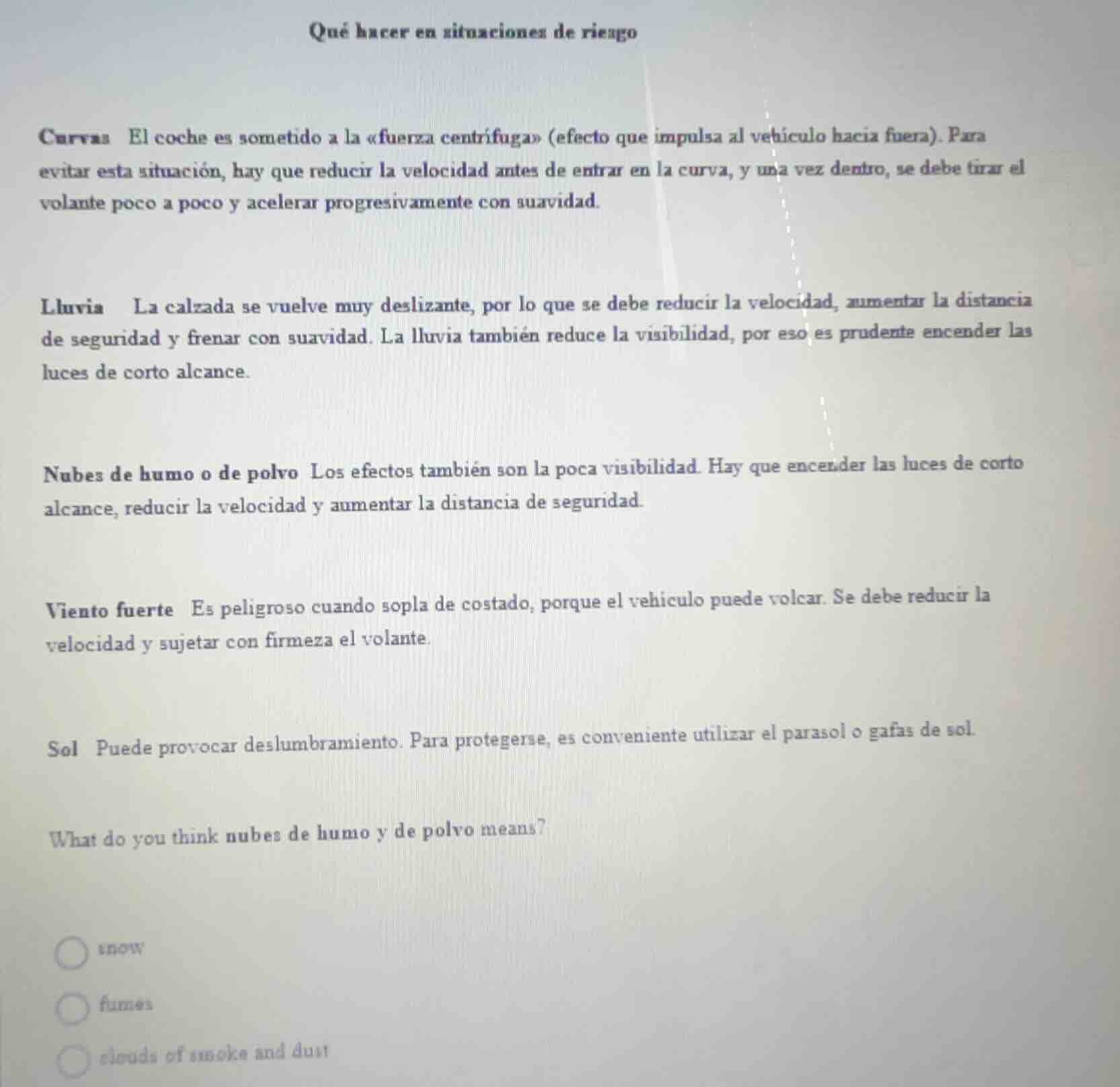
qué hacer en situaciones de riesgo
curvas el coche es sometido a la «fuerza centrífuga» (efecto que impulsa al vehículo hacia fuera). para evitar esta situación, hay que reducir la velocidad antes de entrar en la curva, y una vez dentro, se debe tirar el volante poco a poco y acelerar progresivamente con suavidad.
lluvia la calzada se vuelve muy deslizante, por lo que se debe reducir la velocidad, aumentar la distancia de seguridad y frenar con suavidad. la lluvia también reduce la visibilidad, por eso es prudente encender las luces de corto alcance.
nubes de humo o de polvo los efectos también son la poca visibilidad. hay que encender las luces de corto alcance, reducir la velocidad y aumentar la distancia de seguridad.
viento fuerte es peligroso cuando sopla de costado, porque el vehículo puede volcar. se debe reducir la velocidad y sujetar con firmeza el volante.
sol puede provocar deslumbramiento. para protegerse, es conveniente utilizar el parasol o gafas de sol.
what do you think nubes de humo y de polvo means?
snow
fumes
clouds of smoke and dust
Analyze the target phrase
The question asks for the meaning of the Spanish phrase "nubes de humo y de polvo" based on the provided text. Let's break down the vocabulary using Spanish Vocabulary:
- "Nubes" translates to "clouds".
- "de" means "of".
- "humo" translates to "smoke".
- "y" means "and".
- "polvo" translates to "dust".
Compare with options
Using Spanish Reading Comprehension, we evaluate the given multiple-choice options:
- Option 1: "snow" (Spanish: nieve)
- Option 2: "fumes" (Spanish: gases or humos, but lacks the "dust" and "clouds" components)
- Option 3: "clouds of smoke and dust" (This is a direct, literal translation of "nubes de humo y de polvo")
Therefore, the third option is the correct translation.

Snap & solve any problem in the app
Get step-by-step solutions on Sovi AI
Photo-based solutions with guided steps
Explore more problems and detailed explanations
- snow
- fumes
- clouds of smoke and dust (Correct answer)