QUESTION IMAGE
Question
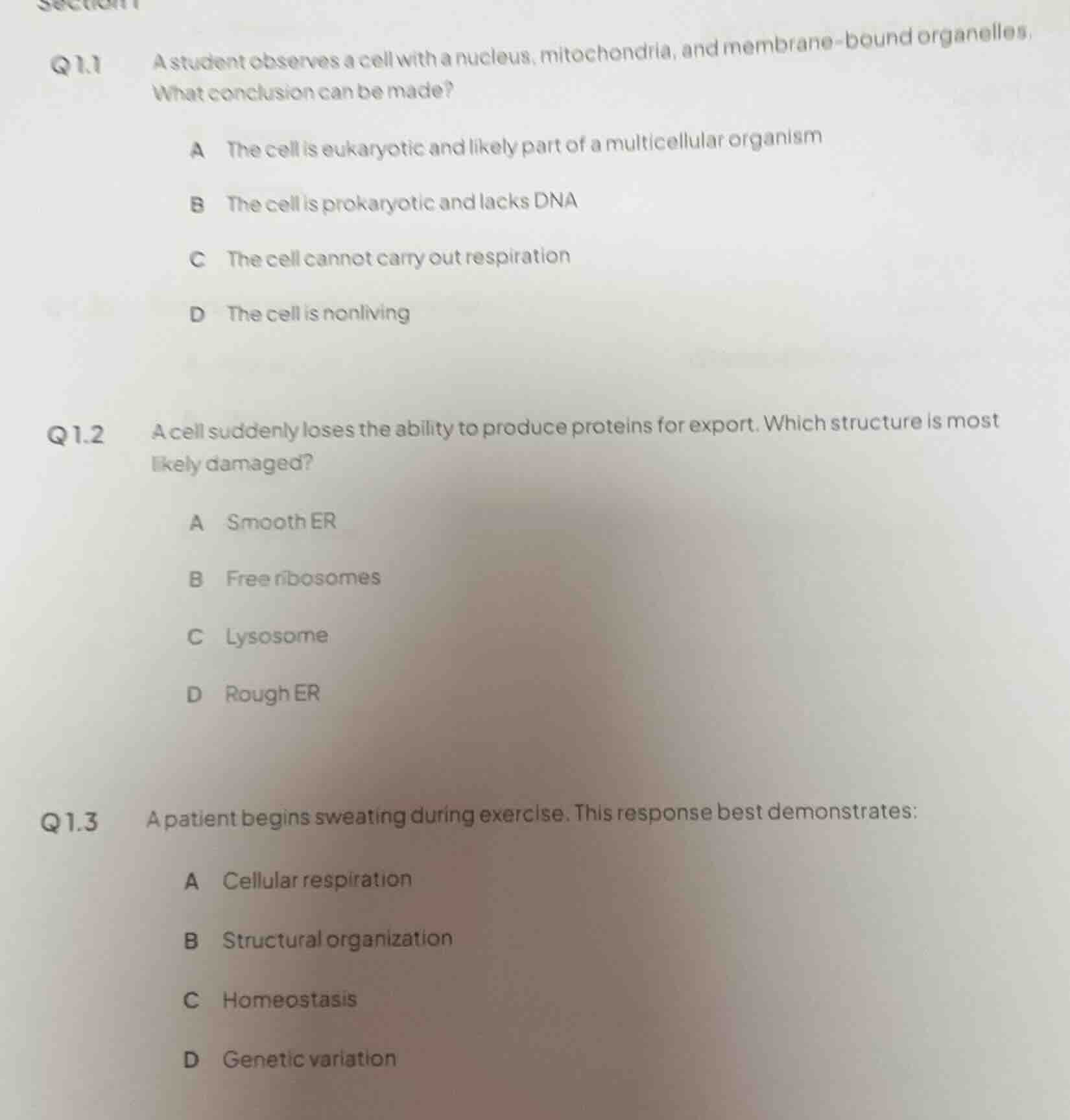
q1.1 a student observes a cell with a nucleus, mitochondria, and membrane-bound organelles. what conclusion can be made?
a the cell is eukaryotic and likely part of a multicellular organism
b the cell is prokaryotic and lacks dna
c the cell cannot carry out respiration
d the cell is nonliving
q1.2 a cell suddenly loses the ability to produce proteins for export. which structure is most likely damaged?
a smooth er
b free ribosomes
c lysosome
d rough er
q1.3 a patient begins sweating during exercise. this response best demonstrates:
a cellular respiration
b structural organization
c homeostasis
d genetic variation
Analyze Q1.1
The presence of a nucleus, mitochondria, and membrane-bound organelles is the defining characteristic of eukaryotic cells, which are found in multicellular (and some unicellular) organisms. Prokaryotes lack these structures.
Analyze Q1.2
The rough endoplasmic reticulum (Rough ER) is studded with ribosomes and is specifically responsible for synthesizing and processing proteins destined for export (secretion) out of the cell. Free ribosomes synthesize proteins for use within the cytosol.
Analyze Q1.3
Sweating during exercise is a physiological mechanism to cool the body down and maintain a stable internal body temperature, which is a direct demonstration of homeostasis.

Snap & solve any problem in the app
Get step-by-step solutions on Sovi AI
Photo-based solutions with guided steps
Explore more problems and detailed explanations
Question 1.1
- (A) The cell is eukaryotic and likely part of a multicellular organism (Correct answer)
- (B) The cell is prokaryotic and lacks DNA
- (C) The cell cannot carry out respiration
- (D) The cell is nonliving
Question 1.2
- (A) Smooth ER
- (B) Free ribosomes
- (C) Lysosome
- (D) Rough ER (Correct answer)
Question 1.3
- (A) Cellular respiration
- (B) Structural organization
- (C) Homeostasis (Correct answer)
- (D) Genetic variation