QUESTION IMAGE
Question
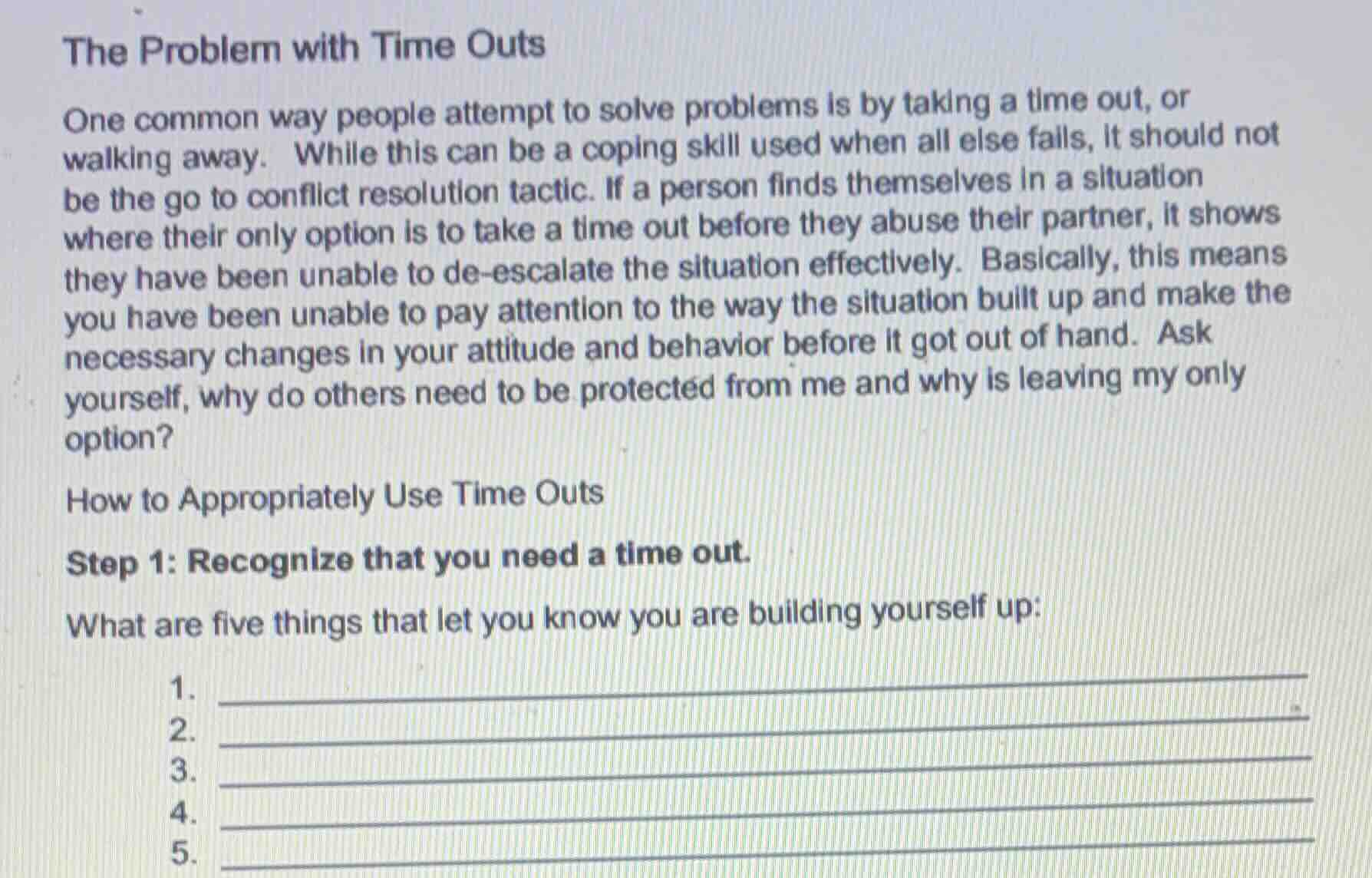
the problem with time outs
one common way people attempt to solve problems is by taking a time out, or walking away. while this can be a coping skill used when all else fails, it should not be the go to conflict resolution tactic. if a person finds themselves in a situation where their only option is to take a time out before they abuse their partner, it shows they have been unable to de-escalate the situation effectively. basically, this means you have been unable to pay attention to the way the situation built up and make the necessary changes in your attitude and behavior before it got out of hand. ask yourself, why do others need to be protected from me and why is leaving my only option?
how to appropriately use time outs
step 1: recognize that you need a time out.
what are five things that let you know you are building yourself up:
1.
2.
3.
4.
5.
Identify the core question
The worksheet asks: "What are five things that let you know you are building yourself up?" in the context of recognizing the need for a time out during a conflict to prevent escalation or abuse. "Building yourself up" refers to the physiological, emotional, and behavioral warning signs of rising anger, stress, or emotional arousal.
Connect to therapeutic concepts
Using Behavioral Therapy principles, recognizing early warning signs of emotional escalation (often called "anger cues" or "triggers") is crucial for timely self-regulation. These signs typically fall into physical, emotional, cognitive, and behavioral categories.
Determine five common warning signs
To provide a comprehensive and practical response for a student in a community college behavioral health or counseling context, we identify five distinct, universally recognized physiological and behavioral indicators of emotional escalation:
- Physiological changes: Increased heart rate or rapid breathing.
- Physical tension: Clenching fists or jaw.
- Body temperature changes: Feeling hot, sweating, or flushing in the face.
- Cognitive/verbal shifts: Raising one's voice or speaking more rapidly.
- Mental/emotional state: Racing thoughts or a strong urge to lash out/defend oneself.

Snap & solve any problem in the app
Get step-by-step solutions on Sovi AI
Photo-based solutions with guided steps
Explore more problems and detailed explanations
What are five things that let you know you are building yourself up:
- <blank>Increased heart rate or rapid, shallow breathing</blank>
- <blank>Physical tension, such as clenching your fists or jaw</blank>
- <blank>Feeling hot, sweating, or flushing in your face and neck</blank>
- <blank>Raising your voice, speaking faster, or using defensive language</blank>
- <blank>Racing thoughts, difficulty concentrating, or a strong urge to lash out</blank>