QUESTION IMAGE
Question
practicing monohybrid crosses
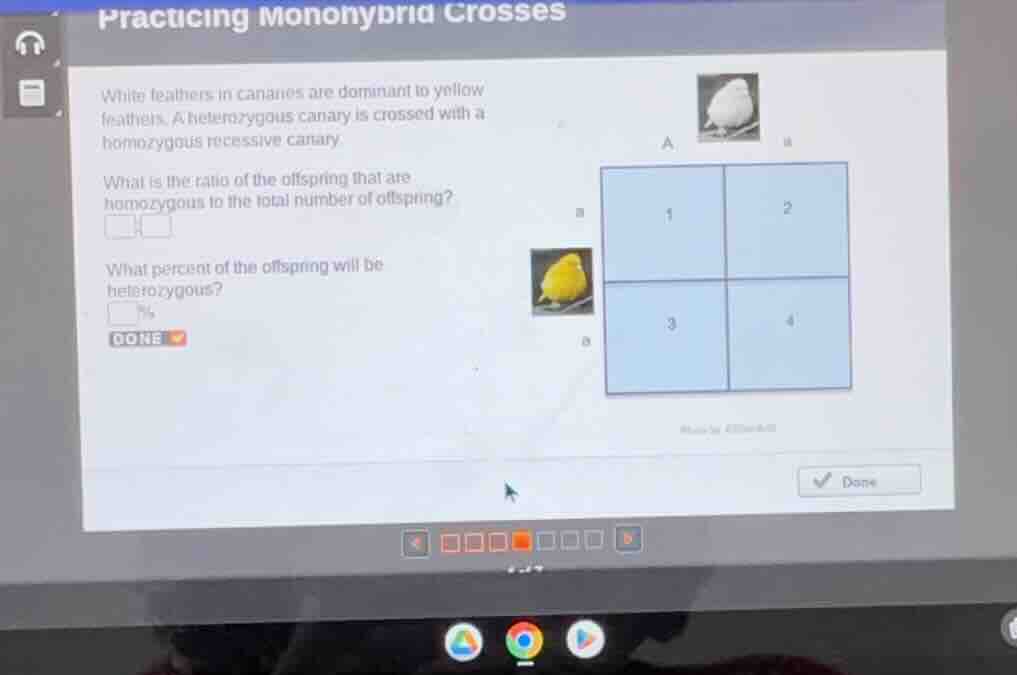
white feathers in canaries are dominant to yellow feathers. a heterozygous canary is crossed with a homozygous recessive canary.
what is the ratio of the offspring that are homozygous to the total number of offspring?
what percent of the offspring will be heterozygous?
Define alleles and parental genotypes
Using the Monohybrid Cross knowledge point
- Let \(W\) represent the dominant allele for white feathers.
- Let \(w\) represent the recessive allele for yellow feathers.
- Heterozygous parent genotype: \(Ww\).
- Homozygous recessive parent genotype: \(ww\).
Set up the Punnett square
Using the Punnett Square knowledge point
- Parent 1 (\(Ww\)) alleles: \(W\) and \(w\).
- Parent 2 (\(ww\)) alleles: \(w\) and \(w\).
- Offspring genotypes:
- Box 1: \(Ww\) (heterozygous)
- Box 2: \(ww\) (homozygous recessive)
- Box 3: \(Ww\) (heterozygous)
- Box 4: \(ww\) (homozygous recessive)
Calculate homozygous ratio
Using the Monohybrid Cross knowledge point
- Homozygous offspring: 2 (\(ww\)) out of 4 total.
- Ratio of homozygous to total: \(2:4\), which simplifies to \(1:2\).
Calculate heterozygous percentage
Using the Monohybrid Cross knowledge point
- Heterozygous offspring: 2 (\(Ww\)) out of 4 total.
- Proportion: \(\frac{2}{4} = 0.5\).
- Percentage: \(50\%\).

Snap & solve any problem in the app
Get step-by-step solutions on Sovi AI
Photo-based solutions with guided steps
Explore more problems and detailed explanations
Question 1
What is the ratio of the offspring that are homozygous to the total number of offspring?
\(1:2\) (or \(2:4\))
Question 2
What percent of the offspring will be heterozygous?
\(50\%\)