QUESTION IMAGE
Question
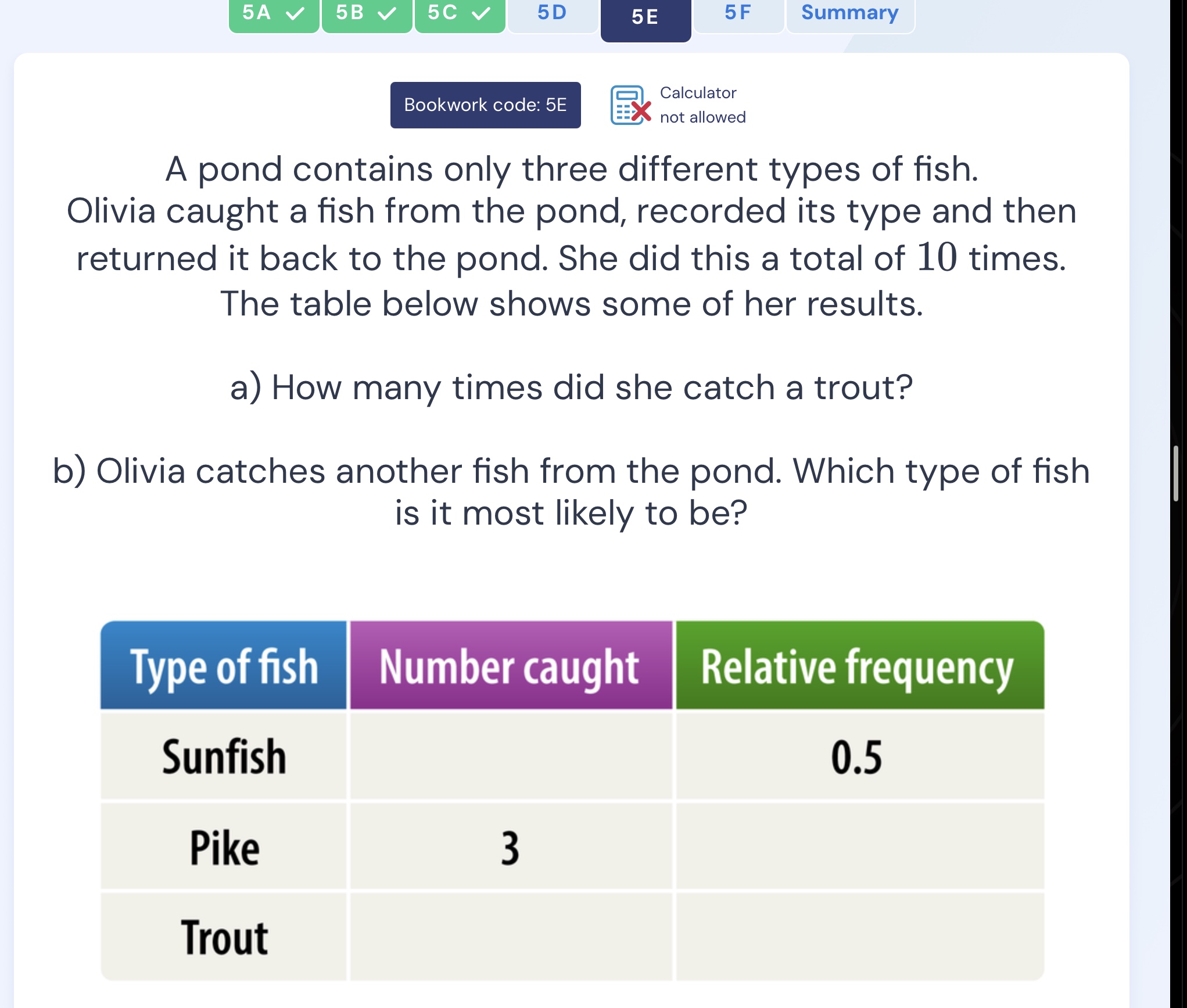
a pond contains only three different types of fish. olivia caught a fish from the pond, recorded its type and then returned it back to the pond. she did this a total of 10 times. the table below shows some of her results.
a) how many times did she catch a trout?
b) olivia catches another fish from the pond. which type of fish is it most likely to be?
| type of fish | number caught | relative frequency |
|---|---|---|
| pike | 3 | |
| trout |
🆕 New Concept Discovered: Relative Frequency and Probability
Using experimental data to estimate likelihoods
Step 1: Find the number of Sunfish caught
The relative frequency of Sunfish is \( 0.5 \). Relative frequency represents the proportion of the total trials in which an event occurs:
Given the total number of trials is \( 10 \):
Step 2: Calculate the number of Trout caught
The total number of fish caught is \( 10 \). The pond contains only Sunfish, Pike, and Trout.
So, Olivia caught a Trout \( 2 \) times.
Step 3: Determine the most likely type of fish
To find which fish is most likely to be caught next, we compare the number of times each fish was caught (or their relative frequencies):
- Sunfish: \( 5 \) times (Relative frequency = \( 0.5 \))
- Pike: \( 3 \) times (Relative frequency = \( \frac{3}{10} = 0.3 \))
- Trout: \( 2 \) times (Relative frequency = \( \frac{2}{10} = 0.2 \))
Since Sunfish has the highest frequency and relative frequency, it is the most likely type of fish to be caught next.

Snap & solve any problem in the app
Get step-by-step solutions on Sovi AI
Photo-based solutions with guided steps
Explore more problems and detailed explanations
a) 2
b) Sunfish