QUESTION IMAGE
Question
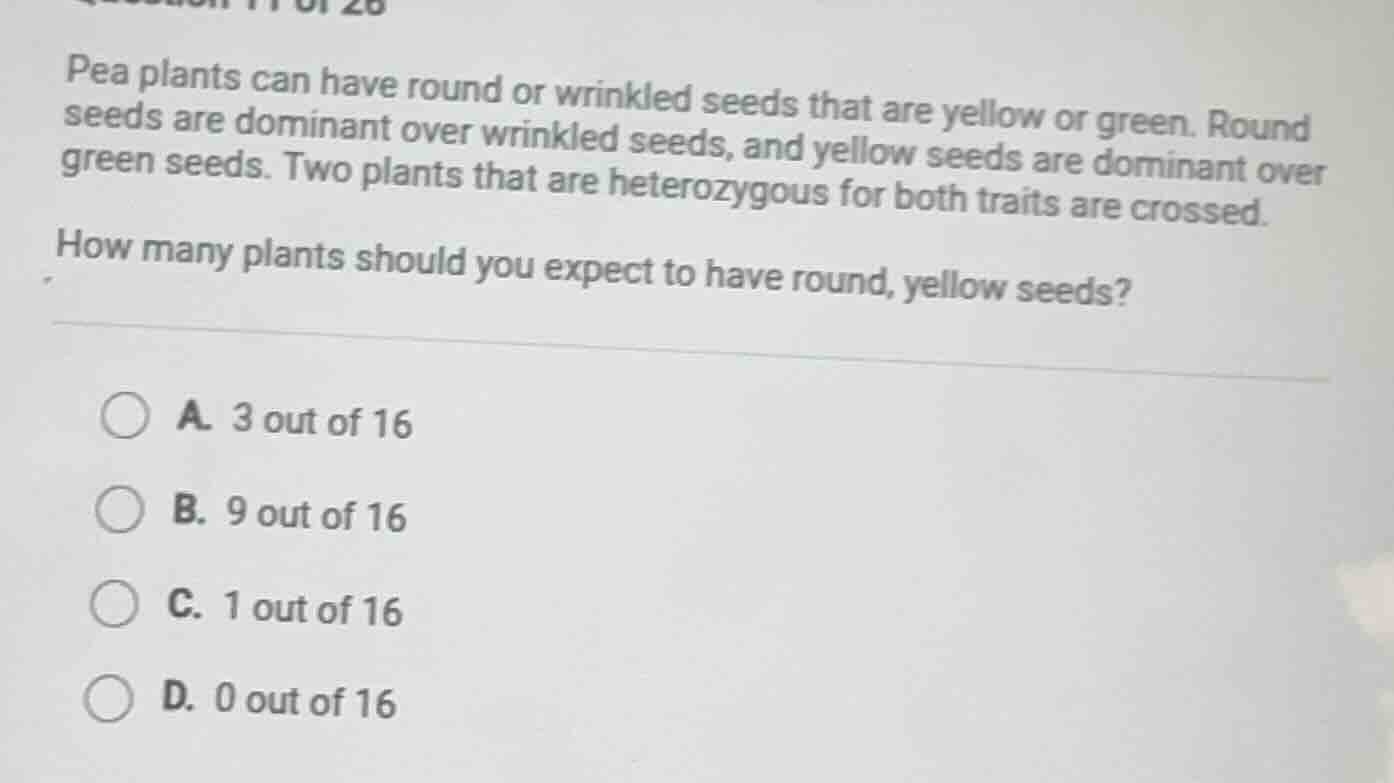
pea plants can have round or wrinkled seeds that are yellow or green. round seeds are dominant over wrinkled seeds, and yellow seeds are dominant over green seeds. two plants that are heterozygous for both traits are crossed.
how many plants should you expect to have round, yellow seeds?
a. 3 out of 16
b. 9 out of 16
c. 1 out of 16
d. 0 out of 16
<pre_analysis>
{
"quality": "clear",
"question_count": 1,
"skills_matched": [
"step_cot",
"multiple_choice_formatter",
"explain_then_answer",
"quick"
],
"needs_drawing": false,
"concepts_used": [
"Mendelian Genetics",
"Dominance"
],
"new_concepts": [
"Dihybrid Cross"
],
"current_concepts": [
"Mendelian Genetics",
"Dominance",
"Dihybrid Cross"
]
}
</pre_analysis>
<reasoning>
Define alleles and parental genotypes
Let \(R\) represent the dominant allele for round seeds, and \(r\) represent the recessive allele for wrinkled seeds.
Let \(Y\) represent the dominant allele for yellow seeds, and \(y\) represent the recessive allele for green seeds.
Both parent plants are heterozygous for both traits: \(RrYy \times RrYy\).
Determine the probability of each dominant phenotype
For seed shape:
\[
P(\text{Round}) = P(R\_) = \frac{3}{4}
\]
For seed color:
\[
P(\text{Yellow}) = P(Y\_) = \frac{3}{4}
\]
Calculate the combined probability of round, yellow seeds
Using the law of independent assortment:
\[
P(\text{Round and Yellow}) = P(R\_) \times P(Y\_) = \frac{3}{4} \times \frac{3}{4} = \frac{9}{16}
\]
This corresponds to 9 out of 16 plants.
</reasoning>
<answer>
<mcq-option>A. 3 out of 16</mcq-option>
<mcq-correct>B. 9 out of 16</mcq-correct>
<mcq-option>C. 1 out of 16</mcq-option>
<mcq-option>D. 0 out of 16</mcq-option>
</answer>
<post_analysis>
{
"subject": "Natural Science",
"question_type": "Multiple Choice",
"knowledge_point": [
"Natural Science",
"Biology",
"Dihybrid Cross"
]
}
</post_analysis>
Snap & solve any problem in the app
Get step-by-step solutions on Sovi AI
Photo-based solutions with guided steps
Explore more problems and detailed explanations
<pre_analysis>
{
"quality": "clear",
"question_count": 1,
"skills_matched": [
"step_cot",
"multiple_choice_formatter",
"explain_then_answer",
"quick"
],
"needs_drawing": false,
"concepts_used": [
"Mendelian Genetics",
"Dominance"
],
"new_concepts": [
"Dihybrid Cross"
],
"current_concepts": [
"Mendelian Genetics",
"Dominance",
"Dihybrid Cross"
]
}
</pre_analysis>
<reasoning>
Define alleles and parental genotypes
Let \(R\) represent the dominant allele for round seeds, and \(r\) represent the recessive allele for wrinkled seeds.
Let \(Y\) represent the dominant allele for yellow seeds, and \(y\) represent the recessive allele for green seeds.
Both parent plants are heterozygous for both traits: \(RrYy \times RrYy\).
Determine the probability of each dominant phenotype
For seed shape:
\[
P(\text{Round}) = P(R\_) = \frac{3}{4}
\]
For seed color:
\[
P(\text{Yellow}) = P(Y\_) = \frac{3}{4}
\]
Calculate the combined probability of round, yellow seeds
Using the law of independent assortment:
\[
P(\text{Round and Yellow}) = P(R\_) \times P(Y\_) = \frac{3}{4} \times \frac{3}{4} = \frac{9}{16}
\]
This corresponds to 9 out of 16 plants.
</reasoning>
<answer>
<mcq-option>A. 3 out of 16</mcq-option>
<mcq-correct>B. 9 out of 16</mcq-correct>
<mcq-option>C. 1 out of 16</mcq-option>
<mcq-option>D. 0 out of 16</mcq-option>
</answer>
<post_analysis>
{
"subject": "Natural Science",
"question_type": "Multiple Choice",
"knowledge_point": [
"Natural Science",
"Biology",
"Dihybrid Cross"
]
}
</post_analysis>