QUESTION IMAGE
Question
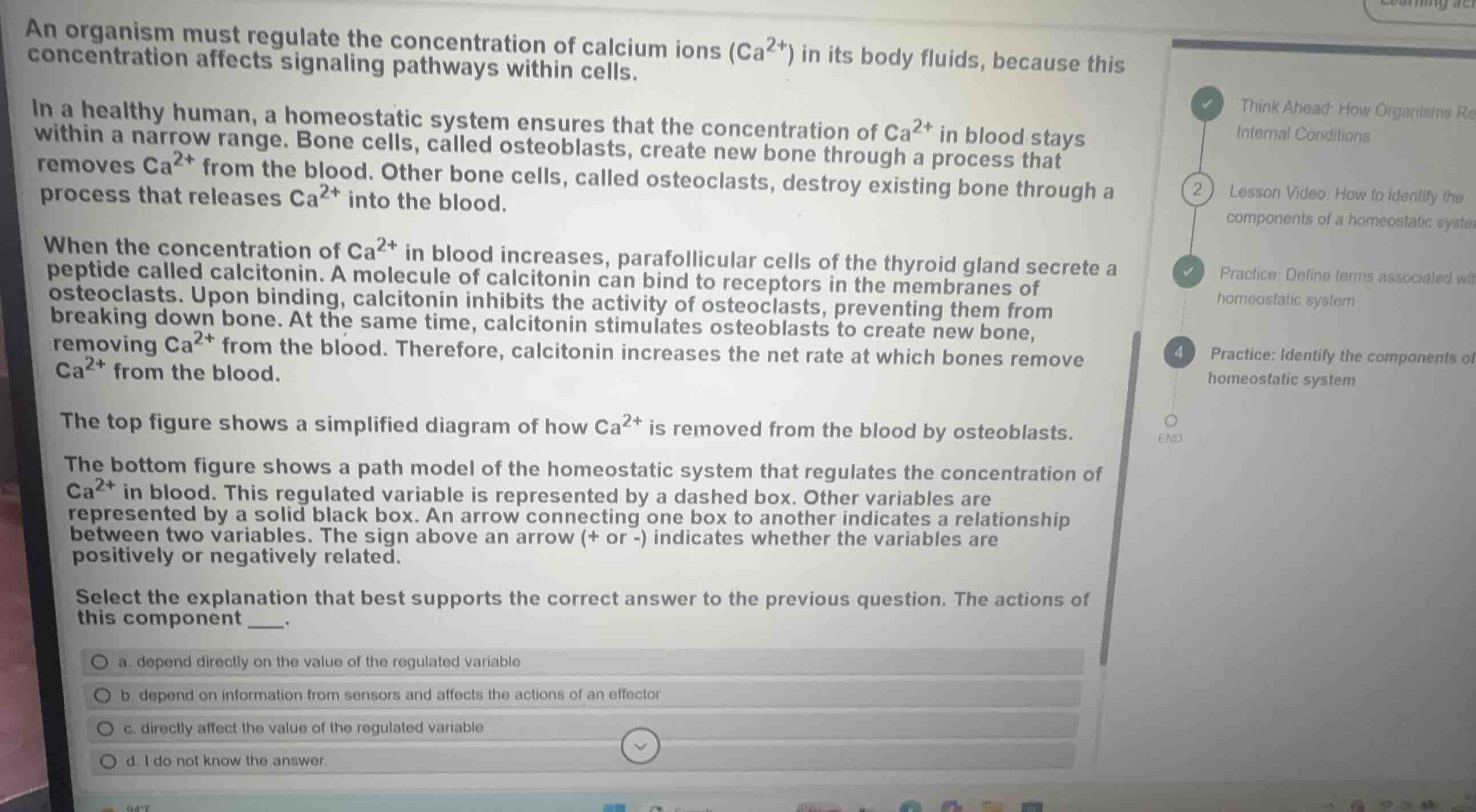
an organism must regulate the concentration of calcium ions (\\(\text{ca}^{2+}\\)) in its body fluids, because this concentration affects signaling pathways within cells.
in a healthy human, a homeostatic system ensures that the concentration of \\(\text{ca}^{2+}\\) in blood stays within a narrow range. bone cells, called osteoblasts, create new bone through a process that removes \\(\text{ca}^{2+}\\) from the blood. other bone cells, called osteoclasts, destroy existing bone through a process that releases \\(\text{ca}^{2+}\\) into the blood.
when the concentration of \\(\text{ca}^{2+}\\) in blood increases, parafollicular cells of the thyroid gland secrete a peptide called calcitonin. a molecule of calcitonin can bind to receptors in the membranes of osteoclasts. upon binding, calcitonin inhibits the activity of osteoclasts, preventing them from breaking down bone. at the same time, calcitonin stimulates osteoblasts to create new bone, removing \\(\text{ca}^{2+}\\) from the blood. therefore, calcitonin increases the net rate at which bones remove \\(\text{ca}^{2+}\\) from the blood.
the top figure shows a simplified diagram of how \\(\text{ca}^{2+}\\) is removed from the blood by osteoblasts.
the bottom figure shows a path model of the homeostatic system that regulates the concentration of \\(\text{ca}^{2+}\\) in blood. this regulated variable is represented by a dashed box. other variables are represented by a solid black box. an arrow connecting one box to another indicates a relationship between two variables. the sign above an arrow (+ or -) indicates whether the variables are positively or negatively related.
select the explanation that best supports the correct answer to the previous question. the actions of this component \\(\underline{\quad\quad}\\).
a. depend directly on the value of the regulated variable
b. depend on information from sensors and affects the actions of an effector
c. directly affect the value of the regulated variable
d. i do not know the answer.
Identify the component from the context
The question asks for the explanation that best supports the correct answer to the previous question regarding the actions of "this component". Based on the context of a Homeostatic Control Loop, the system regulates blood \(Ca^{2+}\) levels. The parafollicular cells of the thyroid gland detect the increase in \(Ca^{2+}\) and secrete calcitonin, which then acts on osteoclasts and osteoblasts (the effectors). In this homeostatic pathway, the thyroid gland acts as an Integrator Component (or control center) that receives information from sensors and coordinates the response of the effectors.
Analyze the functional role of an integrator
An integrator in a Homeostatic Control Loop processes incoming signals from sensors (which detect the regulated variable) and sends out instructions to effectors to adjust their activity. Therefore, the actions of an integrator depend on information from sensors and affect the actions of an effector.
Evaluate the given options
- Option (a) states "depend directly on the value of the regulated variable", which describes the sensor's direct relationship.
- Option (b) states "depend on information from sensors and affects the actions of an effector", which perfectly describes the role of the integrator/control center.
- Option (c) states "directly affect the value of the regulated variable", which describes the direct action of the effector.
- Option (d) is a non-answer choice.
Thus, option (b) is the correct explanation supporting the role of the integrator component.

Snap & solve any problem in the app
Get step-by-step solutions on Sovi AI
Photo-based solutions with guided steps
Explore more problems and detailed explanations
- a. depend directly on the value of the regulated variable
- b. depend on information from sensors and affects the actions of an effector (Correct answer)
- c. directly affect the value of the regulated variable
- d. I do not know the answer.