QUESTION IMAGE
Question
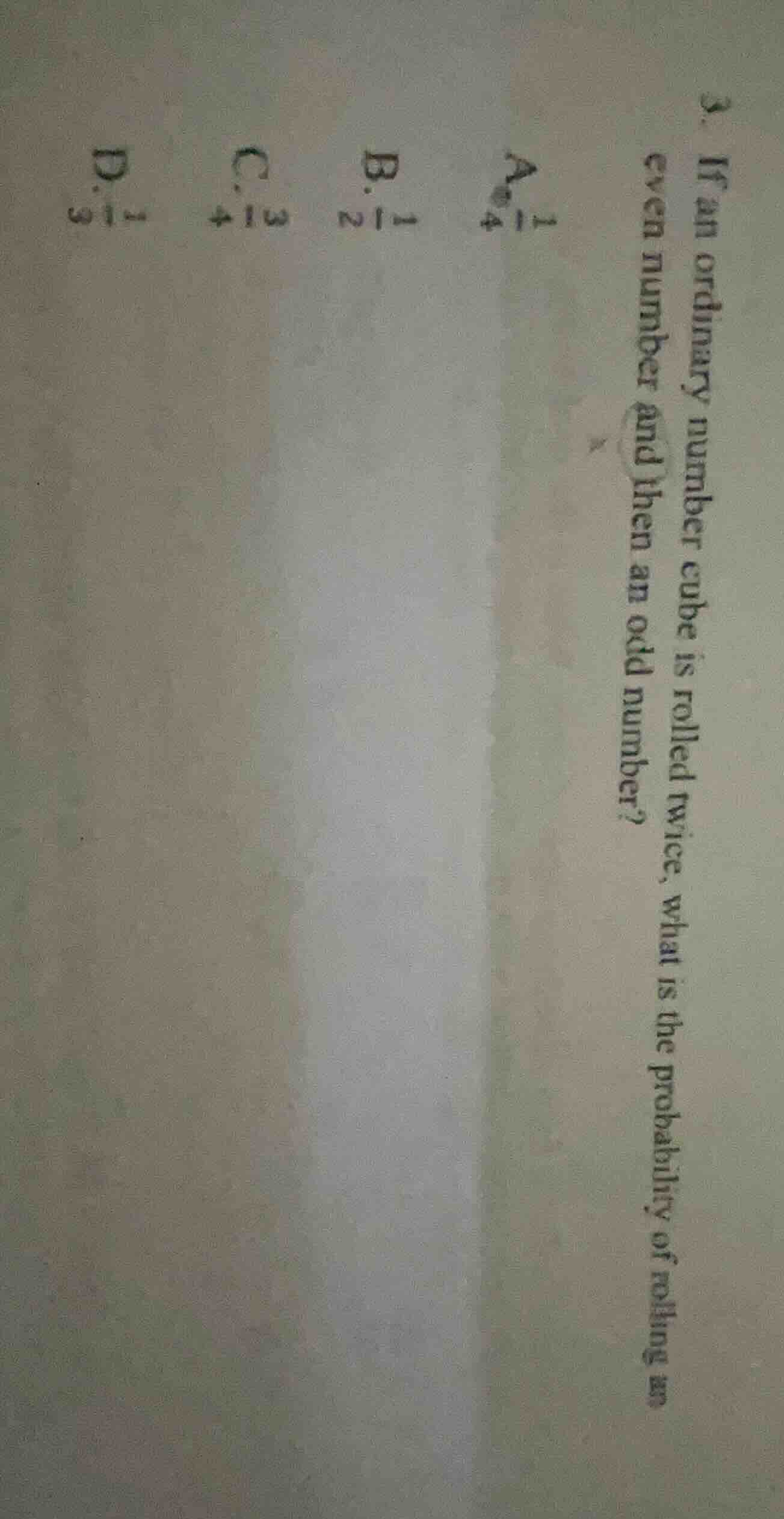
- if an ordinary number cube is rolled twice, what is the probability of rolling an even number and then an odd number?
a. \\(\frac{1}{4}\\)
b. \\(\frac{1}{2}\\)
c. \\(\frac{3}{4}\\)
d. \\(\frac{1}{3}\\)
🆕 New Concept Discovered: Probability of Independent Events
Multiplying individual probabilities for consecutive events.
Step 1: Probability of rolling an even number
An ordinary number cube has 6 sides: \( \{1, 2, 3, 4, 5, 6\} \).
The even numbers are \( \{2, 4, 6\} \) (3 outcomes).
$$ P(\text{Even}) = \frac{3}{6} = \frac{1}{2} $$
Step 2: Probability of rolling an odd number
The odd numbers are \( \{1, 3, 5\} \) (3 outcomes).
$$ P(\text{Odd}) = \frac{3}{6} = \frac{1}{2} $$
Step 3: Combined probability of both events
Since the two rolls are independent, multiply their individual probabilities:
$$ P(\text{Even and then Odd}) = P(\text{Even}) \times P(\text{Odd}) $$
$$ P(\text{Even and then Odd}) = \frac{1}{2} \times \frac{1}{2} = \frac{1}{4} $$

Snap & solve any problem in the app
Get step-by-step solutions on Sovi AI
Photo-based solutions with guided steps
Explore more problems and detailed explanations
A. \(\frac{1}{4}\)