QUESTION IMAGE
Question
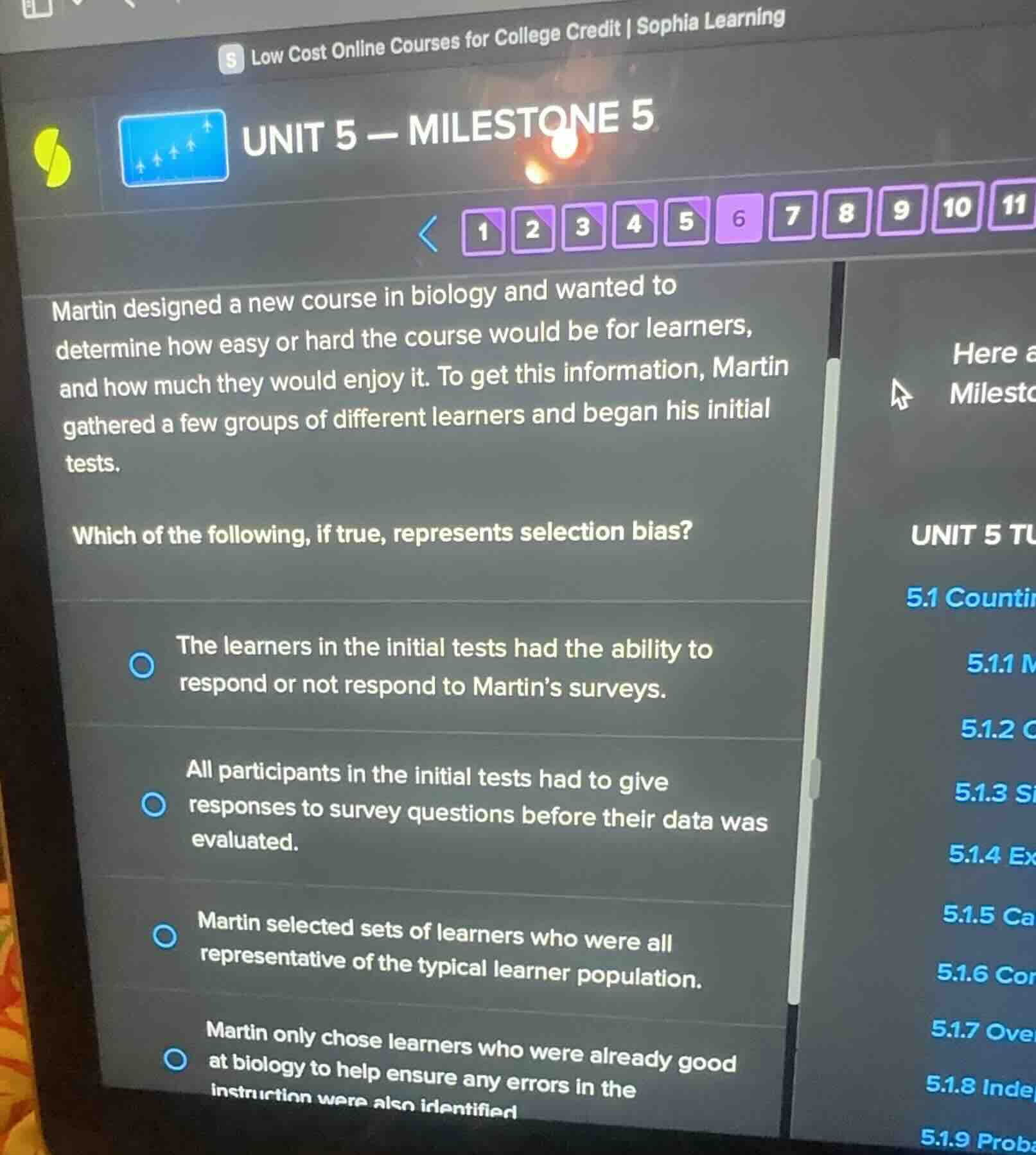
martin designed a new course in biology and wanted to determine how easy or hard the course would be for learners, and how much they would enjoy it. to get this information, martin gathered a few groups of different learners and began his initial tests.
which of the following, if true, represents selection bias?
- the learners in the initial tests had the ability to respond or not respond to martins surveys.
- all participants in the initial tests had to give responses to survey questions before their data was evaluated.
- martin selected sets of learners who were all representative of the typical learner population.
- martin only chose learners who were already good at biology to help ensure any errors in the instruction were also identified.
Define selection bias
In Experimental Design, selection bias occurs when the individuals selected for a study or sample are not representative of the larger target population. This systematic error happens during the selection phase, where the researcher's method of choosing participants inadvertently favors certain characteristics over others, skewing the results.
Analyze the scenario
Martin wants to evaluate a new biology course for general learners. The target population is all potential learners. To avoid selection bias, his sample should represent a broad range of typical learners with varying backgrounds and academic abilities.
Evaluate the options
- Option 1: "The learners in the initial tests had the ability to respond or not respond to Martin's surveys." This describes Participation Bias (specifically voluntary response bias), which is a type of non-response bias rather than selection bias introduced by the researcher's selection criteria.
- Option 2: "All participants in the initial tests had to give responses to survey questions before their data was evaluated." This is a standard data collection requirement and does not describe a systematic bias in how participants were chosen.
- Option 3: "Martin selected sets of learners who were all representative of the typical learner population." This describes an ideal, unbiased sampling method, which is the opposite of selection bias.
- Option 4: "Martin only chose learners who were already good at biology to help ensure any errors in the instruction were also identified." By choosing only students who excel in biology, Martin's sample is systematically different from the general population of "learners" he intends to study. This non-representative selection directly constitutes selection bias.

Snap & solve any problem in the app
Get step-by-step solutions on Sovi AI
Photo-based solutions with guided steps
Explore more problems and detailed explanations
- (A) The learners in the initial tests had the ability to respond or not respond to Martin’s surveys.
- (B) All participants in the initial tests had to give responses to survey questions before their data was evaluated.
- (C) Martin selected sets of learners who were all representative of the typical learner population.
- (D) Martin only chose learners who were already good at biology to help ensure any errors in the instruction were also identified. (Correct answer)