QUESTION IMAGE
Question
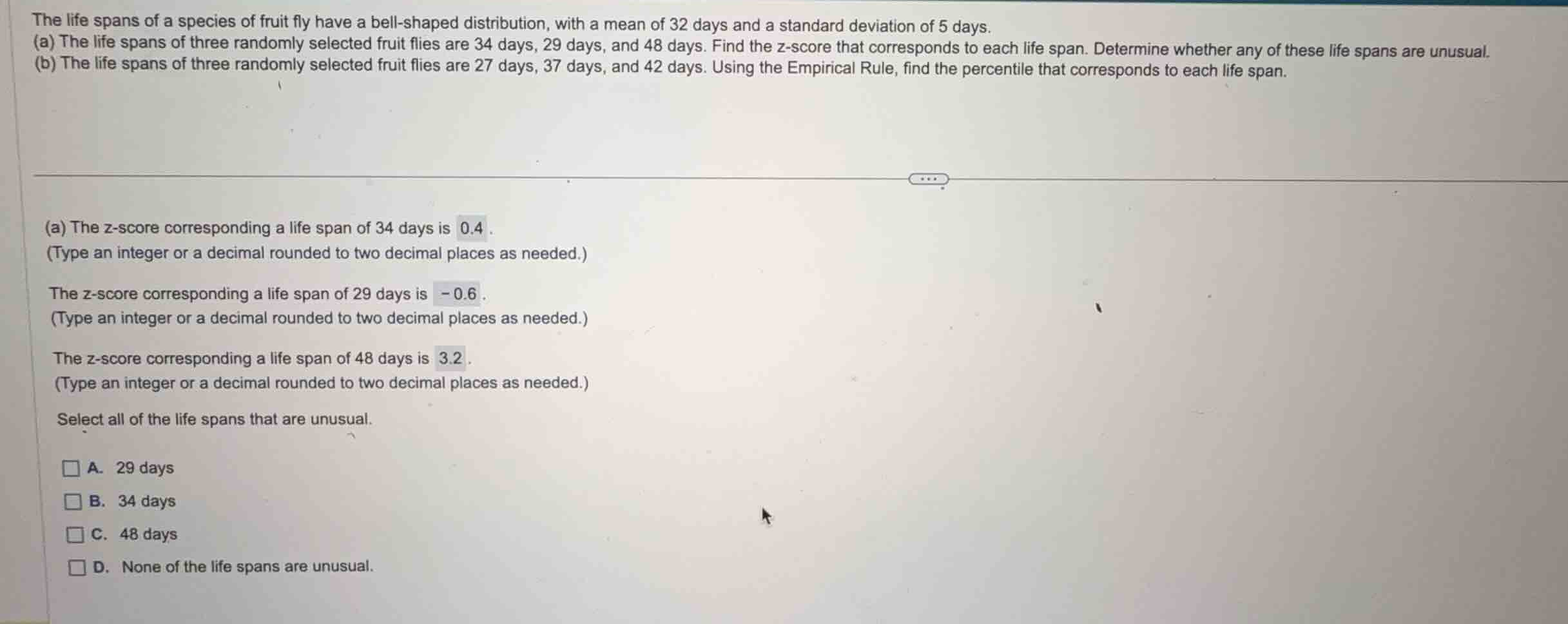
the life spans of a species of fruit fly have a bell-shaped distribution, with a mean of 32 days and a standard deviation of 5 days.
(a) the life spans of three randomly selected fruit flies are 34 days, 29 days, and 48 days. find the z-score that corresponds to each life span. determine whether any of these life spans are unusual.
(b) the life spans of three randomly selected fruit flies are 27 days, 37 days, and 42 days. using the empirical rule, find the percentile that corresponds to each life span.
(a) the z-score corresponding a life span of 34 days is 0.4.
(type an integer or a decimal rounded to two decimal places as needed.)
the z-score corresponding a life span of 29 days is -0.6.
(type an integer or a decimal rounded to two decimal places as needed.)
the z-score corresponding a life span of 48 days is 3.2.
(type an integer or a decimal rounded to two decimal places as needed.)
select all of the life spans that are unusual.
a. 29 days
b. 34 days
c. 48 days
d. none of the life spans are unusual.
Calculate the z-scores for part (a)
Using the Z-Score Calculation knowledge point
Given \(\mu = 32\) and \(\sigma = 5\):
- For \(x = 34\):
- For \(x = 29\):
- For \(x = 48\):
Identify unusual life spans
Using the Z-Score Interpretation knowledge point
- A value is considered unusual if its z-score is less than \(-2\) or greater than \(2\).
- The z-score for \(48\) days is \(3.2\), which is greater than \(2\).
- Therefore, \(48\) days is an unusual life span.
Apply the Empirical Rule for part (b)
The Empirical Rule states that for a bell-shaped distribution:
- Approximately \(68\%\) of data fall within \(1\) standard deviation of the mean (\(\mu \pm 1\sigma\), which is \([27, 37]\)).
- Approximately \(95\%\) of data fall within \(2\) standard deviations of the mean (\(\mu \pm 2\sigma\), which is \([22, 42]\)).
- Approximately \(99.7\%\) of data fall within \(3\) standard deviations of the mean (\(\mu \pm 3\sigma\), which is \([17, 47]\)).
Find the percentile for each life span in part (b)
- For \(27\) days (\(\mu - 1\sigma\)):
Since \(68\%\) of the data lie between \(27\) and \(37\) days, the remaining \(32\%\) is split equally between the two tails.
The lower tail below \(27\) days contains:
Thus, \(27\) days corresponds to the \(16\text{th}\) percentile.
- For \(37\) days (\(\mu + 1\sigma\)):
The area below \(37\) days includes everything except the upper tail above \(37\) days.
The upper tail contains \(16\%\) of the data.
Thus, \(37\) days corresponds to the \(84\text{th}\) percentile.
- For \(42\) days (\(\mu + 2\sigma\)):
Since \(95\%\) of the data lie between \(22\) and \(42\) days, the remaining \(5\%\) is split equally between the two tails.
The upper tail above \(42\) days contains:
The area below \(42\) days is:
Thus, \(42\) days corresponds to the \(97.5\text{th}\) percentile.

Snap & solve any problem in the app
Get step-by-step solutions on Sovi AI
Photo-based solutions with guided steps
Explore more problems and detailed explanations
Part (a)
- The z-score corresponding to a life span of 34 days is 0.4.
- The z-score corresponding to a life span of 29 days is -0.6.
- The z-score corresponding to a life span of 48 days is 3.2.
- The unusual life span is:
C. 48 days
Part (b)
- The percentile corresponding to a life span of 27 days is the 16th percentile.
- The percentile corresponding to a life span of 37 days is the 84th percentile.
- The percentile corresponding to a life span of 42 days is the 97.5th percentile.