QUESTION IMAGE
Question
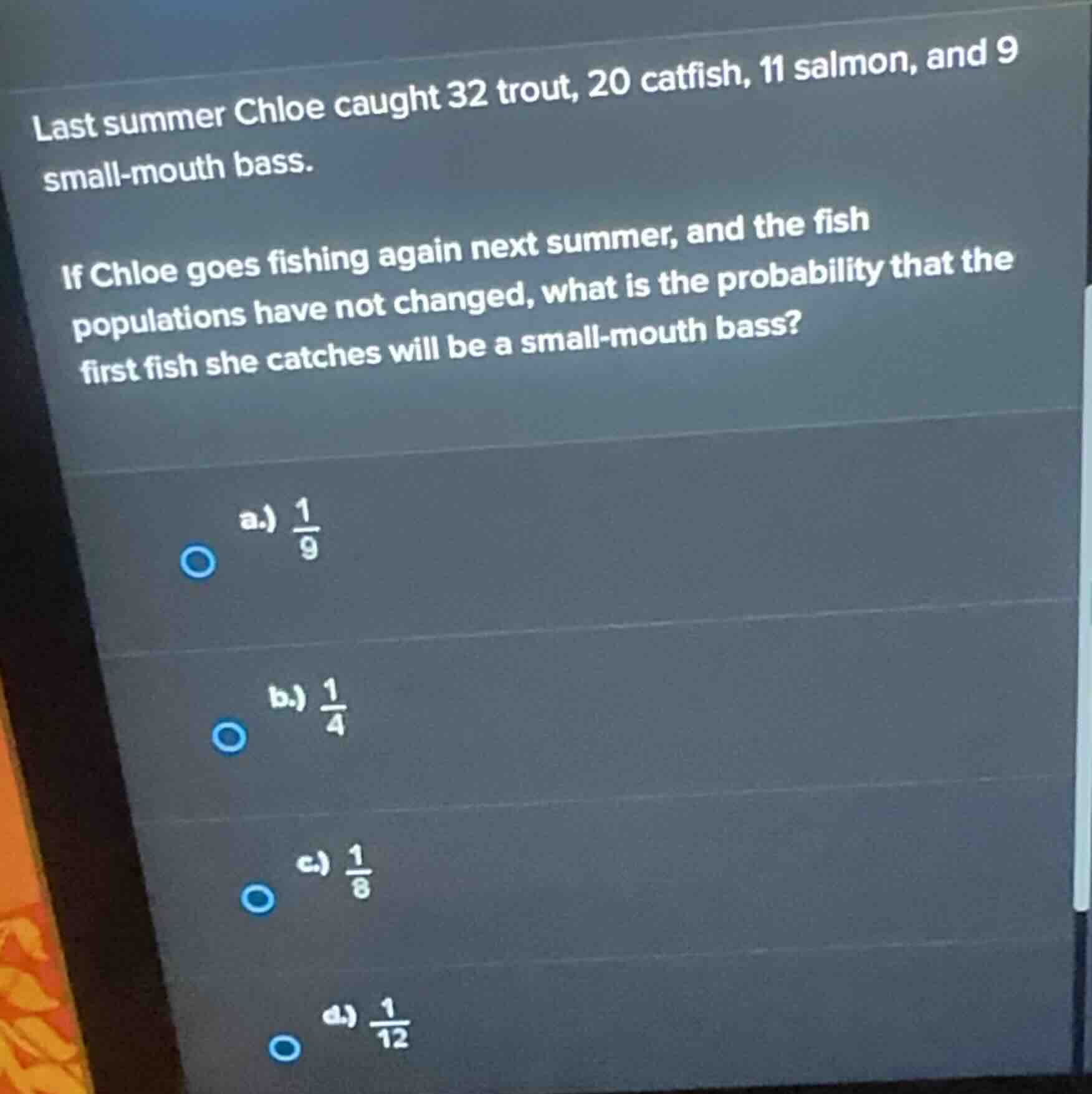
last summer chloe caught 32 trout, 20 catfish, 11 salmon, and 9 small-mouth bass.
if chloe goes fishing again next summer, and the fish populations have not changed, what is the probability that the first fish she catches will be a small-mouth bass?
a.) \\(\frac{1}{9}\\)
b.) \\(\frac{1}{4}\\)
c.) \\(\frac{1}{8}\\)
d.) \\(\frac{1}{12}\\)
Calculate the total number of fish caught
To find the total number of fish in the sample, we sum the quantities of each type of fish caught by Chloe:
Identify the number of favorable outcomes
The event of interest is catching a small-mouth bass. The number of small-mouth bass caught is:
Calculate the probability
The probability \(P\) of an event is the ratio of the number of favorable outcomes to the total number of possible outcomes:
Simplify the fraction
We simplify the fraction by dividing both the numerator and the denominator by their greatest common divisor, which is 9:

Snap & solve any problem in the app
Get step-by-step solutions on Sovi AI
Photo-based solutions with guided steps
Explore more problems and detailed explanations
- a.) \(\frac{1}{9}\)
- b.) \(\frac{1}{4}\)
- c.) \(\frac{1}{8}\) (Correct answer)
- d.) \(\frac{1}{12}\)