QUESTION IMAGE
Question
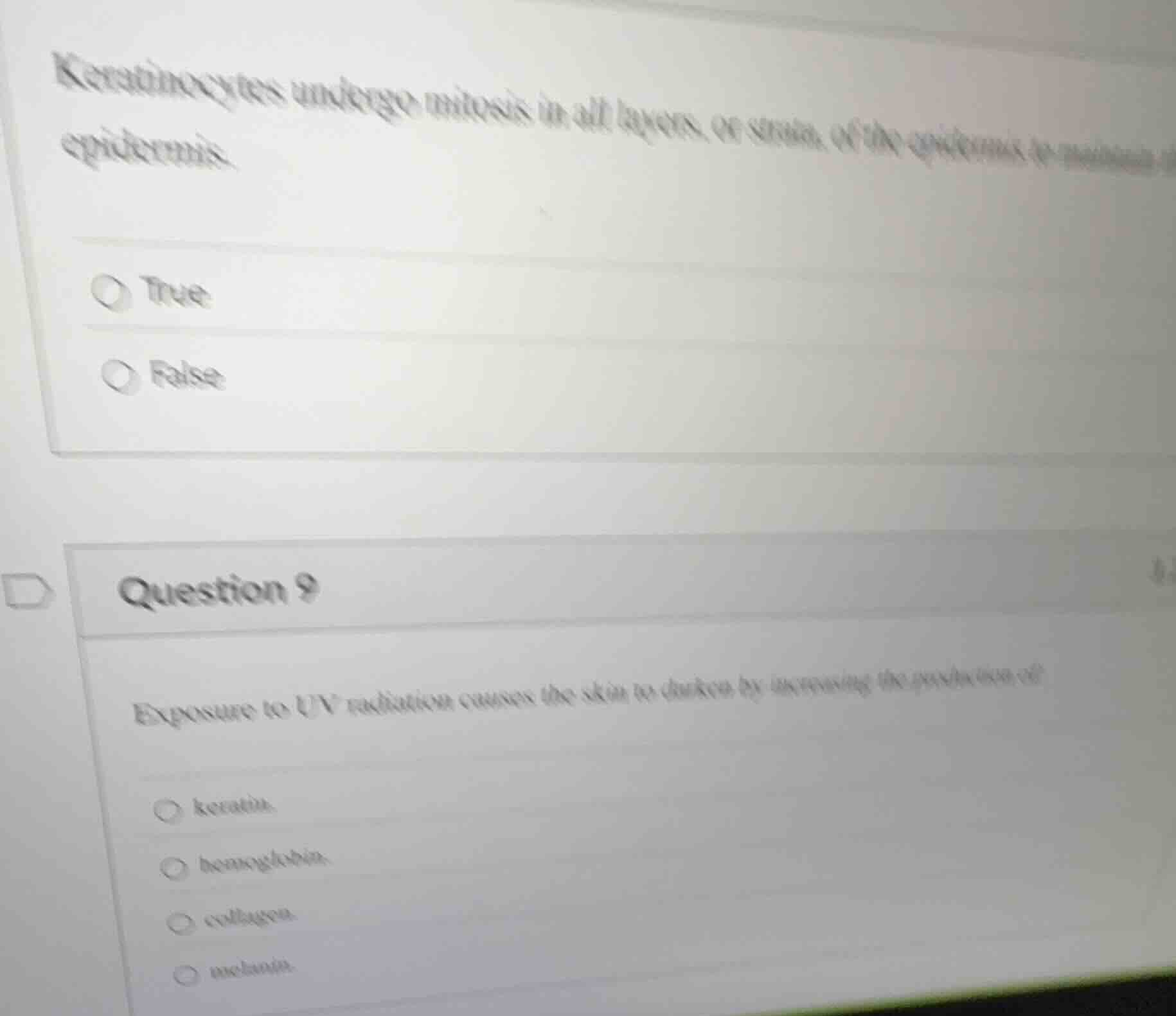
keratinocytes undergo mitosis in all layers, or strata, of the epidermis to maintain the epidermis.
true
false
question 9
exposure to uv radiation causes the skin to darken by increasing the production of
keratin
hemoglobin
collagen
melanin
Analyze the first statement on keratinocyte mitosis
The first question asks whether "Keratinocytes undergo mitosis in all layers, or strata, of the epidermis to maintain the epidermis."
To evaluate this, we apply our understanding of Epidermal Layers. The epidermis is stratified into several layers: stratum basale, stratum spinosum, stratum granulosum, stratum lucidum, and stratum corneum. Mitosis does not occur in all layers. Instead, active cell division (mitosis) is almost entirely restricted to the deepest layer, the stratum basale (and to a lesser extent, the lower part of the stratum spinosum). As cells mature and migrate upward through the superficial layers, they lose their nuclei and organelles, eventually becoming dead, keratinized cells in the stratum corneum. Therefore, the statement is false.
Analyze the second question on skin darkening
The second question (labeled Question 9) asks: "Exposure to UV radiation causes the skin to darken by increasing the production of..." with options: keratin, hemoglobin, collagen, melanin.
Ultraviolet (UV) radiation stimulates melanocytes located in the stratum basale of the epidermis. These specialized cells increase their production of the pigment melanin, which is then transferred to neighboring keratinocytes to protect their DNA from UV damage. This increase in melanin pigment is what causes the skin to darken (tan). Thus, the correct option is melanin.

Snap & solve any problem in the app
Get step-by-step solutions on Sovi AI
Photo-based solutions with guided steps
Explore more problems and detailed explanations
Question 1
- True
- False (Correct answer)
Question 2
- keratin
- hemoglobin
- collagen
- melanin (Correct answer)