QUESTION IMAGE
Question
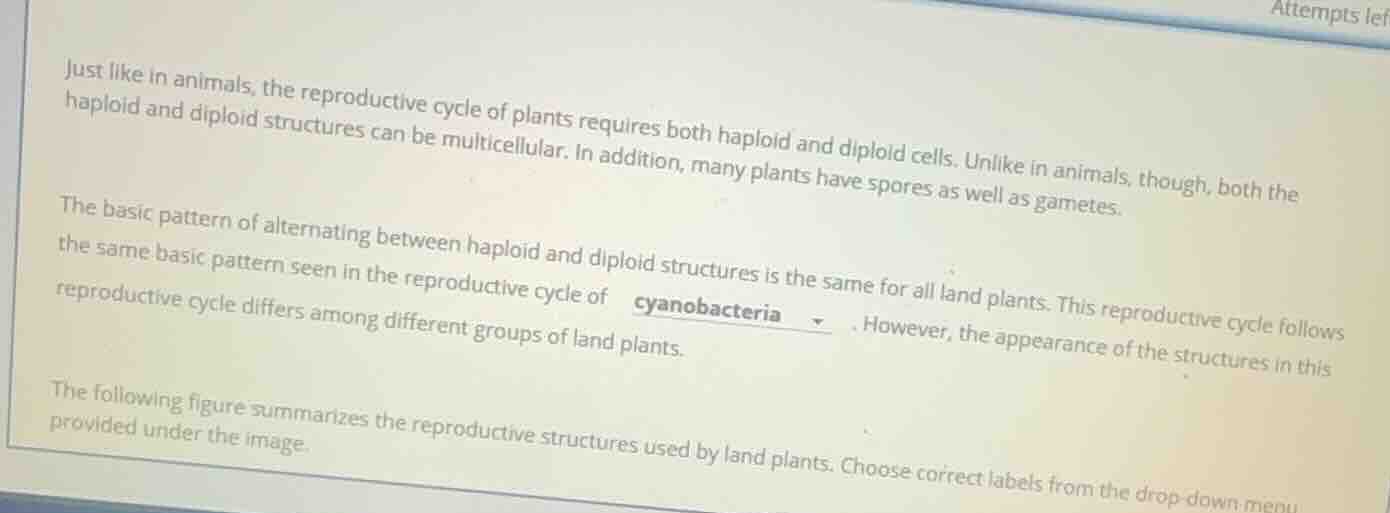
just like in animals, the reproductive cycle of plants requires both haploid and diploid cells. unlike in animals, though, both the haploid and diploid structures can be multicellular. in addition, many plants have spores as well as gametes.
the basic pattern of alternating between haploid and diploid structures is the same for all land plants. this reproductive cycle follows the same basic pattern seen in the reproductive cycle of cyanobacteria. however, the appearance of the structures in this reproductive cycle differs among different groups of land plants.
the following figure summarizes the reproductive structures used by land plants. choose correct labels from the drop-down menu provided under the image.
Identify the core biological process
Using the Alternation of Generations and Plant Life Cycles knowledge points, we analyze the reproductive cycle of land plants. This cycle is characterized by alternating multicellular haploid and diploid generations.
Analyze the comparison organism
The text states: "The basic pattern of alternating between haploid and diploid structures is the same for all land plants. This reproductive cycle follows the same basic pattern seen in the reproductive cycle of [dropdown]."
Among photosynthetic organisms, land plants evolved from ancestral green algae. The specific group of green algae most closely related to land plants, sharing similar life cycle characteristics and evolutionary ancestry, is the charophytes (or green algae). Therefore, the dropdown option must refer to "charophytes" or "green algae" rather than prokaryotic "cyanobacteria".

Snap & solve any problem in the app
Get step-by-step solutions on Sovi AI
Photo-based solutions with guided steps
Explore more problems and detailed explanations
The basic pattern of alternating between haploid and diploid structures is the same for all land plants. This reproductive cycle follows the same basic pattern seen in the reproductive cycle of <blank>charophytes</blank>. However, the appearance of the structures in this reproductive cycle differs among different groups of land plants.