QUESTION IMAGE
Question
identify the sample space of the probability experiment and determine the number of outcomes in the sample space.
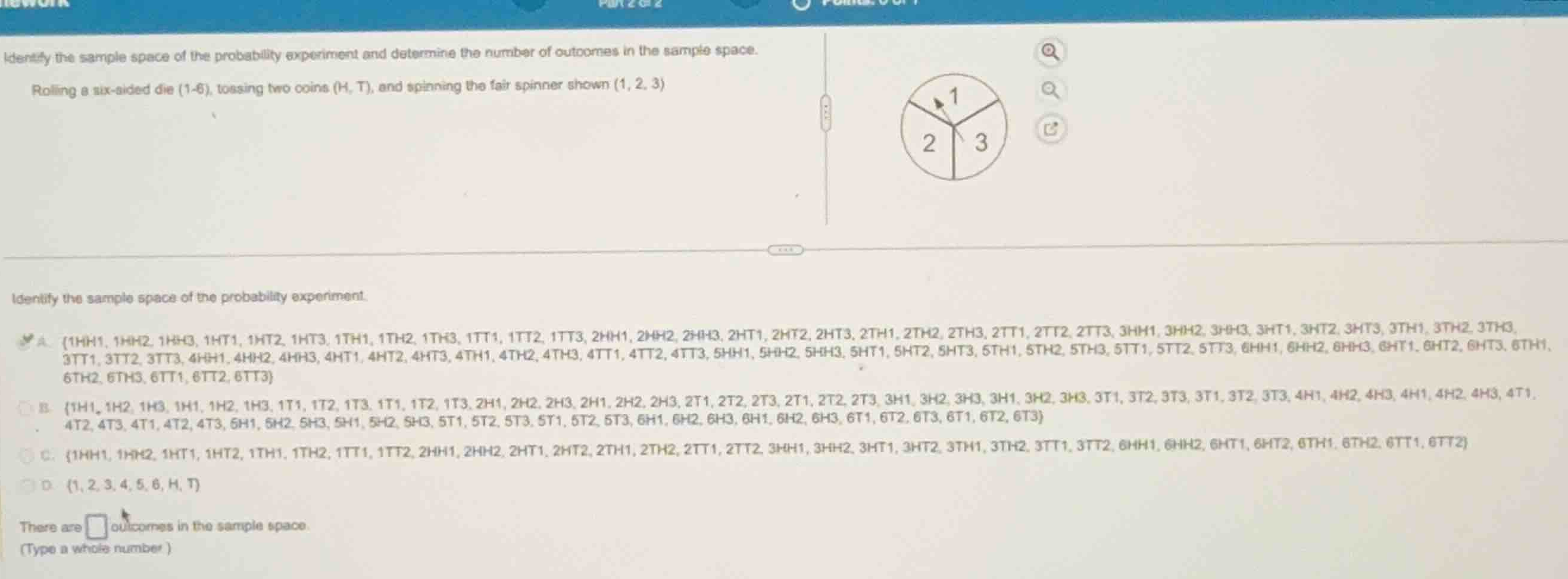
rolling a six-sided die (1-6), tossing two coins (h, t), and spinning the fair spinner shown (1, 2, 3)
identify the sample space of the probability experiment.
a. {1hh1, 1hh2, 1hh3, 1ht1, 1ht2, 1ht3, 1th1, 1th2, 1th3, 1tt1, 1tt2, 1tt3, 2hh1, 2hh2, 2hh3, 2ht1, 2ht2, 2ht3, 2th1, 2th2, 2th3, 2tt1, 2tt2, 2tt3, 3hh1, 3hh2, 3hh3, 3ht1, 3ht2, 3ht3, 3th1, 3th2, 3th3, 3tt1, 3tt2, 3tt3, 4hh1, 4hh2, 4hh3, 4ht1, 4ht2, 4ht3, 4th1, 4th2, 4th3, 4tt1, 4tt2, 4tt3, 5hh1, 5hh2, 5hh3, 5ht1, 5ht2, 5ht3, 5th1, 5th2, 5th3, 5tt1, 5tt2, 5tt3, 6hh1, 6hh2, 6hh3, 6ht1, 6ht2, 6ht3, 6th1, 6th2, 6th3, 6tt1, 6tt2, 6tt3}
b. {1h1, 1h2, 1h3, 1h1, 1h2, 1h3, 1t1, 1t2, 1t3, 1t1, 1t2, 1t3, 2h1, 2h2, 2h3, 2h1, 2h2, 2h3, 2t1, 2t2, 2t3, 2t1, 2t2, 2t3, 3h1, 3h2, 3h3, 3h1, 3h2, 3h3, 3t1, 3t2, 3t3, 3t1, 3t2, 3t3, 4h1, 4h2, 4h3, 4h1, 4h2, 4h3, 4t1, 4t2, 4t3, 4t1, 4t2, 4t3, 5h1, 5h2, 5h3, 5h1, 5h2, 5h3, 5t1, 5t2, 5t3, 5t1, 5t2, 5t3, 6h1, 6h2, 6h3, 6h1, 6h2, 6h3, 6t1, 6t2, 6t3, 6t1, 6t2, 6t3}
c. {1hh1, 1hh2, 1ht1, 1ht2, 1th1, 1th2, 1tt1, 1tt2, 2hh1, 2hh2, 2ht1, 2ht2, 2th1, 2th2, 2tt1, 2tt2, 3hh1, 3hh2, 3ht1, 3ht2, 3th1, 3th2, 3tt1, 3tt2, 6hh1, 6hh2, 6ht1, 6ht2, 6th1, 6th2, 6tt1, 6tt2}
d. {1, 2, 3, 4, 5, 6, h, t}
there are outcomes in the sample space.
(type a whole number)
Analyze the components of the experiment
Using the Sample Space Construction knowledge point, we identify the three independent stages of the probability experiment:
- Rolling a six-sided die: \(D = \{1, 2, 3, 4, 5, 6\}\) with \(n(D) = 6\) outcomes.
- Tossing two coins: \(C = \{HH, HT, TH, TT\}\) with \(n(C) = 4\) outcomes.
- Spinning a fair spinner: \(S = \{1, 2, 3\}\) with \(n(S) = 3\) outcomes.
Determine the total number of outcomes
Using the Sample Space Outcomes knowledge point, we calculate the total number of outcomes in the sample space by applying the Fundamental Counting Principle:
Identify the correct sample space representation
Using the Sample Space Construction knowledge point, each outcome is represented as a combination of the die roll, the two coin tosses, and the spinner result (e.g., \(1HH1\)).
- Option A lists all combinations of the form \((d, c_1, c_2, s)\) where \(d \in \{1..6\}\), \(c_1c_2 \in \{HH, HT, TH, TT\}\), and \(s \in \{1..3\}\).
- Counting the elements in Option A confirms it contains exactly \(6 \times 4 \times 3 = 72\) unique outcomes.

Snap & solve any problem in the app
Get step-by-step solutions on Sovi AI
Photo-based solutions with guided steps
Explore more problems and detailed explanations
Question 1
- (A) {1HH1, 1HH2, 1HH3, 1HT1, 1HT2, 1HT3, 1TH1, 1TH2, 1TH3, 1TT1, 1TT2, 1TT3, 2HH1, 2HH2, 2HH3, 2HT1, 2HT2, 2HT3, 2TH1, 2TH2, 2TH3, 2TT1, 2TT2, 2TT3, 3HH1, 3HH2, 3HH3, 3HT1, 3HT2, 3HT3, 3TH1, 3TH2, 3TH3, 3TT1, 3TT2, 3TT3, 4HH1, 4HH2, 4HH3, 4HT1, 4HT2, 4HT3, 4TH1, 4TH2, 4TH3, 4TT1, 4TT2, 4TT3, 5HH1, 5HH2, 5HH3, 5HT1, 5HT2, 5HT3, 5TH1, 5TH2, 5TH3, 5TT1, 5TT2, 5TT3, 6HH1, 6HH2, 6HH3, 6HT1, 6HT2, 6HT3, 6TH1, 6TH2, 6TH3, 6TT1, 6TT2, 6TT3} (Correct answer)
- (B) {1H1, 1H2, 1H3, 1H1, 1H2, 1H3, 1T1, 1T2, 1T3, 1T1, 1T2, 1T3, 2H1, 2H2, 2H3, 2H1, 2H2, 2H3, 2T1, 2T2, 2T3, 2T1, 2T2, 2T3, 3H1, 3H2, 3H3, 3H1, 3H2, 3H3, 3T1, 3T2, 3T3, 3T1, 3T2, 3T3, 4H1, 4H2, 4H3, 4H1, 4H2, 4H3, 4T1, 4T2, 4T3, 4T1, 4T2, 4T3, 5H1, 5H2, 5H3, 5H1, 5H2, 5H3, 5T1, 5T2, 5T3, 5T1, 5T2, 5T3, 6H1, 6H2, 6H3, 6H1, 6H2, 6H3, 6T1, 6T2, 6T3, 6T1, 6T2, 6T3}
- (C) {1HH1, 1HH2, 1HT1, 1HT2, 1TH1, 1TH2, 1TT1, 1TT2, 2HH1, 2HH2, 2HT1, 2HT2, 2TH1, 2TH2, 2TT1, 2TT2, 3HH1, 3HH2, 3HT1, 3HT2, 3TH1, 3TH2, 3TT1, 3TT2, 6HH1, 6HH2, 6HT1, 6HT2, 6TH1, 6TH2, 6TT1, 6TT2}
- (D) {1, 2, 3, 4, 5, 6, H, T}
Question 2
There are <blank>72</blank> outcomes in the sample space.