QUESTION IMAGE
Question
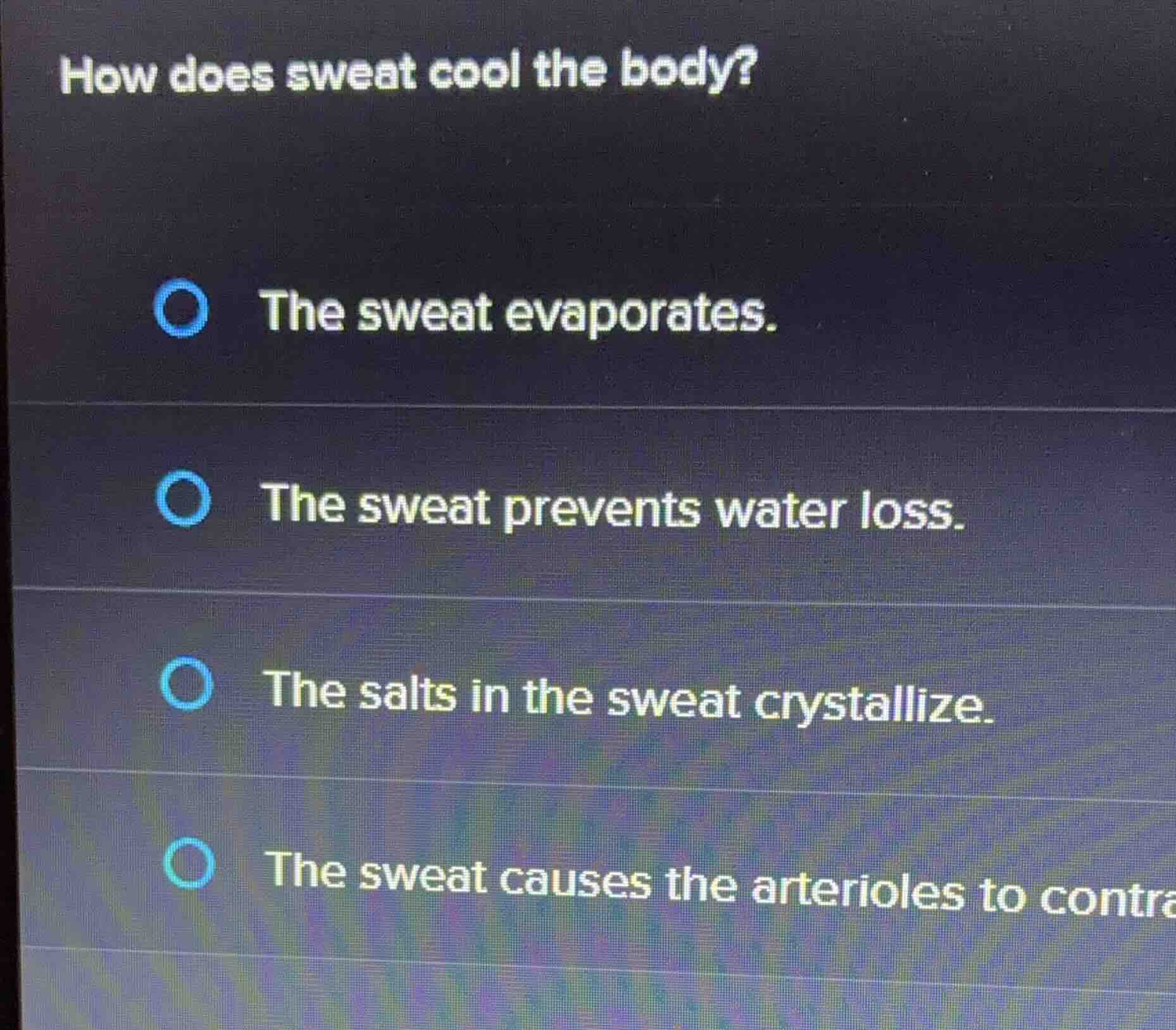
how does sweat cool the body?
- the sweat evaporates.
- the sweat prevents water loss.
- the salts in the sweat crystallize.
- the sweat causes the arterioles to contract.
Identify the mechanism of evaporative cooling
Sweat is primarily composed of water. When sweat is released onto the skin surface, it absorbs thermal energy (heat) from the body to overcome intermolecular forces and transition from a liquid to a gas.
Evaluate the given options
- The sweat evaporates: Correct. The phase change from liquid to gas absorbs heat from the skin, lowering body temperature.
- The sweat prevents water loss: Incorrect. Sweating actively releases water to the environment.
- The salts in the sweat crystallize: Incorrect. Crystallization is not a cooling mechanism.
- The sweat causes the arterioles to contract: Incorrect. Vasodilation (expansion), not contraction (vasoconstriction), of arterioles occurs during overheating to promote heat loss.

Snap & solve any problem in the app
Get step-by-step solutions on Sovi AI
Photo-based solutions with guided steps
Explore more problems and detailed explanations
- The sweat evaporates. (Correct answer)
- The sweat prevents water loss.
- The salts in the sweat crystallize.
- The sweat causes the arterioles to contract.