QUESTION IMAGE
Question
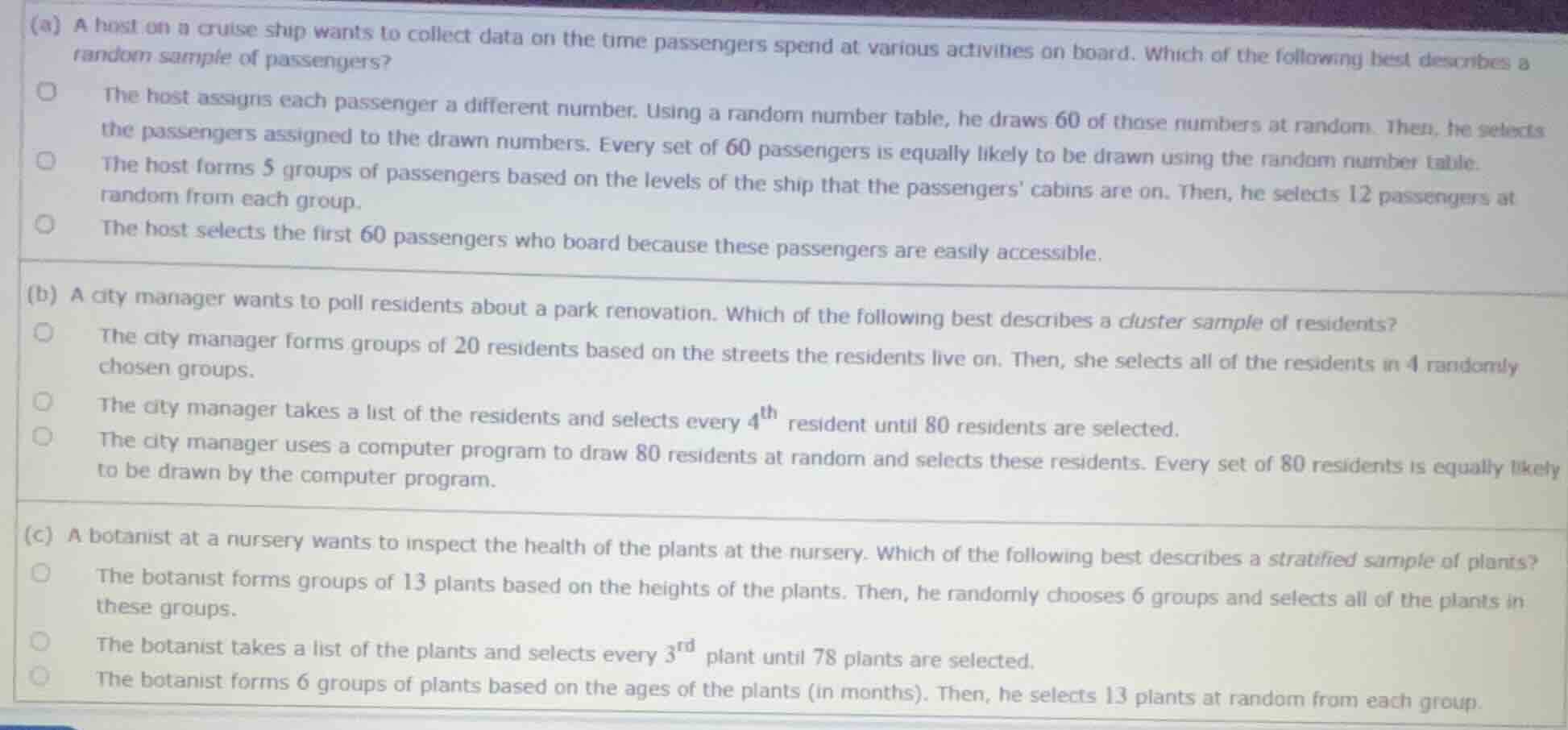
(a) a host on a cruise ship wants to collect data on the time passengers spend at various activities on board. which of the following best describes a random sample of passengers?
- the host assigns each passenger a different number. using a random number table, he draws 60 of those numbers at random. then, he selects the passengers assigned to the drawn numbers. every set of 60 passengers is equally likely to be drawn using the random number table.
- the host forms 5 groups of passengers based on the levels of the ship that the passengers cabins are on. then, he selects 12 passengers at random from each group.
- the host selects the first 60 passengers who board because these passengers are easily accessible.
(b) a city manager wants to poll residents about a park renovation. which of the following best describes a cluster sample of residents?
- the city manager forms groups of 20 residents based on the streets the residents live on. then, she selects all of the residents in 4 randomly chosen groups.
- the city manager takes a list of the residents and selects every \\(4^{\text{th}}\\) resident until 80 residents are selected.
- the city manager uses a computer program to draw 80 residents at random and selects these residents. every set of 80 residents is equally likely to be drawn by the computer program.
(c) a botanist at a nursery wants to inspect the health of the plants at the nursery. which of the following best describes a stratified sample of plants?
- the botanist forms groups of 13 plants based on the heights of the plants. then, he randomly chooses 6 groups and selects all of the plants in these groups.
- the botanist takes a list of the plants and selects every \\(3^{\text{rd}}\\) plant until 78 plants are selected.
- the botanist forms 6 groups of plants based on the ages of the plants (in months). then, he selects 13 plants at random from each group.
Analyze part (a) for random sampling
The question asks for a "random sample" (specifically a Simple Random Sample, or SRS) of passengers. An SRS requires that every individual has an equal chance of selection, and every possible group of size \(n\) is equally likely to be chosen.
- Option 1 describes assigning numbers and drawing 60 at random, where every set of 60 is equally likely. This is the definition of a simple random sample.
- Option 2 describes stratified sampling (grouping by cabin level, then sampling from each).
- Option 3 describes convenience sampling (first 60 who board).
Analyze part (b) for cluster sampling
The question asks for a "cluster sample" of residents. In cluster sampling, the population is divided into separate groups (clusters), a random sample of these clusters is selected, and all individuals within the chosen clusters are surveyed.
- Option 1 describes forming groups based on streets (clusters) and selecting all residents in 4 randomly chosen groups. This is cluster sampling.
- Option 2 describes systematic sampling (selecting every \(4^{\text{th}}\) resident).
- Option 3 describes simple random sampling.
Analyze part (c) for stratified sampling
The question asks for a "stratified sample" of plants. In stratified sampling, the population is divided into non-overlapping subgroups (strata) based on a characteristic, and a random sample is drawn from each subgroup.
- Option 1 describes cluster sampling (selecting all plants in randomly chosen groups).
- Option 2 describes systematic sampling (selecting every \(3^{\text{rd}}\) plant).
- Option 3 describes dividing plants into groups based on age (strata) and selecting 13 plants at random from each group. This is stratified sampling.

Snap & solve any problem in the app
Get step-by-step solutions on Sovi AI
Photo-based solutions with guided steps
Explore more problems and detailed explanations
Question (a)
- The host assigns each passenger a different number. Using a random number table, he draws 60 of those numbers at random. Then, he selects the passengers assigned to the drawn numbers. Every set of 60 passengers is equally likely to be drawn using the random number table. (Correct answer)
- The host forms 5 groups of passengers based on the levels of the ship that the passengers' cabins are on. Then, he selects 12 passengers at random from each group.
- The host selects the first 60 passengers who board because these passengers are easily accessible.
Question (b)
- The city manager forms groups of 20 residents based on the streets the residents live on. Then, she selects all of the residents in 4 randomly chosen groups. (Correct answer)
- The city manager takes a list of the residents and selects every \(4^{\text{th}}\) resident until 80 residents are selected.
- The city manager uses a computer program to draw 80 residents at random and selects these residents. Every set of 80 residents is equally likely to be drawn by the computer program.
Question (c)
- The botanist forms groups of 13 plants based on the heights of the plants. Then, he randomly chooses 6 groups and selects all of the plants in these groups.
- The botanist takes a list of the plants and selects every \(3^{\text{rd}}\) plant until 78 plants are selected.
- The botanist forms 6 groups of plants based on the ages of the plants (in months). Then, he selects 13 plants at random from each group. (Correct answer)