QUESTION IMAGE
Question
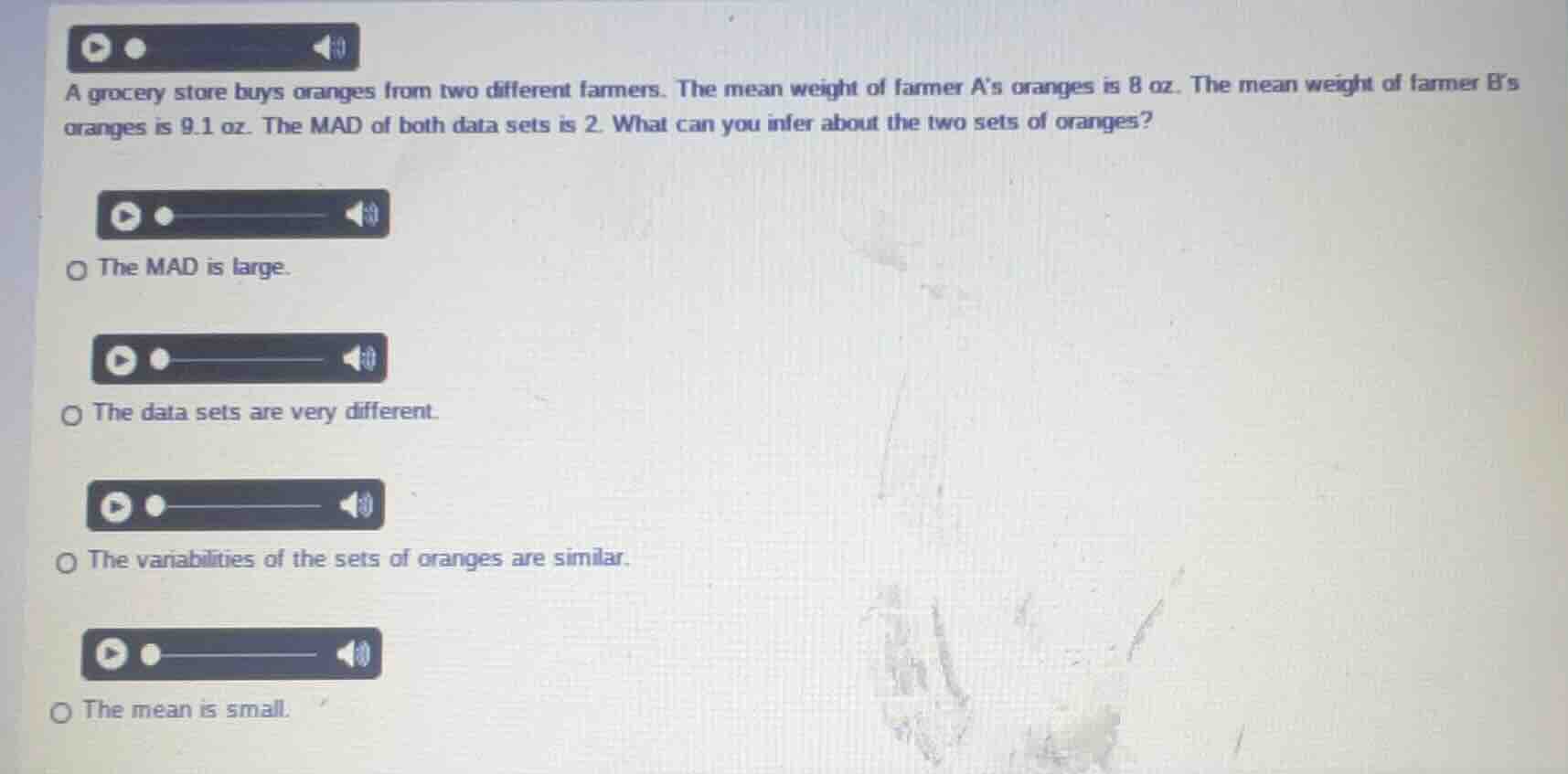
a grocery store buys oranges from two different farmers. the mean weight of farmer as oranges is 8 oz. the mean weight of farmer bs oranges is 9.1 oz. the mad of both data sets is 2. what can you infer about the two sets of oranges?
- the mad is large.
- the data sets are very different.
- the variabilities of the sets of oranges are similar.
- the mean is small.
<pre_analysis>
{
"quality": "clear",
"question_count": 1,
"skills_matched": [
"direct_cot",
"multiple_choice_formatter",
"explain_then_answer",
"quick"
],
"needs_drawing": false,
"concepts_used": [],
"new_concepts": [
"Mean Absolute Deviation",
"Data Variability"
],
"current_concepts": [
"Mean Absolute Deviation",
"Data Variability",
"Measures of Variability"
]
}
</pre_analysis>
<reasoning>
Compare the Mean Absolute Deviation (MAD) of both data sets
\[
\text{MAD of Farmer A's oranges} = 2
\]
\[
\text{MAD of Farmer B's oranges} = 2
\]
Relate MAD to variability
\[
\text{MAD} = \text{Measure of variability}
\]
\[
\text{Equal MAD values} \implies \text{Similar variabilities}
\]
Evaluate the given options
\[
\text{Option 3 matches the conclusion: "The variabilities of the sets of oranges are similar."}
\]
</reasoning>
<answer>
<mcq-option>The MAD is large.</mcq-option>
<mcq-option>The data sets are very different.</mcq-option>
<mcq-correct>The variabilities of the sets of oranges are similar.</mcq-correct>
<mcq-option>The mean is small.</mcq-option>
</answer>
<post_analysis>
{
"subject": "Mathematics",
"question_type": "Multiple Choice",
"knowledge_point": [
"Mathematics",
"Statistics",
"Mean Absolute Deviation"
]
}
</post_analysis>
Snap & solve any problem in the app
Get step-by-step solutions on Sovi AI
Photo-based solutions with guided steps
Explore more problems and detailed explanations
<pre_analysis>
{
"quality": "clear",
"question_count": 1,
"skills_matched": [
"direct_cot",
"multiple_choice_formatter",
"explain_then_answer",
"quick"
],
"needs_drawing": false,
"concepts_used": [],
"new_concepts": [
"Mean Absolute Deviation",
"Data Variability"
],
"current_concepts": [
"Mean Absolute Deviation",
"Data Variability",
"Measures of Variability"
]
}
</pre_analysis>
<reasoning>
Compare the Mean Absolute Deviation (MAD) of both data sets
\[
\text{MAD of Farmer A's oranges} = 2
\]
\[
\text{MAD of Farmer B's oranges} = 2
\]
Relate MAD to variability
\[
\text{MAD} = \text{Measure of variability}
\]
\[
\text{Equal MAD values} \implies \text{Similar variabilities}
\]
Evaluate the given options
\[
\text{Option 3 matches the conclusion: "The variabilities of the sets of oranges are similar."}
\]
</reasoning>
<answer>
<mcq-option>The MAD is large.</mcq-option>
<mcq-option>The data sets are very different.</mcq-option>
<mcq-correct>The variabilities of the sets of oranges are similar.</mcq-correct>
<mcq-option>The mean is small.</mcq-option>
</answer>
<post_analysis>
{
"subject": "Mathematics",
"question_type": "Multiple Choice",
"knowledge_point": [
"Mathematics",
"Statistics",
"Mean Absolute Deviation"
]
}
</post_analysis>