QUESTION IMAGE
Question
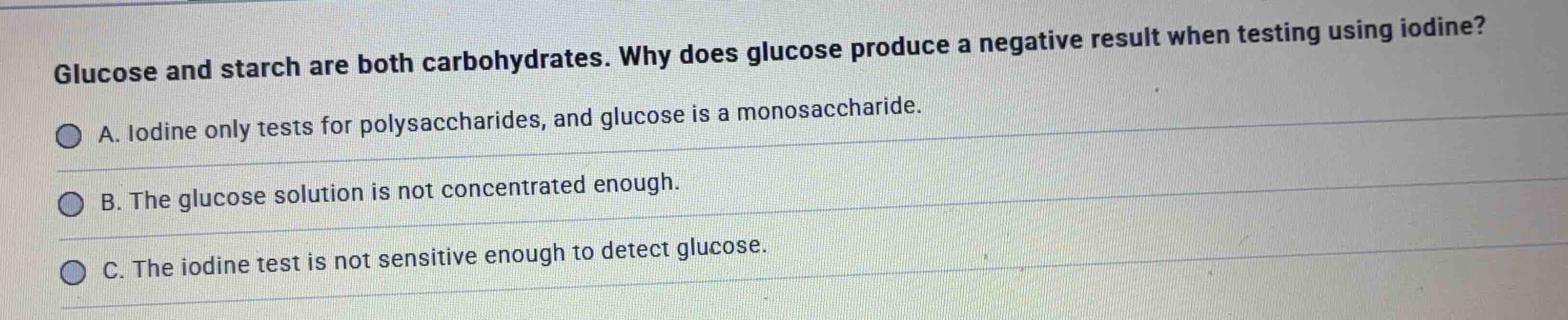
glucose and starch are both carbohydrates. why does glucose produce a negative result when testing using iodine?
a. iodine only tests for polysaccharides, and glucose is a monosaccharide.
b. the glucose solution is not concentrated enough.
c. the iodine test is not sensitive enough to detect glucose.
Understand the chemical specificity of the test
Using the Iodine Test and Starch Detection knowledge points
- Iodine reagent (\(\text{I}_3^-\) complex) specifically interacts with the helical structure of amylose (a component of starch) to produce a dark blue-black color.
- This physical entrapment of iodine inside the carbohydrate helix requires long, coiled polysaccharide chains.
Analyze the structure of glucose
- Glucose is a simple single-ring sugar, classified structurally as a monosaccharide.
- Because it lacks the long, coiled polymer chains of a polysaccharide, it cannot physically trap iodine molecules to produce a color change.
Evaluate the given options
- A: Correctly states that iodine specifically tests for complex polysaccharides (like starch), whereas glucose is a monosaccharide.
- B: Incorrect because concentration is not the issue; even highly concentrated glucose will not react with iodine.
- C: Incorrect because the test is chemically designed for starch, not a matter of sensitivity threshold for glucose.

Snap & solve any problem in the app
Get step-by-step solutions on Sovi AI
Photo-based solutions with guided steps
Explore more problems and detailed explanations
- A. Iodine only tests for polysaccharides, and glucose is a monosaccharide. (Correct answer)
- B. The glucose solution is not concentrated enough.
- C. The iodine test is not sensitive enough to detect glucose.