QUESTION IMAGE
Question
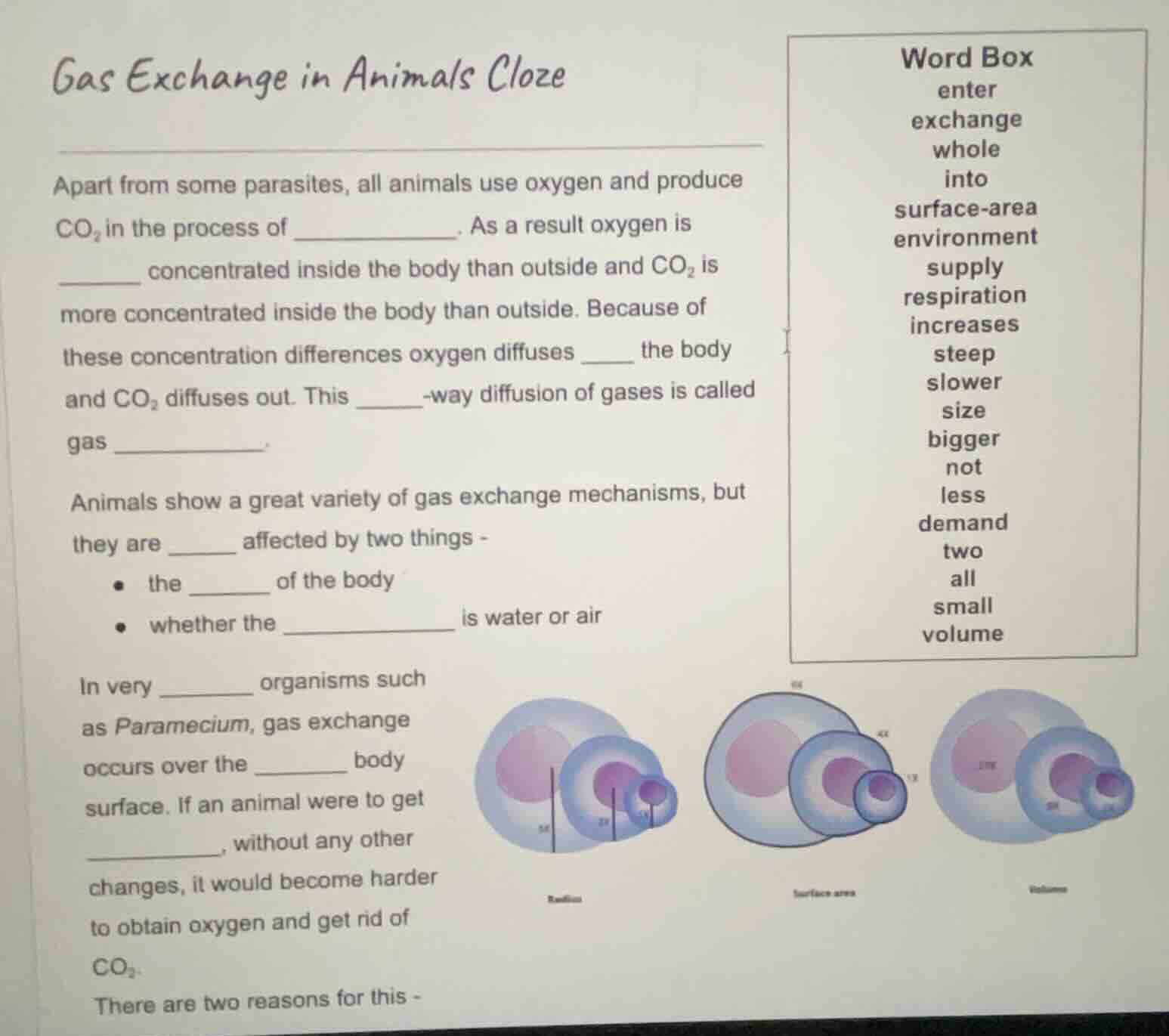
gas exchange in animals cloze
apart from some parasites, all animals use oxygen and produce \\(\text{co}_2\\) in the process of ______. as a result oxygen is ____ concentrated inside the body than outside and \\(\text{co}_2\\) is more concentrated inside the body than outside. because of these concentration differences oxygen diffuses ____ the body and \\(\text{co}_2\\) diffuses out. this ____-way diffusion of gases is called gas ______.
animals show a great variety of gas exchange mechanisms, but they are ________ affected by two things -
- the ________ of the body
- whether the ________ is water or air
in very ______ organisms such as paramecium, gas exchange occurs over the ____ body surface. if an animal were to get ______, without any other changes, it would become harder to obtain oxygen and get rid of \\(\text{co}_2\\).
there are two reasons for this -
word box
enter
exchange
whole
into
surface-area
environment
supply
respiration
increases
steep
slower
size
bigger
not
less
demand
two
all
small
volume
Identify the biological processes
The text describes how animals obtain oxygen and release carbon dioxide. The process where oxygen is consumed and carbon dioxide is produced is cellular respiration. Thus, the first blank is "respiration".
Analyze concentration gradients
Oxygen is consumed inside the body, making its concentration lower inside than outside. Therefore, oxygen is "less" concentrated inside. Because of this gradient, oxygen diffuses "into" the body. This "two"-way diffusion is called gas "exchange".
Determine factors affecting mechanisms
Gas exchange mechanisms are "all" affected by two main physical factors: the "size" of the body, and whether the "environment" is water or air.
Examine surface area constraints
In very "small" organisms like Paramecium, gas exchange occurs over the "whole" body surface. If an animal were to get "bigger" without other changes, its surface-area-to-volume ratio would decrease, making gas exchange insufficient.

Snap & solve any problem in the app
Get step-by-step solutions on Sovi AI
Photo-based solutions with guided steps
Explore more problems and detailed explanations
Gas Exchange in Animals Cloze
Apart from some parasites, all animals use oxygen and produce \(\text{CO}_2\) in the process of <blank>respiration</blank>. As a result oxygen is <blank>less</blank> concentrated inside the body than outside and \(\text{CO}_2\) is more concentrated inside the body than outside. Because of these concentration differences oxygen diffuses <blank>into</blank> the body and \(\text{CO}_2\) diffuses out. This <blank>two</blank>-way diffusion of gases is called gas <blank>exchange</blank>.
Animals show a great variety of gas exchange mechanisms, but they are <blank>all</blank> affected by two things -
- the <blank>size</blank> of the body
- whether the <blank>environment</blank> is water or air
In very <blank>small</blank> organisms such as Paramecium, gas exchange occurs over the <blank>whole</blank> body surface. If an animal were to get <blank>bigger</blank>, without any other changes, it would become harder to obtain oxygen and get rid of \(\text{CO}_2\).