QUESTION IMAGE
Question
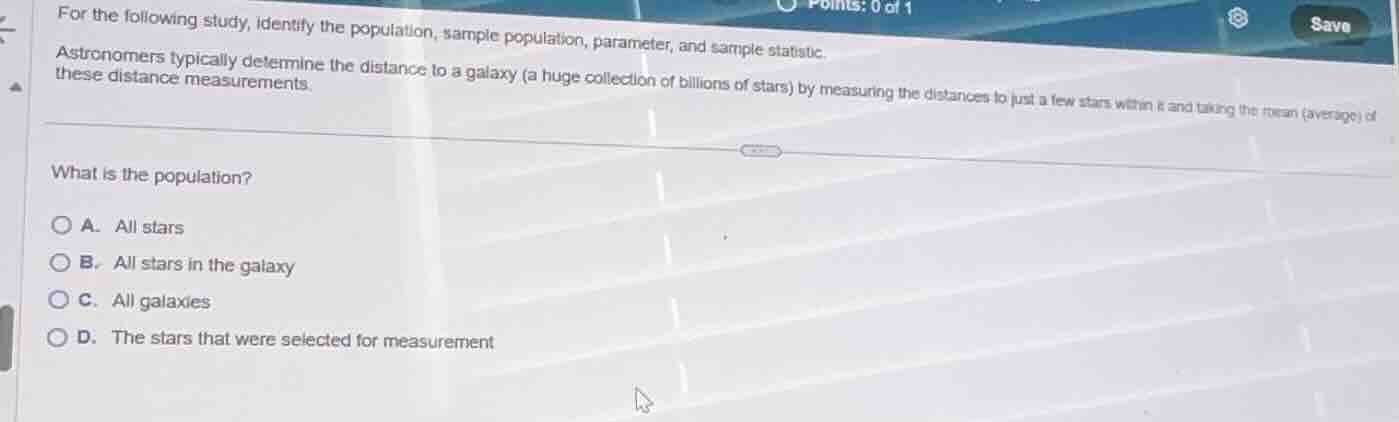
for the following study, identify the population, sample population, parameter, and sample statistic.
astronomers typically determine the distance to a galaxy (a huge collection of billions of stars) by measuring the distances to just a few stars within it and taking the mean (average) of these distance measurements.
what is the population?
a. all stars
b. all stars in the galaxy
c. all galaxies
d. the stars that were selected for measurement
Identify the target of the study
Using the Statistical Population knowledge point
The study aims to determine the distance to a specific galaxy by measuring the distances to a subset of stars within that galaxy.
Define the population
Using the Statistical Population knowledge point
The population consists of the entire collection of individuals or objects that are of interest in a statistical study. Here, the astronomers want to find the distance to "a galaxy" (which is a collection of billions of stars) by measuring stars within it. Therefore, the population of interest is all the stars in that specific galaxy.
Evaluate the given options
Using the Statistical Population knowledge point
- A. All stars: Too broad, as the study is focused on a single specific galaxy.
- B. All stars in the galaxy: Correct, as this represents the entire group of interest from which the sample is drawn.
- C. All galaxies: Incorrect, as the measurements are taken on stars within one galaxy to find its distance.
- D. The stars that were selected for measurement: This represents the sample, not the population.

Snap & solve any problem in the app
Get step-by-step solutions on Sovi AI
Photo-based solutions with guided steps
Explore more problems and detailed explanations
- A. All stars
- B. All stars in the galaxy (Correct answer)
- C. All galaxies
- D. The stars that were selected for measurement