QUESTION IMAGE
Question
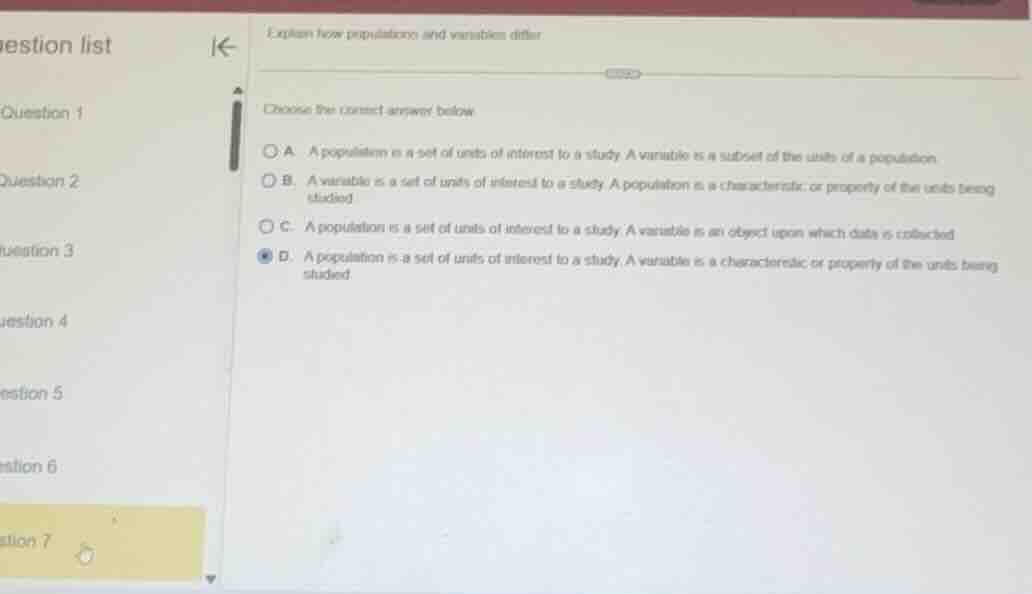
explain how populations and variables differ.
choose the correct answer below.
a. a population is a set of units of interest to a study. a variable is a subset of the units of a population.
b. a variable is a set of units of interest to a study. a population is a characteristic or property of the units being studied.
c. a population is a set of units of interest to a study. a variable is an object upon which data is collected.
d. a population is a set of units of interest to a study. a variable is a characteristic or property of the units being studied.
🆕 New Concept Discovered: Statistical Variables
What we measure about our subjects
Step 1: Define a Population
In statistics, a population is the entire collection or set of units (such as people, objects, or events) that we want to study and draw conclusions about.
Step 2: Define a Variable
A variable is a specific characteristic, property, or attribute of the individual units in that population that can be measured, counted, or categorized (such as height, test score, or eye color). It is called a "variable" because its value can vary from one unit to another.
Step 3: Compare the Options
- A is incorrect because a subset of the units of a population is called a sample, not a variable.
- B is incorrect because it reverses the definitions of a population and a variable.
- C is incorrect because an object upon which data is collected is an experimental unit or individual, not a variable.
- D is correct because it accurately defines a population as the set of units of interest and a variable as a characteristic or property of those units.

Snap & solve any problem in the app
Get step-by-step solutions on Sovi AI
Photo-based solutions with guided steps
Explore more problems and detailed explanations
D. A population is a set of units of interest to a study. A variable is a characteristic or property of the units being studied.