QUESTION IMAGE
Question
experimental inquiry: does dna replication follow the conservative, semiconservative, or dispersive model?
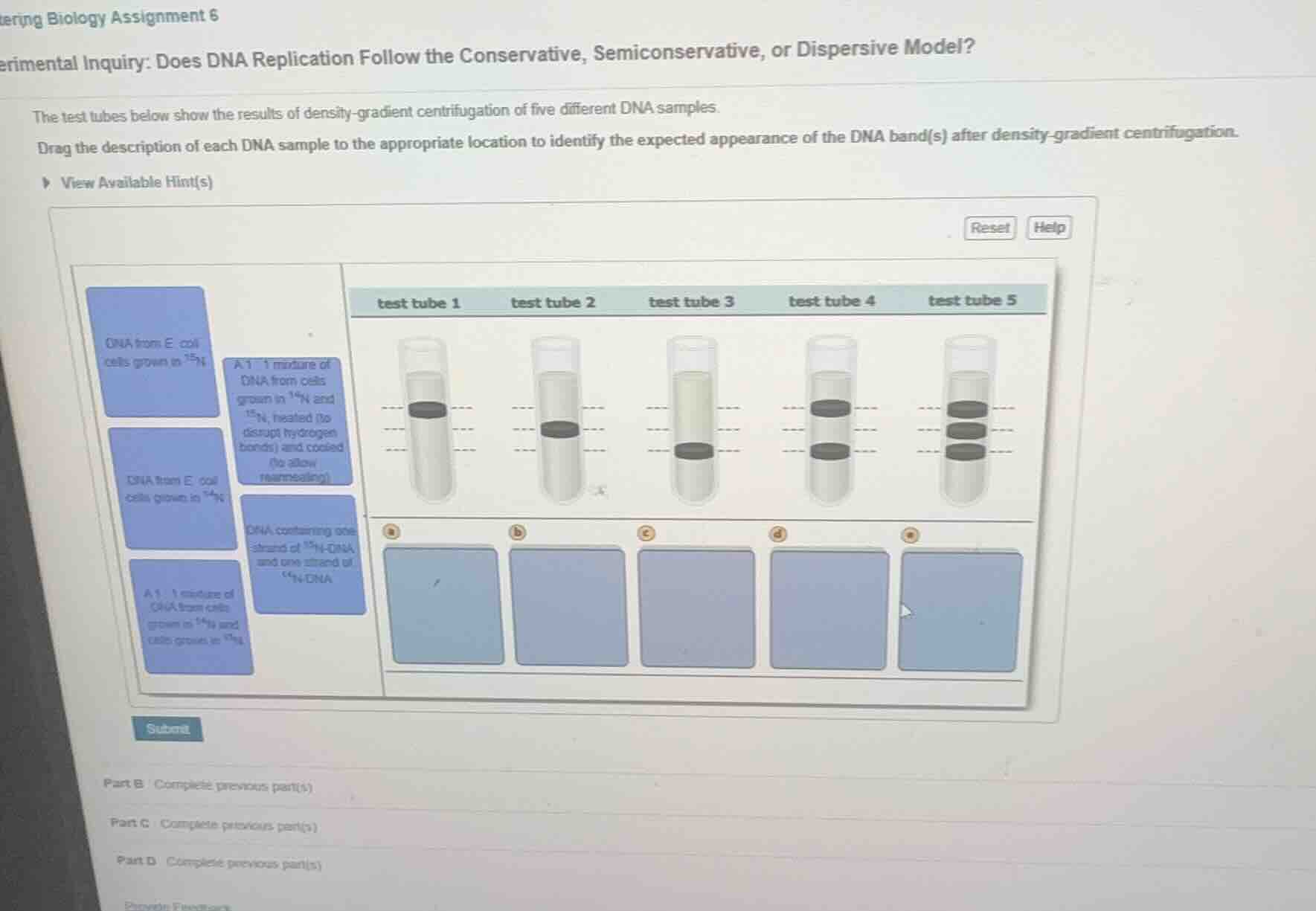
the test tubes below show the results of density-gradient centrifugation of five different dna samples.
drag the description of each dna sample to the appropriate location to identify the expected appearance of the dna band(s) after density-gradient centrifugation.
dna from e. coli cells grown in \\(^{15}\text{n}\\)
dna from e. coli cells grown in \\(^{14}\text{n}\\)
a 1:1 mixture of dna from cells grown in \\(^{14}\text{n}\\) and cells grown in \\(^{15}\text{n}\\)
a 1:1 mixture of dna from cells grown in \\(^{14}\text{n}\\) and \\(^{15}\text{n}\\), heated (to disrupt hydrogen bonds) and cooled (to allow reannealing)
dna containing one strand of \\(^{15}\text{n}\\)-dna and one strand of \\(^{14}\text{n}\\)-dna
Analyze the density bands
Density-gradient centrifugation separates DNA molecules based on their density.
- The top position (dashed line) represents light DNA (\(^{14}\text{N}\)-\(^{14}\text{N}\)).
- The middle position represents intermediate-density hybrid DNA (\(^{14}\text{N}\)-\(^{15}\text{N}\)).
- The bottom position represents heavy DNA (\(^{15}\text{N}\)-\(^{15}\text{N}\)).
Let's identify the bands in each test tube:
- test tube 1: A single band at the top (light density).
- test tube 2: A single band in the middle (hybrid density).
- test tube 3: A single band at the bottom (heavy density).
- test tube 4: Two bands: one at the top (light) and one at the bottom (heavy).
- test tube 5: Three bands: one at the top (light), one in the middle (hybrid), and one at the bottom (heavy).
Match the DNA samples
Now we match each of the five descriptions to the correct test tube:
- "DNA from E. coli cells grown in \(^{15}\text{N}\)":
- This DNA contains only heavy nitrogen, so both strands are heavy (\(^{15}\text{N}\)-\(^{15}\text{N}\)).
- This corresponds to a single heavy band at the bottom.
- Match: test tube 3 (box c).
- "DNA from E. coli cells grown in \(^{14}\text{N}\)":
- This DNA contains only light nitrogen, so both strands are light (\(^{14}\text{N}\)-\(^{14}\text{N}\)).
- This corresponds to a single light band at the top.
- Match: test tube 1 (box a).
- "DNA containing one strand of \(^{15}\text{N}\)-DNA and one strand of \(^{14}\text{N}\)-DNA":
- This is hybrid DNA (\(^{14}\text{N}\)-\(^{15}\text{N}\)).
- This corresponds to a single intermediate band in the middle.
- Match: test tube 2 (box b).
- "A 1:1 mixture of DNA from cells grown in \(^{14}\text{N}\) and cells grown in \(^{15}\text{N}\)":
- This mixture contains fully light DNA molecules (\(^{14}\text{N}\)-\(^{14}\text{N}\)) and fully heavy DNA molecules (\(^{15}\text{N}\)-\(^{15}\text{N}\)).
- This corresponds to two bands: one at the top and one at the bottom.
- Match: test tube 4 (box d).
- "A 1:1 mixture of DNA from cells grown in \(^{14}\text{N}\) and \(^{15}\text{N}\), heated (to disrupt hydrogen bonds) and cooled (to allow reannealing)":
- Heating denatures the double-stranded DNA into single strands: \(^{14}\text{N}\) single strands and \(^{15}\text{N}\) single strands.
- Upon cooling, these strands reassociate randomly.
- The possible combinations are:
- \(^{14}\text{N}\) pairing with \(^{14}\text{N}\) (light DNA, top band)
- \(^{14}\text{N}\) pairing with \(^{15}\text{N}\) (hybrid DNA, middle band)
- \(^{15}\text{N}\) pairing with \(^{15}\text{N}\) (heavy DNA, bottom band)
- This results in three distinct bands.
- Match: test tube 5 (box e).

Snap & solve any problem in the app
Get step-by-step solutions on Sovi AI
Photo-based solutions with guided steps
Explore more problems and detailed explanations
The correct matching of the DNA samples to the test tubes is:
- test tube 1 (a): DNA from E. coli cells grown in \(^{14}\text{N}\)
- test tube 2 (b): DNA containing one strand of \(^{15}\text{N}\)-DNA and one strand of \(^{14}\text{N}\)-DNA
- test tube 3 (c): DNA from E. coli cells grown in \(^{15}\text{N}\)
- test tube 4 (d): A 1:1 mixture of DNA from cells grown in \(^{14}\text{N}\) and cells grown in \(^{15}\text{N}\)
- test tube 5 (e): A 1:1 mixture of DNA from cells grown in \(^{14}\text{N}\) and \(^{15}\text{N}\), heated (to disrupt hydrogen bonds) and cooled (to allow reannealing)