QUESTION IMAGE
Question
exercises
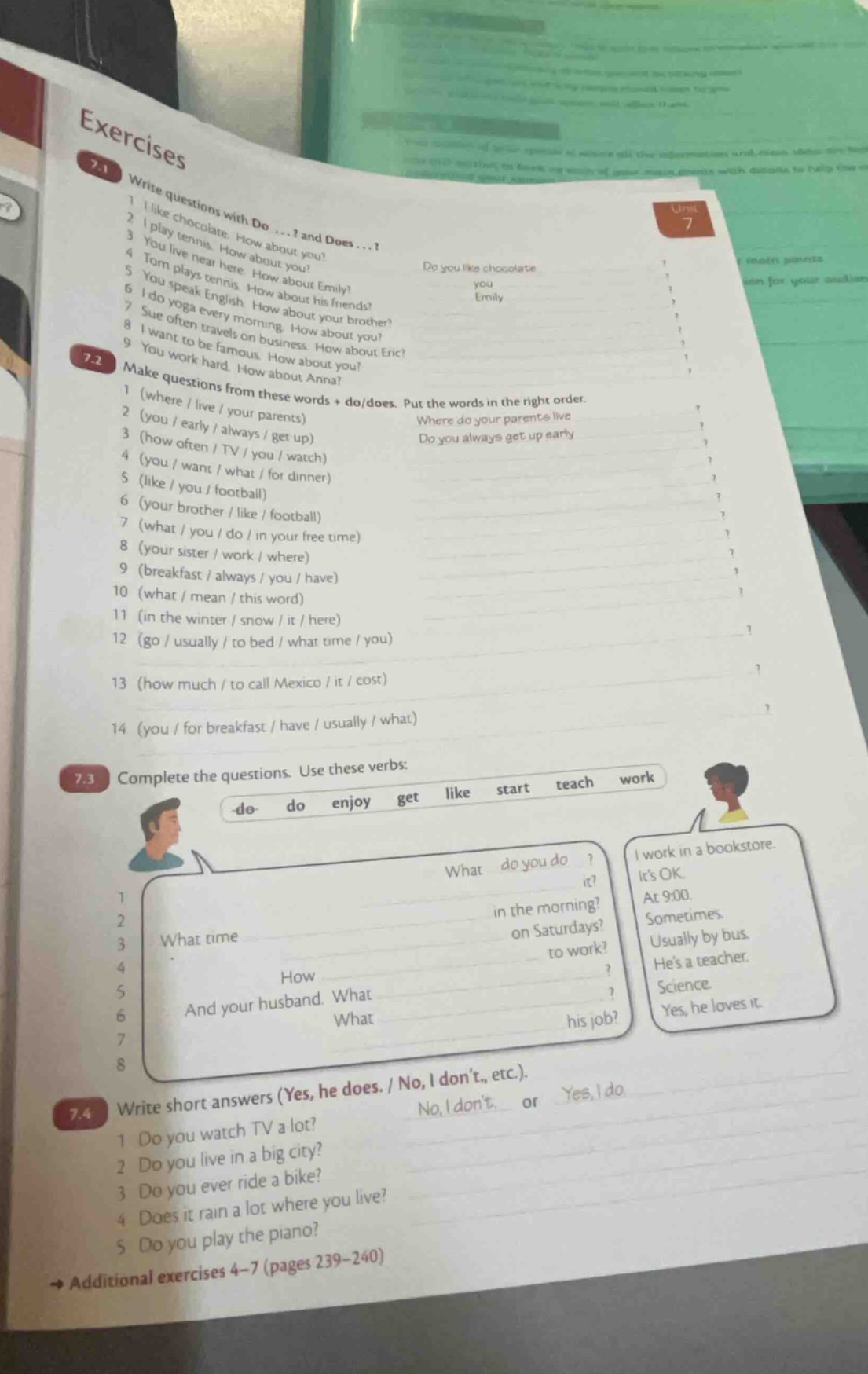
7.1 write questions with do ...? and does ...?
1 i like chocolate. how about you? do you like chocolate?
2 i play tennis. how about you? you?
3 you live near here. how about emily? emily?
4 tom plays tennis. how about his friends?
5 you speak english. how about your brother?
6 i do yoga every morning. how about you?
7 sue often travels on business. how about eric?
8 i want to be famous. how about you?
9 you work hard. how about anna?
7.2 make questions from these words + do/does. put the words in the right order.
1 (where / live / your parents) where do your parents live?
2 (you / early / always / get up) do you always get up early?
3 (how often / tv / you / watch)?
4 (you / want / what / for dinner)?
5 (like / you / football)?
6 (your brother / like / football)?
7 (what / you / do / in your free time)?
8 (your sister / work / where)?
9 (breakfast / always / you / have)?
10 (what / mean / this word)?
11 (in the winter / snow / it / here)?
12 (go / usually / to bed / what time / you)?
13 (how much / to call mexico / it / cost)?
14 (you / for breakfast / have / usually / what)?
7.3 complete the questions. use these verbs:
do do enjoy get like start teach work
1 what do you do? i work in a bookstore.
2 it? its ok.
3 what time in the morning? at 9:00.
4 on saturdays? sometimes.
5 how to work? usually by bus.
6 and your husband. what? hes a teacher.
7 what? science.
8 his job? yes, he loves it.
7.4 write short answers (yes, he does. / no, i dont., etc.).
1 do you watch tv a lot? no, i dont. or yes, i do.
2 do you live in a big city?
3 do you ever ride a bike?
4 does it rain a lot where you live?
5 do you play the piano?
Analyze the structure of present simple questions
We need to construct questions using the present simple tense. The standard word order for questions in the present simple is:
- Wh-question word (if any) + do/does + subject + base verb + rest of the sentence?
We will apply English Grammar rules to solve each section from 7.1 to 7.4.
Formulate questions with Do/Does (Section 7.1)
We look at the statement and the prompt word to form a yes/no question:
- "I like chocolate. How about you?" -> "Do you like chocolate?" (Example given)
- "I play tennis. How about you?" -> "Do you play tennis?"
- "You live near here. How about Emily?" -> "Does Emily live near here?"
- "Tom plays tennis. How about his friends?" -> "Do his friends play tennis?"
- "You speak English. How about your brother?" -> "Does your brother speak English?"
- "I do yoga every morning. How about you?" -> "Do you do yoga every morning?"
- "Sue often travels on business. How about Eric?" -> "Does Eric often travel on business?"
- "I want to be famous. How about you?" -> "Do you want to be famous?"
- "You work hard. How about Anna?" -> "Does Anna work hard?"
Arrange words in the correct order (Section 7.2)
We rearrange the given words and add do/does where appropriate:
- (where / live / your parents) -> "Where do your parents live?" (Example given)
- (you / early / always / get up) -> "Do you always get up early?" (Example given)
- (how often / TV / you / watch) -> "How often do you watch TV?"
- (you / want / what / for dinner) -> "What do you want for dinner?"
- (like / you / football) -> "Do you like football?"
- (your brother / like / football) -> "Does your brother like football?"
- (what / you / do / in your free time) -> "What do you do in your free time?"
- (your sister / work / where) -> "Where does your sister work?"
- (breakfast / always / you / have) -> "Do you always have breakfast?"
- (what / mean / this word) -> "What does this word mean?"
- (in the winter / snow / it / here) -> "Does it snow here in the winter?"
- (go / usually / to bed / what time / you) -> "What time do you usually go to bed?"
- (how much / to call Mexico / it / cost) -> "How much does it cost to call Mexico?"
- (you / for breakfast / have / usually / what) -> "What do you usually have for breakfast?"
Complete the questions using verbs (Section 7.3)
We match the questions on the left with the answers on the right using the verbs: do, do, enjoy, get, like, start, teach, work.
- "What do you do?" -> "I work in a bookstore." (Example given)
- "Do you enjoy it?" -> "It's OK."
- "What time do you start in the morning?" -> "At 9:00."
- "Do you work on Saturdays?" -> "Sometimes."
- "How do you get to work?" -> "Usually by bus."
- "And your husband. What does he do?" -> "He's a teacher."
- "What does he teach?" -> "Science."
- "Does he like his job?" -> "Yes, he loves it."
Write short answers (Section 7.4)
These are personalized yes/no questions. We provide standard short answers:
- "Do you watch TV a lot?" -> "No, I don't." or "Yes, I do." (Example given)
- "Do you live in a big city?" -> "Yes,…

Snap & solve any problem in the app
Get step-by-step solutions on Sovi AI
Photo-based solutions with guided steps
Explore more problems and detailed explanations
Section 7.1
- Do you like chocolate?
- Do you play tennis?
- Does Emily live near here?
- Do his friends play tennis?
- Does your brother speak English?
- Do you do yoga every morning?
- Does Eric often travel on business?
- Do you want to be famous?
- Does Anna work hard?
Section 7.2
- Where do your parents live?
- Do you always get up early?
- How often do you watch TV?
- What do you want for dinner?
- Do you like football?
- Does your brother like football?
- What do you do in your free time?
- Where does your sister work?
- Do you always have breakfast?
- What does this word mean?
- Does it snow here in the winter?
- What time do you usually go to bed?
- How much does it cost to call Mexico?
- What do you usually have for breakfast?
Section 7.3
- What do you do?
- Do you enjoy it?
- What time do you start in the morning?
- Do you work on Saturdays?
- How do you get to work?
- And your husband. What does he do?
- What does he teach?
- Does he like his job?
Section 7.4
(Note: Answers may vary based on personal circumstances)
- No, I don't. / Yes, I do.
- Yes, I do. / No, I don't.
- Yes, I do. / No, I don't.
- Yes, it does. / No, it doesn't.
- No, I don't. / Yes, I do.