QUESTION IMAGE
Question
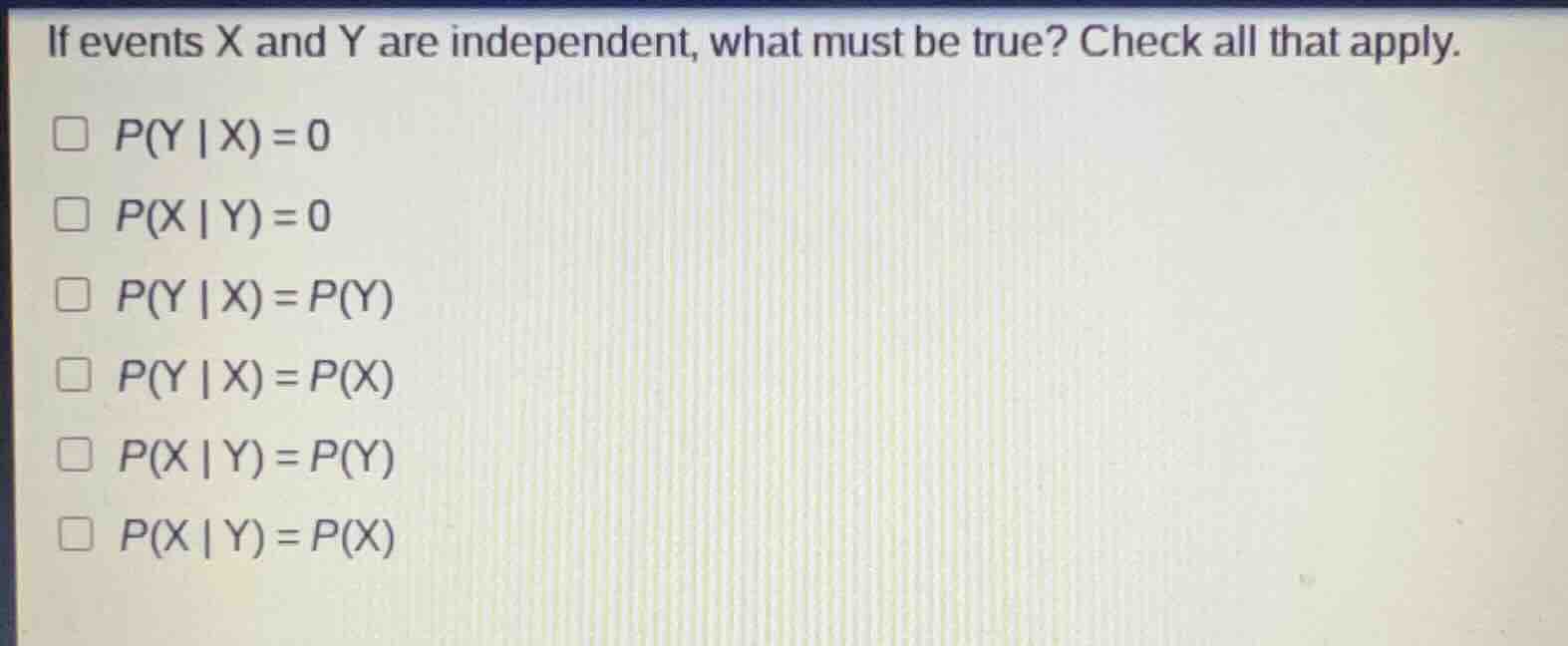
if events x and y are independent, what must be true? check all that apply.\\( p(y | x) = 0 \\)\\( p(x | y) = 0 \\)\\( p(y | x) = p(y) \\)\\( p(y | x) = p(x) \\)\\( p(x | y) = p(y) \\)\\( p(x | y) = p(x) \\)
Recall the definition of independent events: Two events \( X \) and \( Y \) are independent if the occurrence of one does not affect the probability of the occurrence of the other. Mathematically, this is defined using conditional probability. The formula for conditional probability is \( P(A|B)=\frac{P(A\cap B)}{P(B)} \) (for \( P(B)>0 \)). For independent events, \( P(X\cap Y) = P(X)P(Y) \).
- For \( P(Y|X) \): Substitute \( P(X\cap Y)=P(X)P(Y) \) into the conditional probability formula: \( P(Y|X)=\frac{P(X\cap Y)}{P(X)}=\frac{P(X)P(Y)}{P(X)} = P(Y) \) (assuming \( P(X)>0 \)).
- For \( P(X|Y) \): Similarly, \( P(X|Y)=\frac{P(X\cap Y)}{P(Y)}=\frac{P(X)P(Y)}{P(Y)} = P(X) \) (assuming \( P(Y)>0 \)).
Now let's analyze each option:
- \( P(Y|X) = 0 \): This would mean \( Y \) never occurs given \( X \) occurs, which is not a property of independent events (independent events just have no effect on each other's probability, not necessarily zero probability).
- \( P(X|Y) = 0 \): Similar to above, this is not a property of independent events.
- \( P(Y|X) = P(Y) \): This matches the result from the conditional probability formula for independent events.
- \( P(Y|X) = P(X) \): There's no reason for the conditional probability of \( Y \) given \( X \) to equal \( P(X) \); this is incorrect.
- \( P(X|Y) = P(Y) \): Incorrect, as shown earlier, \( P(X|Y) \) should equal \( P(X) \) for independent events.
- \( P(X|Y) = P(X) \): This matches the result from the conditional probability formula for independent events.

Snap & solve any problem in the app
Get step-by-step solutions on Sovi AI
Photo-based solutions with guided steps
Explore more problems and detailed explanations
- \( P(Y | X) = P(Y) \)
- \( P(X | Y) = P(X) \)