QUESTION IMAGE
Question
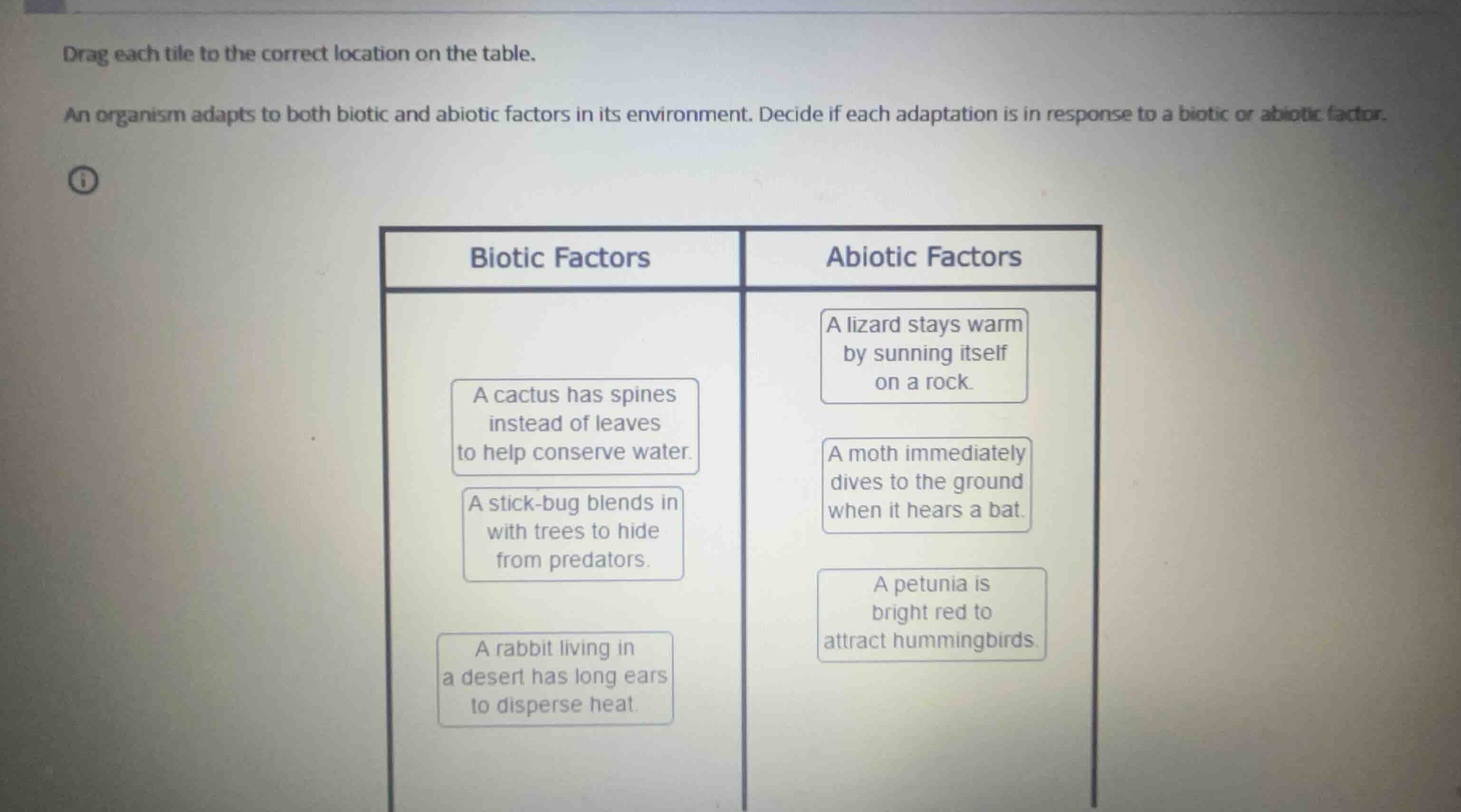
drag each tile to the correct location on the table.
an organism adapts to both biotic and abiotic factors in its environment. decide if each adaptation is in response to a biotic or abiotic factor.
biotic factors
- a cactus has spines instead of leaves to help conserve water.
- a stick-bug blends in with trees to hide from predators.
- a rabbit living in a desert has long ears to disperse heat.
abiotic factors
- a lizard stays warm by sunning itself on a rock.
- a moth immediately dives to the ground when it hears a bat.
- a petunia is bright red to attract hummingbirds.
Define biotic and abiotic factors
Biotic factors are living or once-living components of an ecosystem, such as predators, prey, mates, and competitors. Abiotic factors are non-living physical and chemical elements, such as sunlight, temperature, water, wind, and rocks.
Analyze water and heat adaptations
Using the Plant Adaptations knowledge point
- "A cactus has spines instead of leaves to help conserve water": Water is a non-living physical resource, making this an adaptation to an abiotic factor.
- "A rabbit living in a desert has long ears to disperse heat": Temperature and heat are non-living physical conditions, making this an adaptation to an abiotic factor.
Analyze predator and pollination adaptations
- "A stick-bug blends in with trees to hide from predators": Predators are living organisms, making this an adaptation to a biotic factor.
- "A moth immediately dives to the ground when it hears a bat": Bats are living predators, making this an adaptation to a biotic factor.
- "A petunia is bright red to attract hummingbirds": Hummingbirds are living pollinators, making this an adaptation to a biotic factor.
Analyze temperature regulation adaptation
- "A lizard stays warm by sunning itself on a rock": Sunlight and rocks are non-living physical elements of the environment, making this an adaptation to an abiotic factor.
Synthesize the classifications
- Biotic Factors:
- A stick-bug blends in with trees to hide from predators.
- A moth immediately dives to the ground when it hears a bat.
- A petunia is bright red to attract hummingbirds.
- Abiotic Factors:
- A cactus has spines instead of leaves to help conserve water.
- A rabbit living in a desert has long ears to disperse heat.
- A lizard stays warm by sunning itself on a rock.

Snap & solve any problem in the app
Get step-by-step solutions on Sovi AI
Photo-based solutions with guided steps
Explore more problems and detailed explanations
| Biotic Factors | Abiotic Factors |
|---|---|
| A moth immediately dives to the ground when it hears a bat. | A rabbit living in a desert has long ears to disperse heat. |
| A petunia is bright red to attract hummingbirds. | A lizard stays warm by sunning itself on a rock. |