QUESTION IMAGE
Question
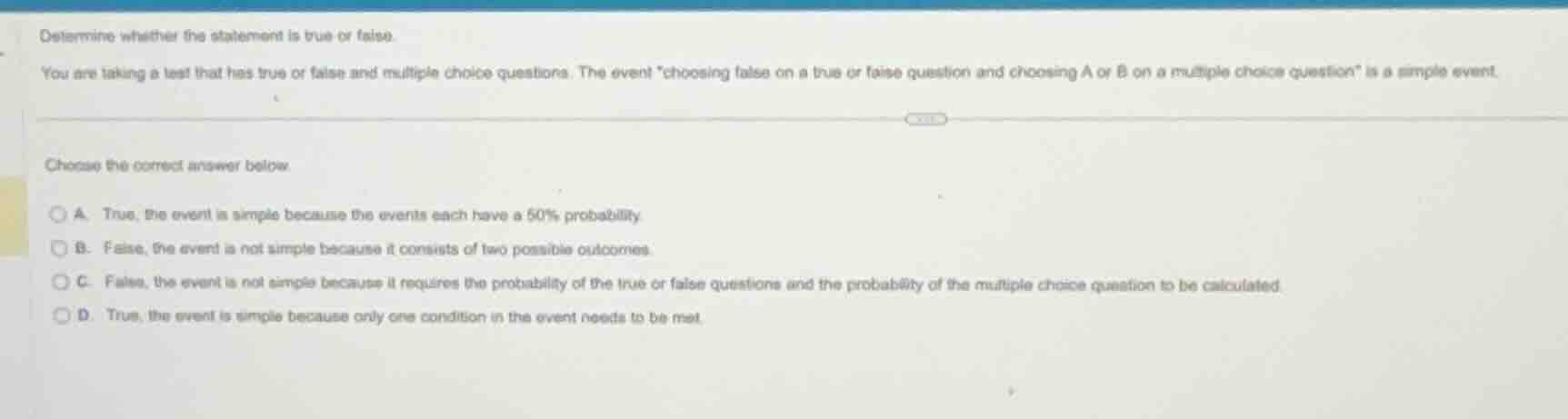
determine whether the statement is true or false.
you are taking a test that has true or false and multiple choice questions. the event \choosing false on a true or false question and choosing a or b on a multiple choice question\ is a simple event.
choose the correct answer below.
a. true, the event is simple because the events each have a 50% probability.
b. false, the event is not simple because it consists of two possible outcomes.
c. false, the event is not simple because it requires the probability of the true or false questions and the probability of the multiple choice question to be calculated.
d. true, the event is simple because only one condition in the event needs to be met.
Define simple and compound events
An event is simple if it consists of exactly one outcome from the sample space. An event is compound if it consists of more than one outcome.
Analyze the given event
The event is "choosing false on a true or false question and choosing A or B on a multiple choice question." Let the outcomes of the experiment be represented as pairs \((TF, MC)\), where \(TF \in \{T, F\}\) and \(MC \in \{A, B, C, D, \dots\}\).
List the outcomes in the event
The event described contains the following distinct outcomes:
- \((F, A)\) (choosing false and choosing A)
- \((F, B)\) (choosing false and choosing B)
Determine if the event is simple
Since the event consists of two possible outcomes rather than a single outcome, it is not a simple event. Therefore, the statement is false.
Match with the correct option
Option B correctly states: "False, the event is not simple because it consists of two possible outcomes."

Snap & solve any problem in the app
Get step-by-step solutions on Sovi AI
Photo-based solutions with guided steps
Explore more problems and detailed explanations
- A. True, the event is simple because the events each have a 50% probability.
- B. False, the event is not simple because it consists of two possible outcomes. (Correct answer)
- C. False, the event is not simple because it requires the probability of the true or false questions and the probability of the multiple choice question to be calculated.
- D. True, the event is simple because only one condition in the event needs to be met.