QUESTION IMAGE
Question
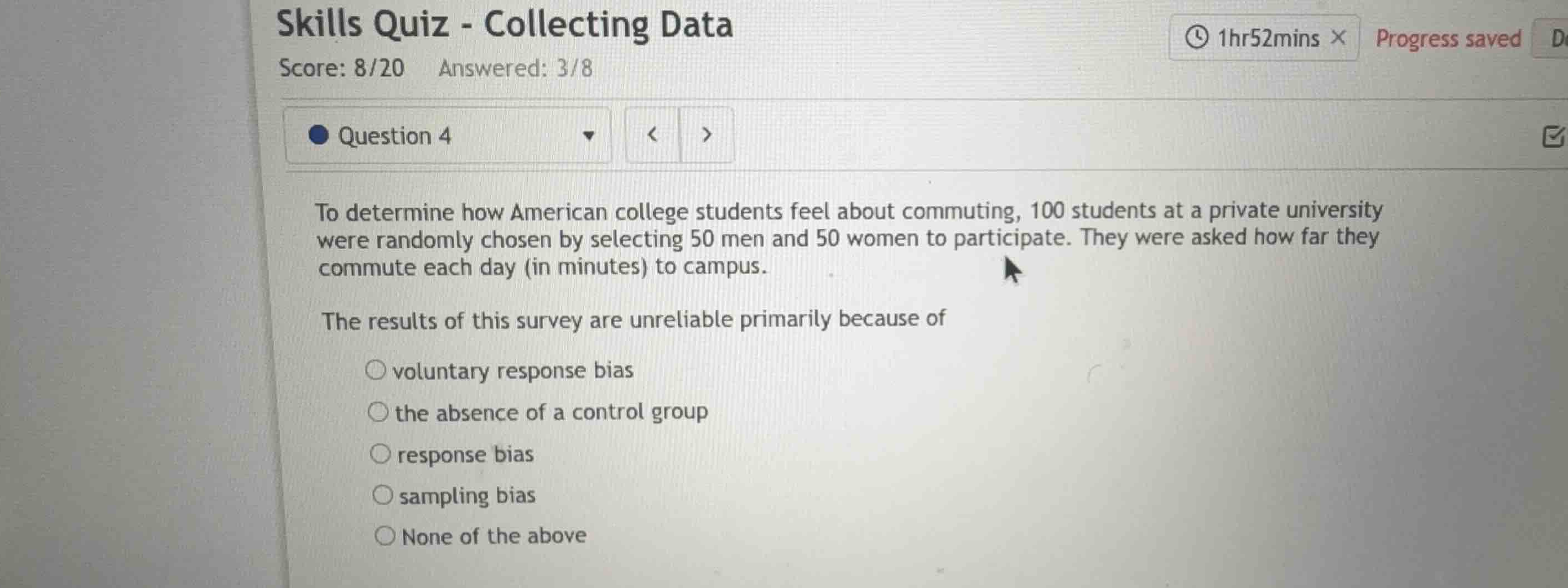
to determine how american college students feel about commuting, 100 students at a private university were randomly chosen by selecting 50 men and 50 women to participate. they were asked how far they commute each day (in minutes) to campus.
the results of this survey are unreliable primarily because of
- voluntary response bias
- the absence of a control group
- response bias
- sampling bias
- none of the above
⚡ Using what you learned: Sampling Methods · 🆕 New Concept Discovered: Sources of Bias in Surveys
How a sample fails to represent the target population
Step 1: Identify the Target Population and the Sample
The goal of the study is to determine how all American college students feel about commuting.
However, the researchers selected their sample of 100 students exclusively from one private university.
Step 2: Analyze the Discrepancy (Sampling Bias)
Because the sample is drawn only from a single private university, it is not representative of the entire population of American college students. Students at a private university may have different commuting patterns, socioeconomic backgrounds, or housing options compared to students at public universities, community colleges, or universities in different geographic regions.
When the method of selecting a sample systematically excludes parts of the population of interest, it introduces sampling bias (specifically, undercoverage).
Step 3: Evaluate Other Options
- Voluntary response bias: This occurs when sample members self-select to participate (e.g., highly motivated volunteers). Here, the students were randomly chosen by the researchers to participate.
- The absence of a control group: Control groups are used in experimental designs to compare treatments, not in observational surveys measuring opinions or characteristics.
- Response bias: This occurs when respondents give inaccurate, dishonest, or influenced answers (e.g., due to poorly worded questions or social desirability). There is no indication of this here.

Snap & solve any problem in the app
Get step-by-step solutions on Sovi AI
Photo-based solutions with guided steps
Explore more problems and detailed explanations
sampling bias