QUESTION IMAGE
Question
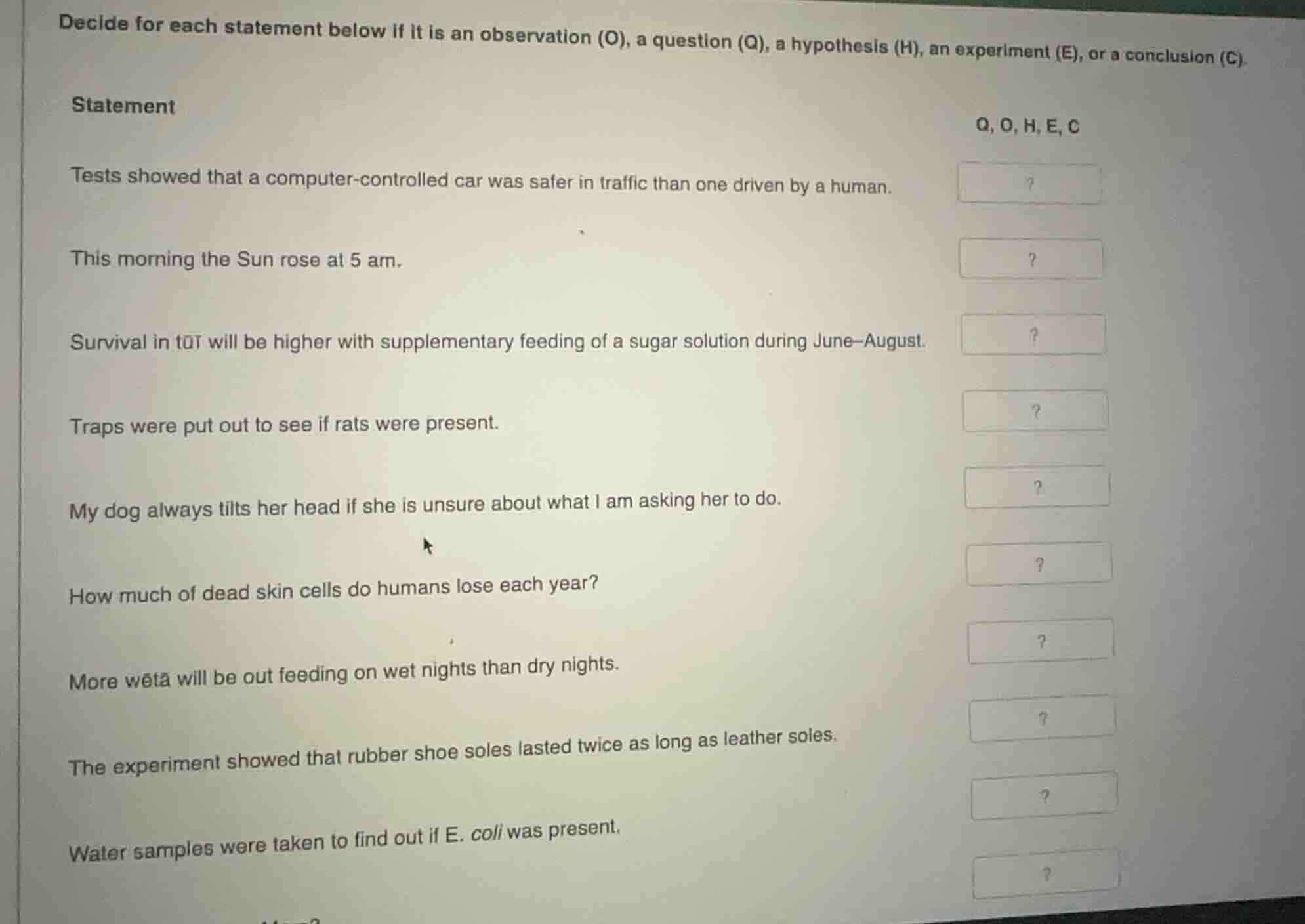
decide for each statement below if it is an observation (o), a question (q), a hypothesis (h), an experiment (e), or a conclusion (c).
statement
q, o, h, e, c
tests showed that a computer-controlled car was safer in traffic than one driven by a human.
this morning the sun rose at 5 am.
survival in tūī will be higher with supplementary feeding of a sugar solution during june-august.
traps were put out to see if rats were present.
my dog always tilts her head if she is unsure about what i am asking her to do.
how much of dead skin cells do humans lose each year?
more wētā will be out feeding on wet nights than dry nights.
the experiment showed that rubber shoe soles lasted twice as long as leather soles.
water samples were taken to find out if e. coli was present.
Analyze the scientific method components
To classify each statement, we define the components of the scientific method:
- Observation (O): Information gathered directly through the senses or instruments about a current or past event.
- Question (Q): An inquiry about how or why something happens, usually ending with a question mark.
- Hypothesis (H): A testable, predictive statement about a relationship or outcome (often using future tense or "will be").
- Experiment (E): An action, procedure, or test performed to gather data or investigate a question.
- Conclusion (C): A summary or interpretation of experimental results that answers the initial question or hypothesis.
Classify statements 1 to 3
- Statement 1: "Tests showed that a computer-controlled car was safer in traffic than one driven by a human."
- This summarizes the outcome of tests, making it a Conclusion (C).
- Statement 2: "This morning the Sun rose at 5 am."
- This is a direct, factual record of an event witnessed, making it an Observation (O).
- Statement 3: "Survival in tūī will be higher with supplementary feeding of a sugar solution during June–August."
- This is a predictive, testable claim about a future outcome, making it a Hypothesis (H).
Classify statements 4 to 6
- Statement 4: "Traps were put out to see if rats were present."
- This describes a physical action taken to gather data, making it an Experiment (E).
- Statement 5: "My dog always tilts her head if she is unsure about what I am asking her to do."
- This is a direct, repeated behavior witnessed by the owner, making it an Observation (O).
- Statement 6: "How much of dead skin cells do humans lose each year?"
- This is an inquiry seeking information, making it a Question (Q).
Classify statements 7 to 9
- Statement 7: "More wētā will be out feeding on wet nights than dry nights."
- This is a predictive, testable statement about an expected pattern, making it a Hypothesis (H).
- Statement 8: "The experiment showed that rubber shoe soles lasted twice as long as leather soles."
- This summarizes the findings and results of a completed test, making it a Conclusion (C).
- Statement 9: "Water samples were taken to find out if E. coli was present."
- This describes a practical procedure and sampling action carried out to collect data, making it an Experiment (E).

Snap & solve any problem in the app
Get step-by-step solutions on Sovi AI
Photo-based solutions with guided steps
Explore more problems and detailed explanations
| No. | Statement | Answer |
|---|---|---|
| 2 | This morning the Sun rose at 5 am. | O |
| 3 | Survival in tūī will be higher with supplementary feeding of a sugar solution during June–August. | H |
| 4 | Traps were put out to see if rats were present. | E |
| 5 | My dog always tilts her head if she is unsure about what I am asking her to do. | O |
| 6 | How much of dead skin cells do humans lose each year? | Q |
| 7 | More wētā will be out feeding on wet nights than dry nights. | H |
| 8 | The experiment showed that rubber shoe soles lasted twice as long as leather soles. | C |
| 9 | Water samples were taken to find out if E. coli was present. | E |