QUESTION IMAGE
Question
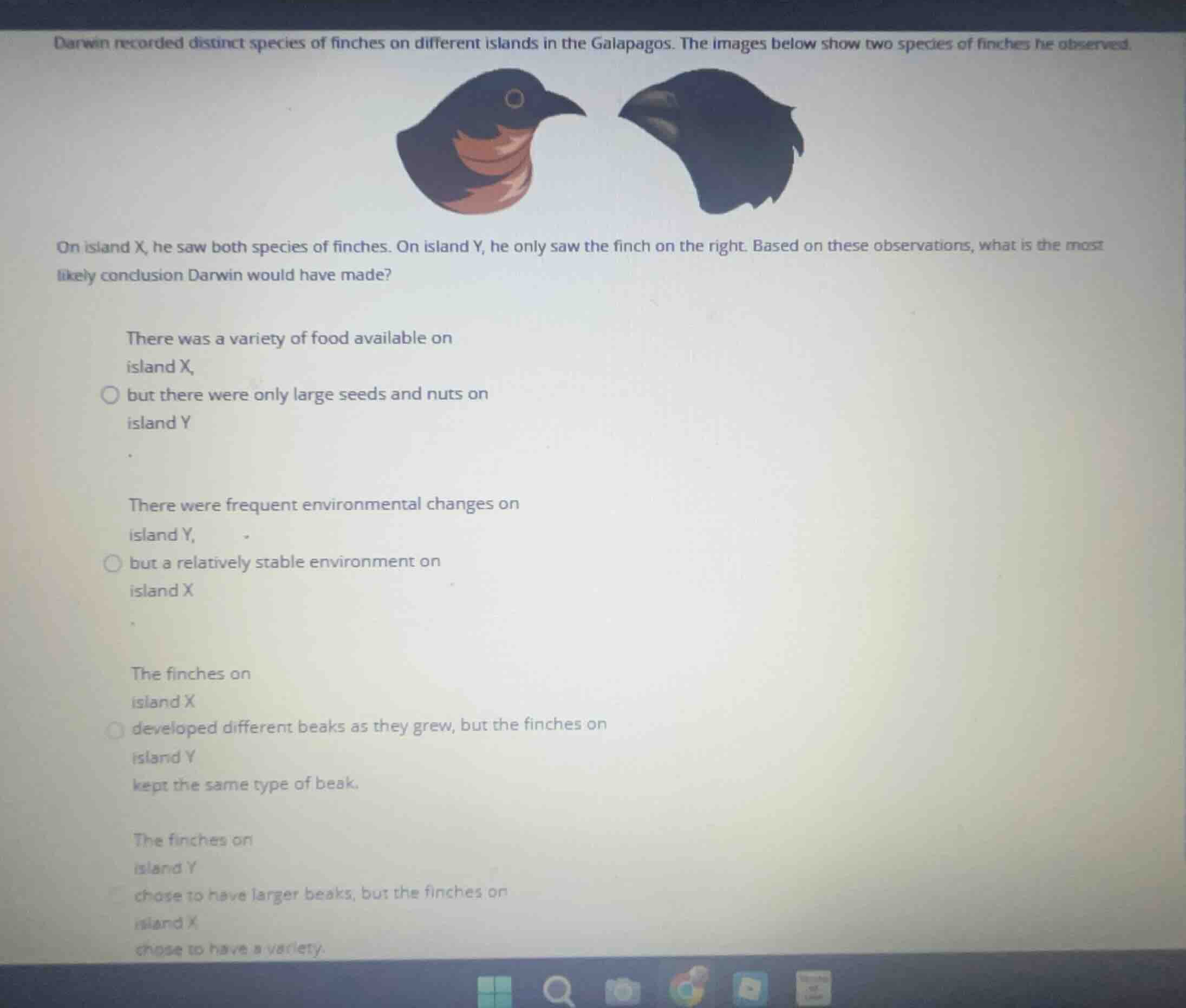
darwin recorded distinct species of finches on different islands in the galapagos. the images below show two species of finches he observed.
on island x, he saw both species of finches. on island y, he only saw the finch on the right. based on these observations, what is the most likely conclusion darwin would have made?
there was a variety of food available on island x, but there were only large seeds and nuts on island y
there were frequent environmental changes on island y, but a relatively stable environment on island x
the finches on island x developed different beaks as they grew, but the finches on island y kept the same type of beak.
the finches on island y chose to have larger beaks, but the finches on island x chose to have a variety.
Analyze the visual evidence
Using the Evidence of Evolution knowledge point
- The image shows two distinct species of finches with different beak shapes.
- The finch on the left has a smaller, more pointed beak, suitable for eating insects or small seeds.
- The finch on the right has a much larger, thicker, and deeper beak, adapted for cracking large, hard seeds and nuts.
Evaluate the island observations
- Island X has both species of finches present.
- Island Y only has the finch on the right (the one with the large, thick beak).
Connect beak adaptations to food availability
- Since beak shape is an adaptation to the type of food available, the presence of both species on Island X suggests a variety of food sources (both small/soft food and large/hard food).
- The presence of only the large-beaked finch on Island Y suggests that the food source there is limited to what that specific beak is adapted for, namely large seeds and nuts.
Assess the given options
- Option 1: Suggests a variety of food on Island X, but only large seeds and nuts on Island Y. This aligns perfectly with the ecological principles of natural selection and adaptive radiation.
- Option 2: Discusses environmental stability, which cannot be directly concluded from the presence of specific beak types alone.
- Option 3: Suggests individuals developed different beaks as they grew, which is a Lamarckian misconception; adaptations are inherited, not acquired during an individual's lifetime.
- Option 4: Suggests the finches "chose" their beak sizes, which is biologically incorrect as natural selection is not a conscious choice.

Snap & solve any problem in the app
Get step-by-step solutions on Sovi AI
Photo-based solutions with guided steps
Explore more problems and detailed explanations
- (A) There was a variety of food available on island X, but there were only large seeds and nuts on island Y (Correct answer)
- (B) There were frequent environmental changes on island Y, but a relatively stable environment on island X
- (C) The finches on island X developed different beaks as they grew, but the finches on island Y kept the same type of beak
- (D) The finches on island Y chose to have larger beaks, but the finches on island X chose to have a variety