QUESTION IMAGE
Question
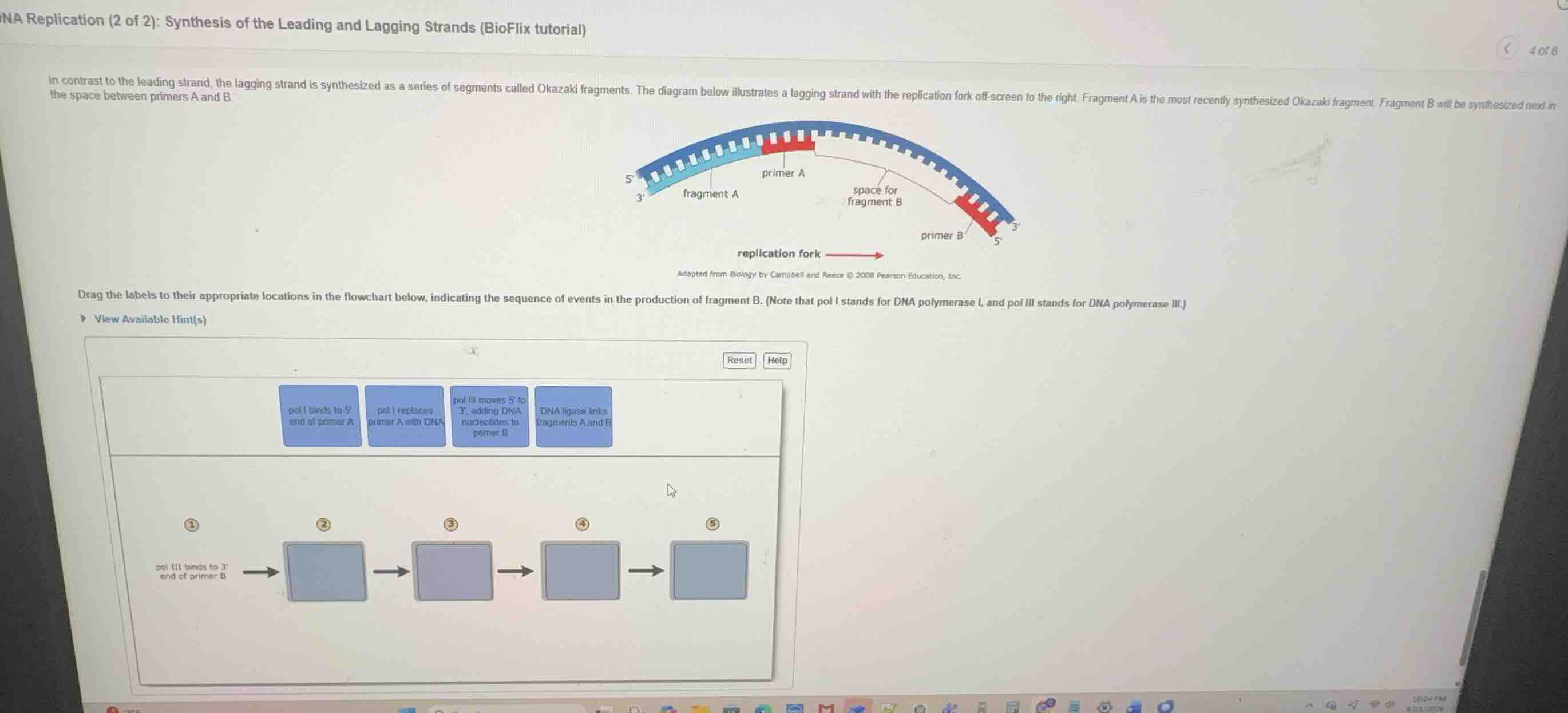
in contrast to the leading strand, the lagging strand is synthesized as a series of segments called okazaki fragments. the diagram below illustrates a lagging strand with the replication fork off-screen to the right. fragment a is the most recently synthesized okazaki fragment. fragment b will be synthesized next in the space between primers a and b.
drag the labels to their appropriate locations in the flowchart below, indicating the sequence of events in the production of fragment b. (note that pol i stands for dna polymerase i, and pol iii stands for dna polymerase iii.)
pol i binds to 5 end of primer a
pol i replaces primer a with dna
pol iii moves 5 to 3, adding dna nucleotides to primer b
dna ligase links fragments a and b
pol iii binds to 3 end of primer b
Identify the sequence of lagging strand synthesis
The question asks us to order the events involved in the synthesis and processing of Okazaki fragment B on the lagging strand.
We are given the first step:
- Step 1: "pol III binds to 3' end of primer B"
We need to place the remaining four labels into positions 2, 3, 4, and 5:
- Label A: "pol I binds to 5' end of primer A"
- Label B: "pol I replaces primer A with DNA"
- Label C: "pol III moves 5' to 3', adding DNA nucleotides to primer B"
- Label D: "DNA ligase links fragments A and B"
Determine the next step after binding of pol III
After DNA polymerase III (pol III) binds to the 3' end of primer B, it must synthesize the DNA fragment.
- Therefore, the next event is: pol III moves 5' to 3', adding DNA nucleotides to primer B (this fills the space for fragment B until it reaches primer A).
- This corresponds to position 2.
Determine the removal of the RNA primer
Once pol III finishes synthesizing fragment B, the RNA primer of the preceding fragment (primer A) must be removed and replaced with DNA. This is carried out by DNA polymerase I (pol I).
- First, pol I must bind to the junction: pol I binds to 5' end of primer A.
- This corresponds to position 3.
Determine the replacement of the RNA primer
After binding, pol I uses its 5' to 3' exonuclease activity to remove the RNA primer and its 5' to 3' polymerase activity to replace it with DNA nucleotides.
- Therefore, the next event is: pol I replaces primer A with DNA.
- This corresponds to position 4.
Determine the final nick sealing step
Once the RNA primer is completely replaced by DNA, a nick remains in the sugar-phosphate backbone between the newly synthesized fragment B and the completed fragment A.
- DNA ligase catalyzes the formation of a phosphodiester bond to seal this nick: DNA ligase links fragments A and B.
- This corresponds to position 5.

Snap & solve any problem in the app
Get step-by-step solutions on Sovi AI
Photo-based solutions with guided steps
Explore more problems and detailed explanations
The correct sequence of events in the production of fragment B is:
- pol III binds to 3' end of primer B (Given)
- pol III moves 5' to 3', adding DNA nucleotides to primer B
- pol I binds to 5' end of primer A
- pol I replaces primer A with DNA
- DNA ligase links fragments A and B