QUESTION IMAGE
Question
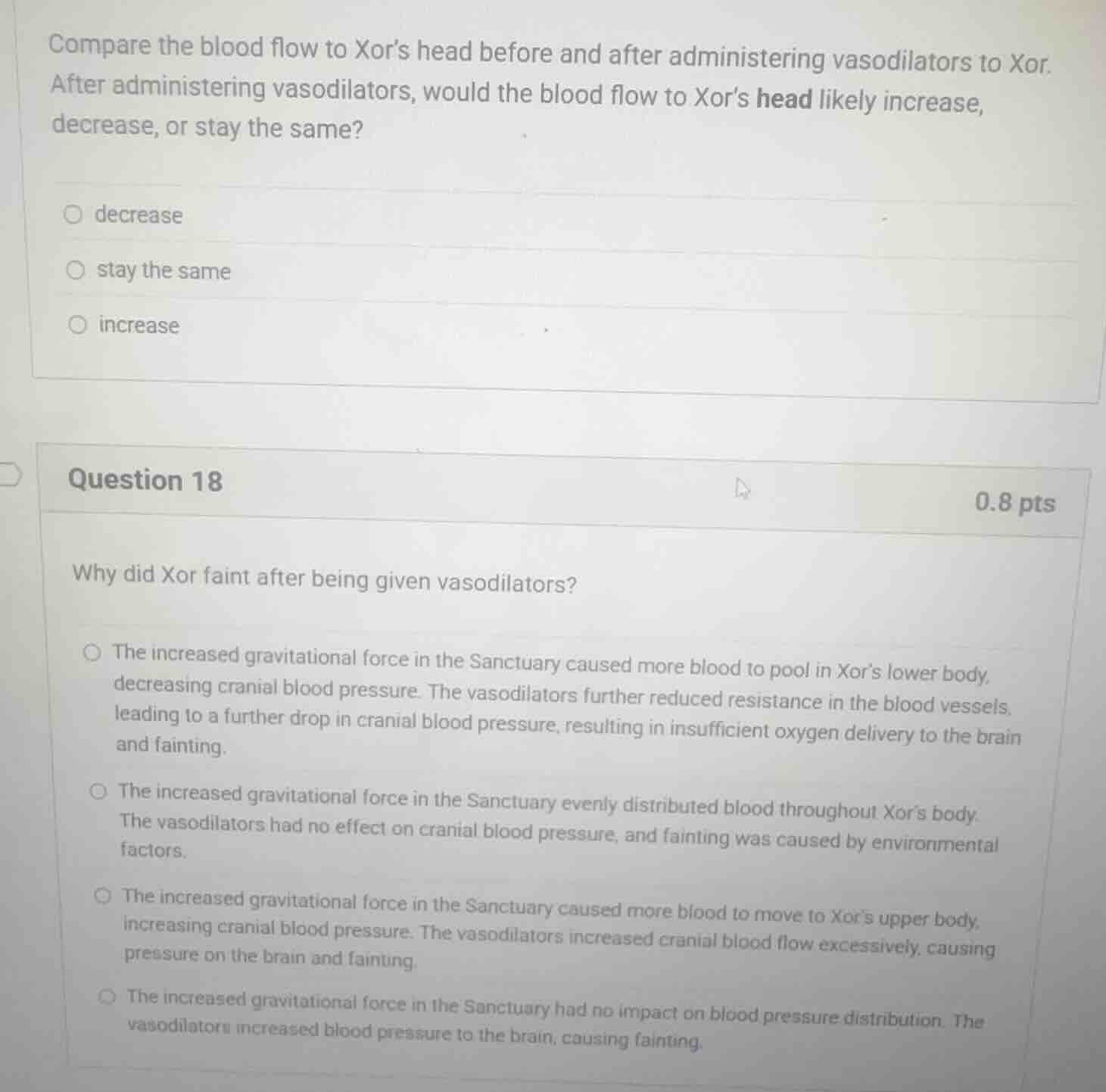
compare the blood flow to xors head before and after administering vasodilators to xor. after administering vasodilators, would the blood flow to xors head likely increase, decrease, or stay the same?
decrease
stay the same
increase
question 18
why did xor faint after being given vasodilators?
the increased gravitational force in the sanctuary caused more blood to pool in xors lower body, decreasing cranial blood pressure. the vasodilators further reduced resistance in the blood vessels, leading to a further drop in cranial blood pressure, resulting in insufficient oxygen delivery to the brain and fainting.
the increased gravitational force in the sanctuary evenly distributed blood throughout xors body. the vasodilators had no effect on cranial blood pressure, and fainting was caused by environmental factors.
the increased gravitational force in the sanctuary caused more blood to move to xors upper body, increasing cranial blood pressure. the vasodilators increased cranial blood flow excessively, causing pressure on the brain and fainting.
the increased gravitational force in the sanctuary had no impact on blood pressure distribution. the vasodilators increased blood pressure to the brain, causing fainting.
Analyze the effect of vasodilators on blood flow to the head
Using the Vasodilation Effects and Hemodynamics knowledge points, we analyze how administering vasodilators affects blood flow to the head. Vasodilators widen blood vessels, which decreases systemic vascular resistance and causes blood pressure to drop. In a standing or upright organism, gravity pulls blood downward. When vessels are dilated, blood pools in the lower extremities, reducing venous return and cardiac output. This leads to a decrease in cranial blood pressure and a subsequent decrease in blood flow to the head.
Evaluate the mechanism of fainting
Fainting (syncope) occurs due to a temporary reduction in blood flow and oxygen delivery to the brain. Under increased gravitational force, blood naturally pools in the lower body, lowering cranial blood pressure. Administering vasodilators further reduces resistance in the blood vessels, exacerbating this pooling and causing a severe drop in cranial blood pressure. This results in insufficient oxygen delivery to the brain, leading to fainting.
Match with the correct multiple-choice options
For the first question, the blood flow to Xor's head would likely decrease.
For the second question (Question 18), the first option correctly describes this physiological mechanism: the increased gravitational force caused blood to pool in the lower body, decreasing cranial blood pressure, and the vasodilators further reduced resistance, leading to a further drop in pressure and fainting.

Snap & solve any problem in the app
Get step-by-step solutions on Sovi AI
Photo-based solutions with guided steps
Explore more problems and detailed explanations
Question 1
- decrease (Correct answer)
- stay the same
- increase
Question 18
- The increased gravitational force in the Sanctuary caused more blood to pool in Xor's lower body, decreasing cranial blood pressure. The vasodilators further reduced resistance in the blood vessels, leading to a further drop in cranial blood pressure, resulting in insufficient oxygen delivery to the brain and fainting. (Correct answer)
- The increased gravitational force in the Sanctuary evenly distributed blood throughout Xor's body. The vasodilators had no effect on cranial blood pressure, and fainting was caused by environmental factors.
- The increased gravitational force in the Sanctuary caused more blood to move to Xor's upper body, increasing cranial blood pressure. The vasodilators increased cranial blood flow excessively, causing pressure on the brain and fainting.
- The increased gravitational force in the Sanctuary had no impact on blood pressure distribution. The vasodilators increased blood pressure to the brain, causing fainting.